The images are sharp and stand out against the backdrop
I was looking for a range of expressions on Sam’s face whiich I obtained – but it was limited by what he was prepared to do
I considered both black and white and colour images
I have gone for colour; but I am concerned that the faces can get lost against the highly coloured background and am still wondering about the advantage of black and white to minimise this effect
Quality of outcome:
There are a range of images taken of a difficult subject
The images do tell a story about Sam although somewhat limited
Demonstration of creativity:
I spent considerable time planning this exercise both in organising the shoot and the necessary pre-work
These are fairly straightforward portrait shots and I don’t think I have been overly creative in the actual pictures
Context:
The whole assignment was based on the work done in part 2
The work sits within the framework of images taken of people with mental health images and I referenced some similar works
ASD is a particular interest and I have been looking at ways of picturing it since starting EYV so there is a thread of work about it and about mental health though the course
The objective of this assignment is to provide you with an opportunity to explore the themes covered in Part Two with regard to the use of both studio and location for the creation of portraits.
This assignment is about taking what has worked from the above exercises and then trying to develop this further in terms of interchanging the use of portraits taken on location (street) with portraits taken inside (studio).
You need to develop a series of five final images to present to the viewer as a themed body of work. Pay close attention to the look and feel of each image and think of how they will work together as a series. The theme is up to you to choose; you could take a series of images of a single subject or a series of subjects in a themed environment. There is no right answer, so experiment.
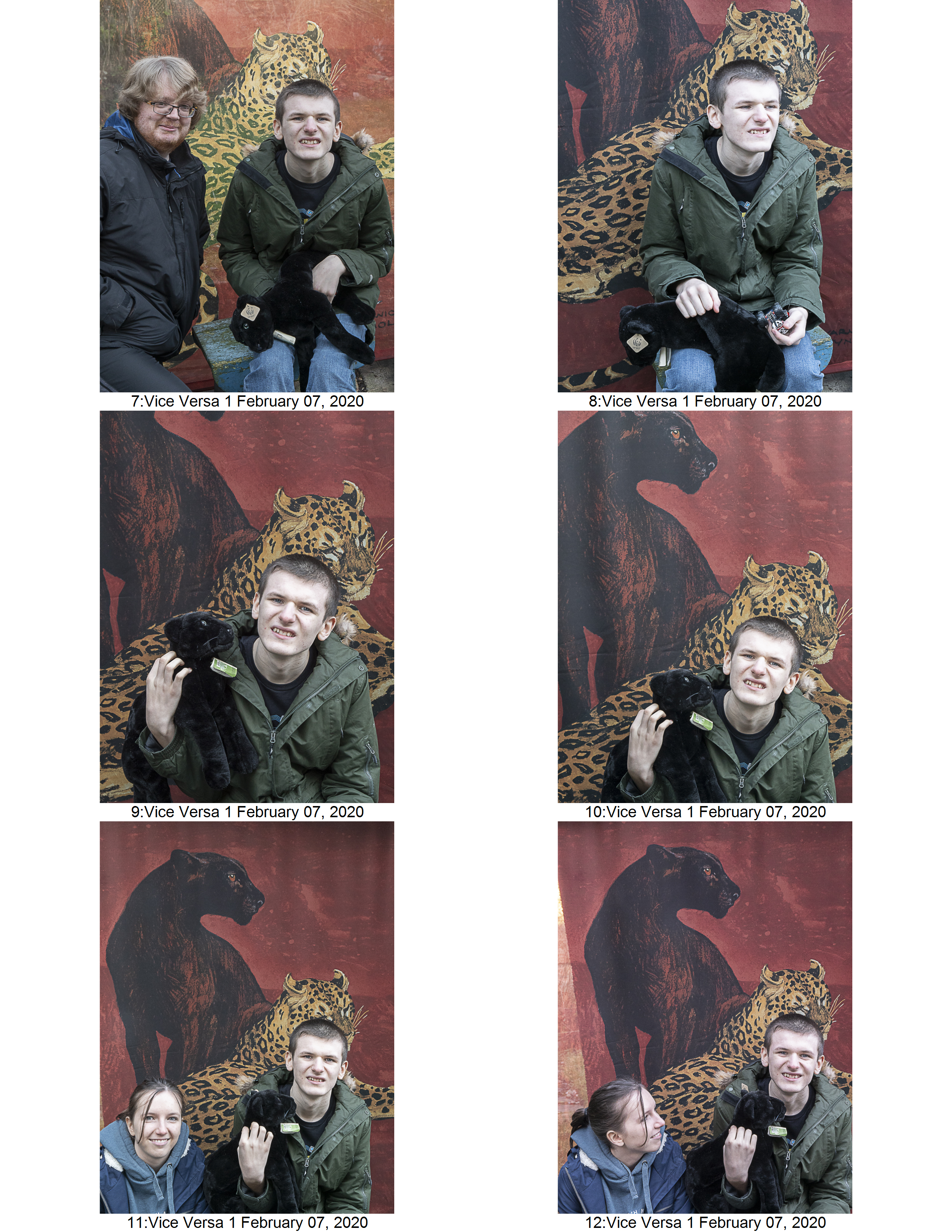
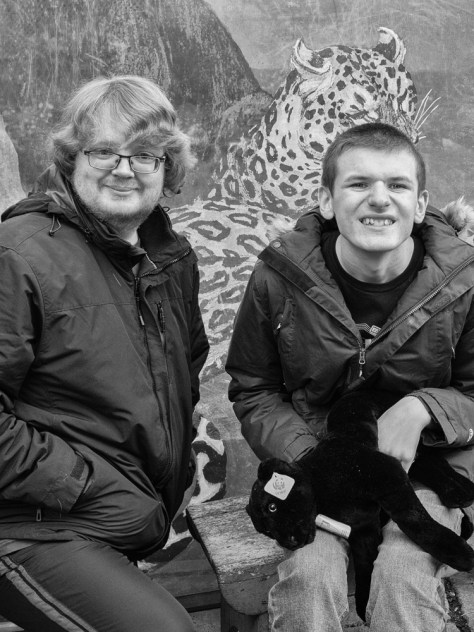
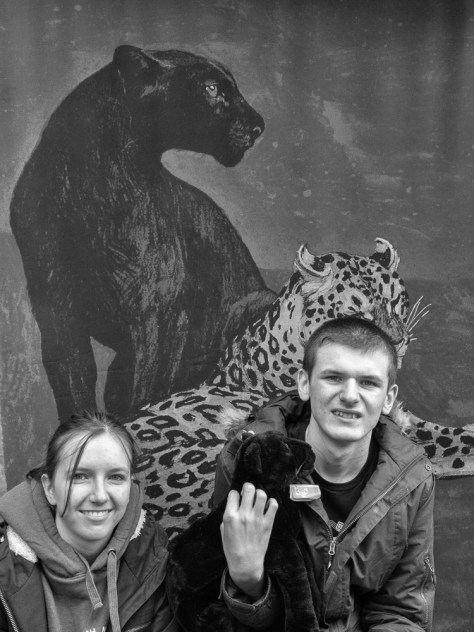
The images I have chosen for this assignment are those of an autistic young man, Sam – age 14. Sam has very little language and so everything that was done with him needed to be carefully explained and directed by example. I set up an outdoor backdrop of a large painting of big cats that I thought would appeal to him and took a series of images of him by himself, with his sister and with a friend. I had planned to also include his mother but was not able to do so on the day. Sam was very co-operative, but found it amusing and insisted on pulling faces at me.
We took the images outside rather than making up an indoor studio as that would have necessitated the use of flash which Sam might not have tolerated. Prior to taking the images we had a practice session where Sam familiarised himself with my garden to reassure him. Sam generally enjoys having photographs taken and likes looking at them afterwards.
I could not get formal consent from Sam because of his lack of language but discussed the situation and the use of the images with his mother and she gave consent on his behalf.
I chose to attempt this series as I have not previously done any formal studio work. It built on the portraits taken both for assignment 1 and those taken for the exercises in part 2 however in this case I used an artificial background to mimic a studio. I tried to avoid getting the ‘automatic smile’ that most people give when faced with a camera – but in reality, I had little control over Sam’s facial expressions.
I am pleased with the outcome although I would have liked to manage a greater range of images, possibly including other members of Sam’s family and this is something I will continue to work on.
Final Images:
Reflective SamSam and his sisterSam and a friendSam, sister and big catsCurious Sam
I attended a recent zoom led by Andrea on reflective writing. I found it interesting and it pointed up several issues I have had about the topic. Like many of the people attending the zoom I have been reflecting after the event! Using reflection as ‘looking back’. This can be helpful, but it does depend on how long after something you are doing the reflection. I have recently read Annette Kuhn’s Family Secrets (see….for and extended review) – and she points out that when looking back over an extended period the memories become increasingly changed with the time, the viewpoint alters and other things become entangled in the memory.
During the zoom we discussed reflection from a different angle – looking forward rather than backward. Using reflection to think about what you are doing and where you are going. I found the revolving arrow a helpful way of looking at it, as are the questions around reviewing the issue and action to be taken forward.
Andrea suggested regular journaling or note taking as a way to keep reflection real and of the actual time. I started this earlier this year (having been given a diary) and try to write down what I have read and what I thought of it together with what I am doing. It does make it easier for my (roughly 2 weekly) progress reports. But I think I could take it further and write down more of my thoughts about where I am and where I am going.
Afterwards Kate suggested an essay by Mike Simmons with 3 core questions:
What?
So what?
Now what?
These are very useful points to consider as are the suggestions from Karen:
One thing I am going to do is
One idea I’m taking away is…
I am going to think about…
I have found out that…
I’d like to know…
In future I am going to…
The overall zoom was very helpful (even though I kept getting interrupted by family matters). I was reassured by Andrea’s comments that the tutors and assessors find the evidence of reflection valid – I have not really been adding to my blog – but will do so from now.
For some reason this assignment has been one of the hardest I have tackled so far. Part of the reason has been outside issues – the weather, health, family deaths. However, part has been pure procrastination on my part.
I initially planned to use some images that I had taken when doing exercise 2.3 – Exercise 2.3 – Same model, different background using some of the other images of Martin and his wife, either inside the house or more close up portraits in the garden – however it didn’t really fit the brief. I did make it into a newspaper, which I am moderately pleased with, and which was an interesting experiment. See Newspaper trial
I then decided to try and take some images of an autistic boy (Sam). This got delayed over and over for practical reasons, and I couldn’t seem to get past it. I then took some separate images of another autistic family – which seemed to work well.
But still I was stuck!
I finally decided to just do it, work up both sets of images and see what happened.
Learning points:
Read the brief carefully
Get on and take the photographs
Have a backup plan
Take risks – it might not be perfect (in fact, won’t be) – but just do it.
Spending too much time reading and researching the possibilities is only useful if you have infinite time
The objective is to explore the themes in Part 2 and develop them further, exchanging portraits taken on location with ones taken within the studio or inside developing a series of 5 images, either of one person or of a linked series.
In my earlier exercises for part 2 all the work was done outside, with the exception of a few trialled images inside our local abbey. They were also done in daylight and without a flash.
Research:
As part of the background work for part 2 I have looked at several photographers and how they went about their portrait work. This included looking at images that were taken while people were not aware of what you were doing (see Project 1 – The Unaware 1 and Project 1 – The unaware – 2) and other, more formal images. These have been described in Project 2 – The aware and Project 2 – The Aware – 2 The ones I found most interesting were the images of Alice by Siân Davey, (Davey, 2015) which tell a very clear story, the images by Paul Graham of his mother, taken inside in very subdued lighting and the images by Clare Strand in Gone Away (Drew et.al, 2009) where she uses a painted back cloth to relate the images of people to Victorian photography and to contrast idealism with distress.
I thought about several options for extending the work:
Make an outside studio with backdrops
Try more images within the abbey
Take some images within someone’s house
Set up a ‘studio’ within my own house using backdrops
Outside in a made up studio:
I decided to enlist the help of an autistic young man I know, his sister and my son who he is friendly with. Sam is fascinated with animals, especially the family of big cats so I decided to set his images against a backdrop showing two big cats which I hung in my garden. This was fraught with problems:
We had difficulty arranging a photo shoot because
Sam was unwell and we had to delay it on several occasions
The weather was not obliging (Scotland in winter)
When we did get together Sam insisted on pulling a series of silly faces. In the end I just went with that as it was a way of getting his cooperation
I had trouble getting focus on Sam and the other 2 people and tended to focus on the backdrop – I think this was because Sam moved a lot.
It was not very good light, but I could not use additional flash as it would have upset Sam
Planning:
I organised time with Sam’s mother to give her a chance to explain what was happening to Sam
We did a preliminary visit to my house and garden to allow him to be comfortable
I had a trial run of taking pictures against the backdrop to find the best position to put it up in the garden
Outcome:
I eventually obtained 40 images, using 2 different backdrops. One backdrop of a tree on a brightly coloured background was not successful as I managed to get the tree growing out of Sam’s head. I should have positioned him more carefully.
Out of these 24 were in focus and showed Sam engaged with the game (how it was explained to him).
11 were landscape and 13 were portrait. The portrait images were more successful as they showed Sam engaged with the other people and also with 2 toys (a car and a toy cat).
Images:
12 preferred images
Inside a house (leaving the house as it is):
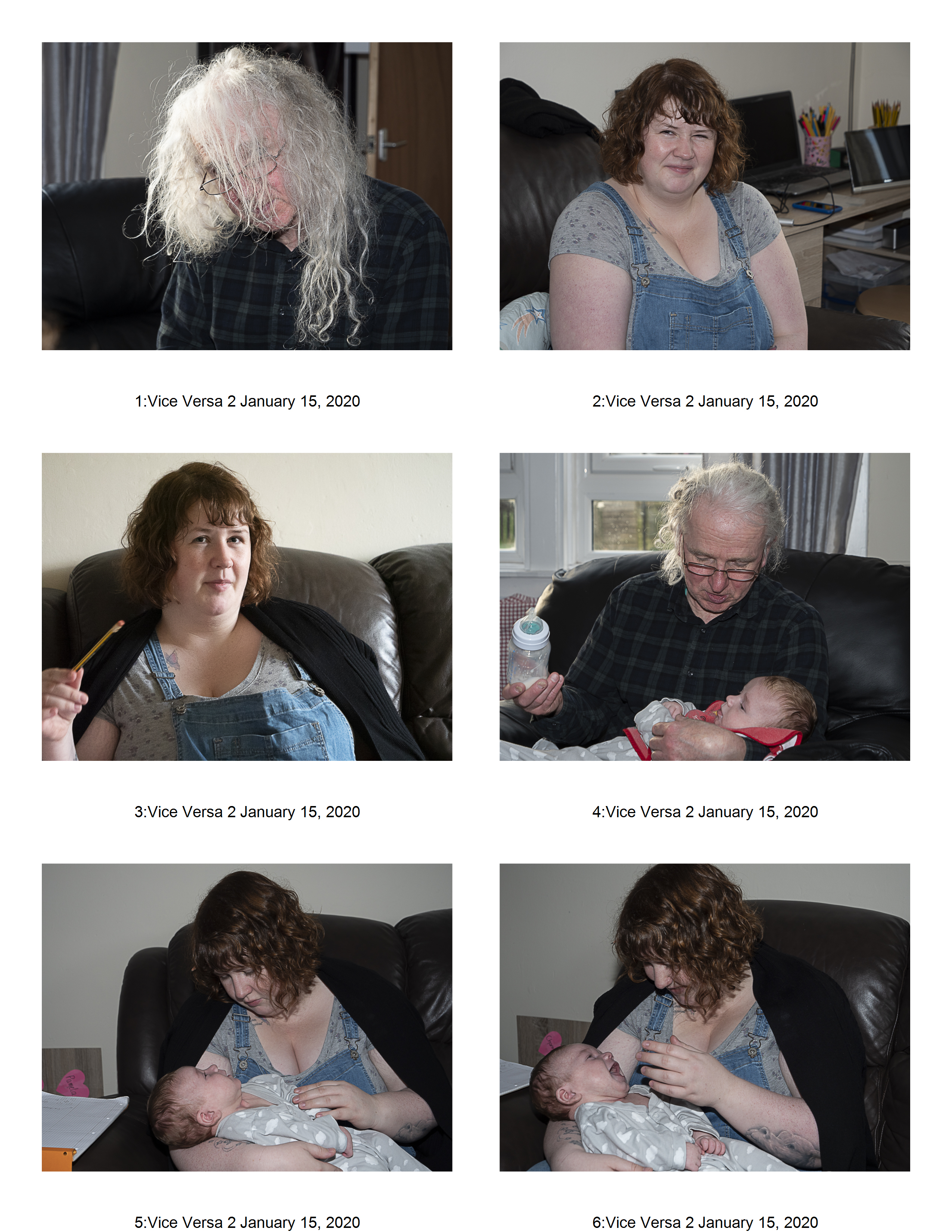
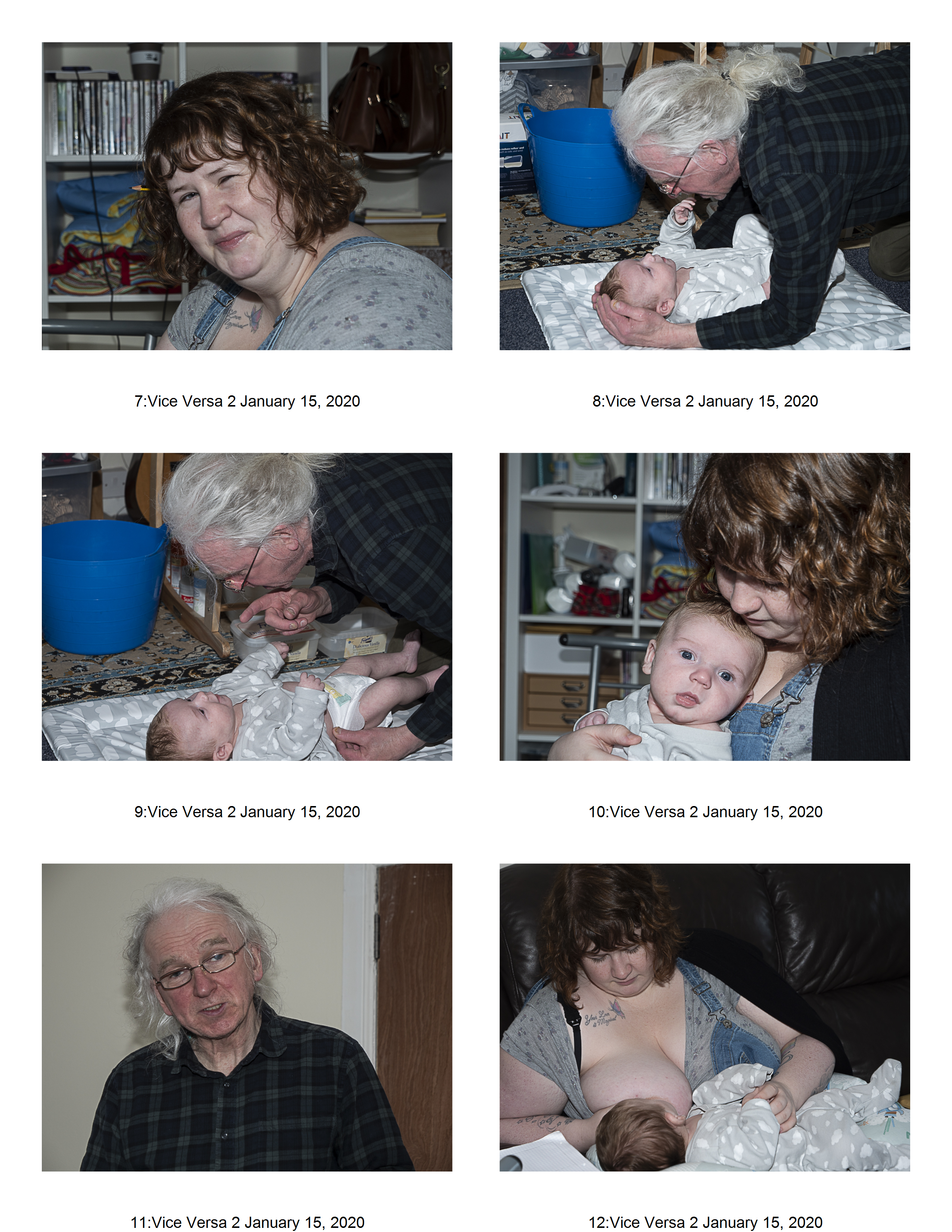
For this series I took pictures of an autistic couple and their new baby in their house. It was the first time I had met Rich, and while keen to engage he was very shy about having photographs taken, however he did eventually relax. These images were taken with flash as the light inside their house was not adequate by itself. They were very keen to tell me that everything a ‘neurotypical’ person could do they could also do if they wanted to. They were very proud of their baby and that they could look after him well. Janey was especially proud of the fact she was breast feeding.
Planning:
I contacted several autistic people and their families though a local autism network. This is part of a larger project that I am working on
We arranged to meet in a neutral place (a local cafe)
I explained who I was and what I was aiming at to Janey and gave her the opportunity to choose to engage or not
Outcome:
I obtained about 70 images of the family – which was far too many
As is typical of autistic people eye contact was an issue, and so in many of the pictures they were either looking away or partially hiding their faces
30 images showed them either in typical positions or interacted with the baby
All were landscape – possibly because of the flash unit
Images:
12 preferred images
Final Choices:
Having thought about both pieces of work I decided to use the outdoor ‘studio’ images. This was partly because I thought they fulfilled the brief better, in that they were taken with an artificial background and, while using some of the portrait skills I had experimented with earlier, they were clearly different in the way they were set-up. However, I am not convinced about the painted background, which, although it references Sam’s interests, could be considered too intrusive. I have since made my own backdrop from a painted sheet and plan to take more images of Sam against this to compare them.
Colour or black and white?
I then had to decide on the final 5 images and also whether colour or black and white gave a clearer view of who Sam is.
Reflective Sam – the individual image worked – but the series lacked coherency. The background is too complicayed and does not add anything
Sam and his sister
Sam and a friend
Sam, sister and big cats
Curious Sam
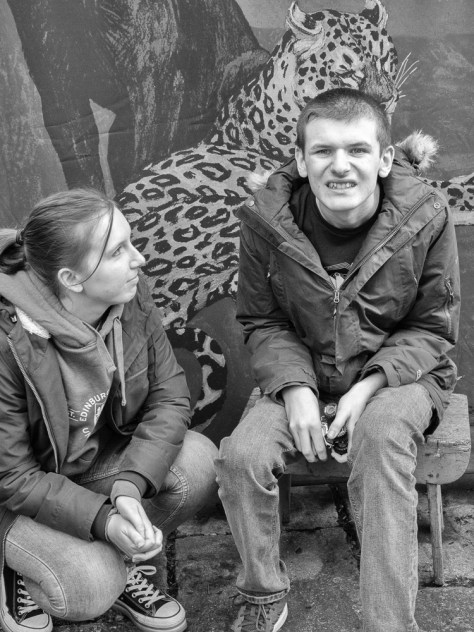
To decide about the issues of black and white versus colour I had to think about what I was planning to show. Colour is more ‘contemporary’ in feel. Black and white could be considered a more traditional take on portraiture. Most of the photographic portrait series I have looked at on people with ASD and other mental health issues have been in colour – Polly Braden in Great Interactions (Braden, 2016) and Louis Quail in Big Brother (Quail, 2018) are examples of this.. Equally there is the work by Clare Strand on Gone Away (Strand, n.d.) where the portraits are taken against a backdrop which are in black and white as are many of her other images. I suspect (although I have not been able to find out) that the images were taken using black and white film. My digital camera takes the information in colour even if I set it to black and white. Black and white is what I see – until I download the images at which point I get the colour image. So, to get a black and white image I have to convert it – this does seem somewhat counter-intuitive – but is what happens.
Having looked at the series both in colour and black and white I then asked for opinions from the OCA group (the Critiques site, the Facebook pages and the IAP email group). The general opinion was for colour – more contemporary, why use black and white? too flat a light and one interesting comment ‘colour rather than black & white, moves them away from being a documentary-style observed-type/ teenage wildlife captured on safari sort of thing…”. I also asked for the opinion of Sam’s mother, she is not a photographer, but I was curious about what she preferred. She immediately said colour. Sam himself was also more interested in the colour images.
Eventually I settled on the colour images:
They do give a more contemporary feel
They echo the age of the person more appropriately
Sam looks much older than he actually is in the black and white images (however I process them)
Although this was a ‘formal’ attempt at a series it turned into a game with Sam – and this is better reflected in the colour images.
Learning Points:
Thinking is useful but actually doing is more useful
Have a back-up plan
Have a second back-up as well!
The weather is not your friend
Ask for help and ideas from other people if you are stuck
References:
Braden, P. (2016). Great interactions : life with learning disabilities and autism. Stockport, England: Dewi Lewis Publishing.
Davey, S. (2015). Looking for Alice. Great Britain: Trolley Ltd.
Drew, R., Chandler, D., Eskildsen, U., Jeffrey, I., Mullen, C. and Strand, C. (2009). Clare Strand : a Photoworks Monograph. Brighton: Photoworks ; Göttingen, Germany.
Graham, P. (2019). Mother. S.L.: Mack.
Quail, L. (2018). Big brother. Stockport: Dewi Lewis Publishing.
Family secrets by Annette Kuhn is partly an autobiography and partly an extended essay on memory and how memory supports out understanding of both our own lives and the historical context that we live in. Kuhn describes it as a book that has sprung from the genre of ‘revisionist autobiography’ (p.147) and points out that any autobiography is ‘inevitably the outcome of a considerable reworking of the raw materials of an identity and a life story’ (p.149).
I found this book in parts fascinating, in parts heart- breaking and partly terrifying. The later was because it managed to bring back so many memories of my own past. I was born only a few years later than Kuhn and brought up in an upper working-class family (my father owned a butcher’s shop). Unlike Kuhn’s, my mother was very pushy and was desperate for me to go to university. In retrospect I think this was because she had missed out the opportunity of doing so because of the war. My mother was German, living in the USA, and repatriated to Germany during the war and, I think, resented the missed opportunities. My father died when I was young, my mother worked hard to keep the family running, and eventually married my stepfather, who, by coincidence, was a professional photographer.
Mother
Me
Mother and me at similar ages!
I took multiple notes, and these led on to other thoughts, and I will attempt to summarise them:
‘Telling stories about the past, our past, is a key moment in the making of ourselves’ (p.2) – but how much do we tell, how much do we hide, and how much do we really remember? All families have secrets, and many are similar to those in other families – mine as much as Kuhn’s.
‘The past is gone forever’ (p.4) – what traces remain. Looking for them in your memory is like archeology, making a story from small fragments. Different readings of the fragments may lead to a different story.
The past is not single – the historical context informs your memory, as much as it informs what actually happened. WWII had a major impact on my past. Much of it was hidden as my mother was concerned about the stigma of being German. Much we only learnt from her in the very last months of her life.
Memory work can start from a single piece of information, a single photo found at the bottom of a box, or a hidden letter. This evokes emotions, uses the intellect and may become part of the truth – at least your truth. A photograph can be interpreted, it gives information about the person, the place, who took the image, who was missed out and why it was taken. The clothes talk about the social aspects. The event may be recalled – although, if many years ago, one may question the accuracy. If the image has been looked at and discussed many times, each time the story might have changed. There is no single, final story.
Family albums tell a more complex story, partly mediated by the order the images are shown in. My album is random – the pictures are not in any historical order – just the one I acquired them in. I also have boxes (multiple) of unsorted and unlabelled photos – the order I sort them into may change the story. Which ones get priority? And why? Looking at these images is like looking at a box of jigsaw pieces, without the picture!
‘This past-in-the-future, nostalgia-in-prospect’ (p.23) – makes you want to produce a ‘good’ story of the ‘ideal family’ – even if it isn’t quite right. Is the truth what you remember or what actually happened? Or what makes you feel good about the time?
How does culture effect what you take from images? What about the films you have watched as a child? How do you reconcile what you felt then with what you see when analysing them as an adult? What about the books you have read? Your reaction as a child may have been (probably was) mainly emotional – does this have validity in a critical response to a film or book as an adult concerned with theory? Will it make for a wider understanding – or does it cloud the issue?
Any given photo will hold multiple meanings, for different people, at different times and in different social contexts. It may be specific to a family – but also generic to the culture – the hyper-cute baby photo, smiling up at you, it’s your baby, it’s you as a child, it’s the picture that advertises the photographer’s studio, its something to embarrass your son with to his girlfriend. It’s a memory of a time that will never be repeated.
Are the main images in your library just of the child, just of the adults or groups? And why? What does this say about family relationships? I have very few of me with my parents but several of mum with her family. Why? Was I not there? Were photos saved for the ‘special occasions’ – family visiting from abroad. A very different situation from the multiple images taken nowadays – but will they still be around in 50 years from now?
Photos were often taken in best clothes, dressed-up, in uniform – to show pride? A credit to the mother ‘an end in itself’ (p.62). Or in a cute setting, an important place – “look where we have been”. Does the clothing and the dressing-up tell more about the dresser (usually the mother) then the person? What does it say about the family relationships?
Photos may be taken to mark a special occasion – the image then brings back memories of the occasion – not just the photo, both the local – we were in the pub, Aunty Mary’s house, the garden, – with Sam, Jane, that odd person from down the street – when the Queen was married, the Two Towers blown up or England won the World Cup. Moving from the specific and local to the actual event. Especially relevant when marking global celebrations.
The image tells about the relationship between the photographer, the person photographed and the person the image is for. Why does the child look uncomfortable? What was the parent expecting by dressing them like that? How subtle is the rebellion?
Popular memory of shared events – can be provoked by images of the time, celebrations, national and local. People’s memory of a major event is often surprising similar – but may focus on the specific – where they were at the time before the actual event is brought into focus.
Changing places, homes, schools, countries has an effect on not only where you are but who you are and how you interact with others. it’s a way of changing your social background – but you may never fit in totally. Not everyone can be a chameleon! Roots are important and abandoning them can/does lead to feelings of insecurity. You can ‘For survivals sake you can….learn to keep quiet about what really matters to you……but you risk forgetting the value of those ‘resources of generations gone before’ that might still be there inside you, your resilience , your courage’ (p.116).
School has an impact on what you do – not only then but much later on. Like Kuhn I was streamed into the ‘academic’ side, in my case science. I remember being told ‘It’s no point you doing art, you’re too clever, and anyway you can’t draw” – the latter comment was possibly true, but there was no consideration that other forms of art might exist, or that I might benefit from engaging with them. In spite of taking pictures all my life, it wasn’t until I was much older (in my 50’s) that I started ‘making art’.
Why do images from the past, that we are not directly involved with effect us so much? Kuhn gives the example of the St. Pauls’s picture in the London blitz. I can think of ones from the Africa corp in WWII. How does the collective memory that these invoke impact on personal memory? And vice versa?
Remembering, looking back, allows for changes. Memory can be sparked by other people’s pictures, paintings, music and writing. Anything can be used as a basis for memory work and allow you to make sense of what you see. Other pieces are very private and particular to you (Barthes’s picture of his mother as a child), an image I have just found of my grandmother who I never knew.
All this leads to the question – how much of memory is imagination?
Photographs can be used as groundwork – but they may still tell lies, partial truths – but rarely the whole truth. They lead to a ‘constant reworking of memory and identity (p.154). The act/activity (remember it is an ongoing process) is not neutral. There is always ‘secondary revision’. New stories can be told. Things can be healed. Lives can be changed.
This whole book is well worth reading (and re-reading). Maybe it spoke so much to me because I have a similar background – but the lessons learned are valid for everyone.
Reference:
Kuhn, A. (2002). Family secrets: acts of memory and imagination. London; New York: Verso.
The exercise is to consider how marginalised or under-represented groups could be badly or unhelpful portrayed and how being an insider could help combat this.
People who are marginalised include people with mental health difficulties, people with learning difficulties, people of races that are not the prevalent one in the area/country/context that the information is read in, drug users, the poor, the whole LGBTQ+ population, the Jews in Nazi Germany, the Palestinians in Israel and the Mexicans in the USA – and this list could continue. It is well recognised that information about these groups could help decrease marginalisation and there have been many attempts in popular culture to say that these groups should be included. There is a song by Dory Previn (Previn, 1971) which contains the words:
Give me your poor
Your tired your pimps
You carhops your cowboys
Your midgets your chimps
Give me your freaks
Your whores your harlots
Your flunkies your junkies
Give me your starlets
……..
Give me your poor
Your maladjusted
Your sick and your beat
And your sad and your busted
Give me your has-beens
Give me your twisted
Your loners your losers
Give me your black-listed
And, of course, there is the sonnet by Emma Lazarus – “The New Colossus” (Lazarus, 1883) that is inscribed on the Statue of Liberty which contains the words:
‘With silent lips. “Give me your tired, your poor,
Your huddled masses yearning to breathe free,
The wretched refuse of your teeming shore.’
Much of the time these groups of people are negatively shown simply by the poor choice of words that are used about them and therefore leading to assumptions being made by the majority of people that have no insight into the reality of the people involved or the life they live. A topic I know a reasonable amount about is autism. A quick internet search netted me an article about the myths of ASD such as autistic people can’t make friends, autistic people can’t show empathy, only boys are autistic and autistic children are naughty. Luckily this was an article saying that all these are wrong – but equally I have heard all of them expounded to me at length as incontrovertible truths usually along with the statement ‘but everybody knows that’.
Reasons for unhelpful portrayal include (in no particular order):
Oversimplification of the issues
Lack of understanding and research by the writer, speaker or photographer
Real bigotry, racism, homophobia and similar problems
Overuse of stereotypes in TV, film and novels – such as the psychotic person who kills someone or lies in storylines – this is particularly common in crime novels, which are widely read. This also occurs in sitcoms “She’s painted as ‘the other’ or ‘mad, bad and dangerous’” – although to a large extent this is being minimised by the involvement of organisations such as Mind (see https://www.mind.org.uk/information-support/your-stories/improving-representations-of-mental-health-on-tv/ – for more information on the work they do).
Over-glamourising of mental health problems such as a a focus on suicide or anorexia
Compassion fatigue – and overuse of violence -as described by Susan Sontag in ‘On Photography’ (Sontag, 1978) although she later changed her mind about how much this is true.
Showing negative aspects makes for more exciting (and often simpler) reading about a topic and is not always (or often) balanced by the positive (bad news sells)
Much information is written (photographed) by an outsider, a ‘normal’ ‘average’ person (often a white male) and is read by people of the same group.
People often write information to ‘raise awareness’ for a cause and therefore may well use the extremes (worst and best).
Deliberate misinformation -possibly the scariest reason of all
Sound bites, snippets of information reduced down to what fits in a Twitter message
The risk of multiple negative images in the media is well recognised. It is even included in a popular song by The Black Eyed Peas – ‘Where is the Love?’ (Black Eyed Peas, 2003)
What’s wrong with the world, mama
People livin’ like they ain’t got no mamas
I think the whole world addicted to the drama
Only attracted to things that’ll bring you trauma
………
Wrong information always shown by the media
Negative images is the main criteria
Infecting the young minds faster than bacteria
Kids wanna act like what they see in the cinema
Yo’, whatever happened to the values of humanity
Whatever happened to the fairness and equality
Instead of spreading love we’re spreading animosity
Lack of understanding, leading us away from unity
But the problem is wider than just the proliferation of negative images. Incorrect positive images can be equally harmful. A suggestion that all people of colour are be as suave, intelligent and successful as Barak Obama might lead to the lack of any additional resources needed to support the group that fall at the opposite end of the educational spectrum in the USA! There needs to be understanding that all groups that consist of more than one person are going to to have a range of problems, along with a range of positive aspects.
The most likely way to be able to spread accurate information is to know as much as possible about the situation and then to be able to describe it accurately and without bias. There are two ways of gaining that information. One is to research the situation as an outsider, being careful to take cognisance of all the viewpoints. An example of this would be if I decided to research the issues facing Jewish people in Fife. I am not a Jew and am therefore looking at it from the outside. I can never become a Jew. However, I could spend considerable time meeting with people, listening to their individual stories and trying to portray them accurately. The other way is to be an insider. In the above example, a Jewish person, even if they came from somewhere outside Fife, or even outside the United Kingdom would start from a place well ahead of me. They would understand the basic culture, know the religious rules and have a much greater chance of getting an accurate story.
However, there are ways of becoming an insider in a group. They involve time and patience and a willingness to listen and do careful research. Being an insider should combat most of the concerns listed above such as lack of understanding, overuse of stereotypes and over-glamorisation of the issues. Someone who is a member of the group, and therefore invested in their needs is less likely to give deliberate misinformation and more likely to show and accurate and balanced picture.
True Insiders (an invented term) are those that are living with the issues on a daily basis. They know and understand the situation from the ground up. These people can tell the story accurately and with emotion. They do, however, risk a bias of being over involved. The story is theirs. There is no neutrality. They story is told in depth and with heart-breaking detail.
Nan Goldin in the Ballad of Sexual Dependency tells about a group of people who are marginalised, a combination of drug users, people with AIDS and people who are involved with domestic violence. Goldin says, “Real memory, which these pictures trigger, is an invocation of the color, smell, sound, and physical presence, the density and flavor of life.” (Goldin, 1986). She is completely an insider.
Graham McIndoe in his exhibition Coming Clean and the associated book Chancers: Addiction, Prison, Recovery, Love talks about his drug addiction and its consequences to him and his family (Stellin and MacIndoe, 2016).
Sian Davey in Looking for Alice shows graphic (and endearing) images of what it is like to be the mother of a person with Down Syndrome, (Davey,2015) while Louis Quail in Big Brother describes the haunting life of someone with schizophrenia, the ups and downs, the disasters and the laughs (Quail, 2018).
Jim Mortram in Small Town Inertia shows people in his local community that struggle on a daily basis with debt, poor living situations and problems with mental health. He takes pictures of the people that are local to him while struggling himself as a Carer to his mother. The people are not quite as closely linked to him as the families of Davey and Quail – but he lives so closely within the community that he shows a real awareness of the difficulties involved (Mortram, 2017).
Timothy Archibald in Echolalia (Archibald and Levin, 2010) took a series of pictures of his autistic son to act as a a way of increasing his understanding and their joint communication. He says ‘Parents sent me snapshots of their kids that could have easily fit into the pages of my project: the notes, the body language, the in-door nudity, the hyper focus on an everyday object…parents around the world were snapping photographs of their autistic kid’s obsessions and behaviors. This was part of the process of trying to figure their kids out. It occurred to me then that I really had done nothing new with this project. I simply was doing what any parent would do, but I had an eye for good light and possibly a better camera’ (Smithson, 2013).
Involved observers are those who make a real personal investment of learning as much about the community as possible. They know the detail. They understand the issues. But they have a degree of neutrality. They are telling about others. They make an excellent case as there can be no assumption that they are biased. As they are more trusted by the community the story and images they obtain are more based in a real understanding, more truthful and more explanatory to others.
Polly Braden, who, as far as I am aware, has no personal connection with autism or learning disabilities (I am happy to be corrected if I am wrong) has produced two books on this difficult topic Great Interactions (Braden, 2016) where things are mainly going well and the people are supported appropriately and Out of the Shadows (Williams and Braden, 2018) where much is not right. In spite of not being personally involved she has become emotionally involved and tells the stories from an inside viewpoint.
Sara Davidmann in Crossing the Line (Davidmann, 2003) tells the story of a cross-dressing community in London. She says ‘As I continued to work in the studio my role shifted. As these sessions were usually one to one more was required of me. I soon understood I had as much to give as take from the sessions’ (my italics). This sentence sums up much of what I’d important in becoming an involved observer and is crucial to telling the story with integrity.
Summary:
Information about marginalised people is often poorly portrayed because of lack of real understanding and personal/social bias leading to over-simplification, repeating of inaccuracies that are widely accepted and attempting to glamourise the situation to make for a good ‘sound bite’. An insider (or a involved observer) can combat this by giving accurate and nuanced information, that tells a story in a way that people will understand, therefore benefiting the community. Their involvement allows them access to information that a stranger would either not obtain or that they might misinterpret. An involved photographer is more likely to be able to put the people at ease and therefore obtain more meaningful photographs.
References:
Archibald, T. and Levin, A. (2010). Echolilia: sometimes I wonder. San Francisco: Echo Press.
Braden, P. (2016). Great Interactions: life with learning disabilities and autism. Stockport, England: Dewi Lewis Publishing.
Davidmann, S. (2003). Crossing the Line. Stockport: Dawi Lewis.
Goldin, N., Heiferman, M., Holborn, M. and Fletcher, S. (1986). The Ballad of Sexual Dependency. New York, N.Y.: Aperture Foundation.
Lazarus, E. (1883). The New Colossus by Emma Lazarus – Poems | Academy of American Poets. [online] Poets.org. Available at: https://poets.org/poem/new-colossus.
Mortram, J. (2017). Small Town Inertia. Liverpool: Bluecoat Press.
A general theory book about art designed for A level students, read to try and update my woefully absent knowledge about the general history of art and therefore how photography fits into it. Most useful info gained is about the hierarchy of images from the past, a useful glossary and the final chapter on gender and ethnicity.
Fascinating book looking at memory and how photographs help you understand the past and its effect on you
Photography:
Finally took some pictures for Assignment 2, however they were probably the worst images I have taken in ages. The focus was not correct (no idea why), the background too complicated, his Mum liked them though!
Secondary to above I have now spent some time dying and painting a neutral backdrop to try out
Pictures of hands doing things for Exercise 3.2 – done.
On holiday for 2 weeks so lots of holiday images
Planning:
Had a meeting with Julie to discuss her input into ASP project
This exercise is similar to some I have done previously. When I started IAP I thought about identity (including my own) at some length, What is Identity? and Theories of Identity In CAN I also thought about identity and ended up making a series of images about the chairs in my house where I sit My Spaces.
Listing aspects of your own personality is difficult. Identity and personality are not the same, although personality is part of your identity. Identity can be broken down into several aspects:
Who you are to other people:
mother
daughter (still relevant although both my parents are dead)
wife
ex-wife
friend
doctor
Person who goes to your café regularly
What your interests are:
Photography
Reading
Knitting
Music
Collecting (mainly bears)
Gardening
Historical places (castles, houses)
Travelling
Where you live (and how that defines you)
My room
My house
Dunfermline
Fife
Scotland
United Kingdom
Europe
Race, ethnicity and religion
Caucasian
Scottish
Unreligious but interested in all
Gender (in the widest sense)
Cis-Female
None of these really explain my personality – but all go towards making it up. I am also:
Kind (usually)
Patient (usually) – but have a real temper when things go wrong
Intelligent – academic
Understanding of other people’s emotions
Hard-working
Diligent
Odd sense of humour (some people say I don’t have one)
Obsessional
Organised
Introvert
Shy
A loner
Caring
Not feminine
Someone else could descibe their personality in exactly the same way – but without having any similarities in the list of ‘identity criteria’ I have listed above.
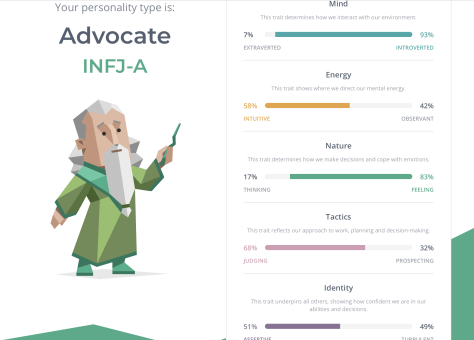
Out of interest I took several online personality tests. Obviously, the results of these are only as good as the information that you put in! And on how truthful you are! And on how well you know yourself to begin with!
Oddly enough they all came out with similar results. The first is based on the standard Myers-Briggs’ 16 categories of personalities which is very well researched, and if I am honest does describe me well.
So – how can you take pictures that describe your personality?
It is (relatively) easy to show some of the aspects – but almost impossible to show others. One of the ways to show your personality is to show the things you are interested in, as this will give an idea of what makes you ‘tick’. Another way would be to take pictures of people you are engaged with and ask than to give a short (one sentence, or preferably one word) description of you as a person. In a wider sense you could look at the community you are involved in, where you live, what you do, what’s around you and show that. But – how do you show kindness, or patience, or diligence?
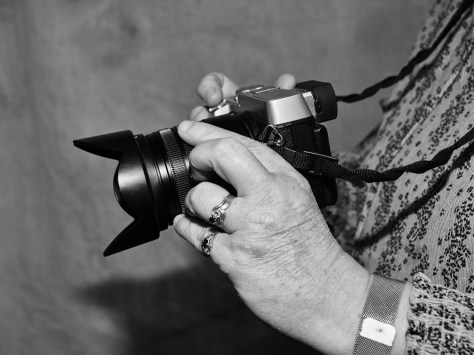
I decided to start by thinking about the things I am interested in that make up part of my identity, and therefore contribute to my personality. I could have just taken a series of images without including myself – a pile of books, my piano and so on but decided to try to take pictures of me involved in these activities. I settled on taking pictures of my hands doing things. This was harder to do than to say. Hands actually tell you a lot about the person.
I bite my nails – therefore I am anxious
I wear a wedding ring
I have a Fitbit – so I try to exercise – or at least pretend that I do
They are wrinkled – therefore older
White and freckled – therefore Caucasian
Process:
I enlisted the help of my son as a stand in to enable me to set up the images and get the focus correct
The images were taken indoors- so I used a tripod and flash
I looked for neutral backgrounds
I considered using a cable release myself – but that altered the hand position so ended up with my assistant actually pressing the release
Images:
What do these tell me about my personality?
I have a range of interests
Most of these interests are solitary (at least the ones I have shown)
I tend to be anxious
I don’t like showing my face in photos (shy, introverted)
Patient (knitting needs patience)
How could this be taken further?
To explain a personality, you need a wide variety of images. To develop a body of work about your own personality is difficult as in many ways everything you take expresses how you are, as you would not take that subject if you were not interested/involved. If I was developing this further, I would move towards doing two pieces of work:
The images of people who I am involved with together with the single word/sentence about what they think of me
Images of me taken by the same people, with them choosing the setting
Those images could then be paired, looking out and looking in.
Sherman was born in America in 1954, so she is slightly older than I am. Her early experiences may well have been similar, although transmuted via an American, rather than British, perspective, you played on the street, you dressed up and pretended to be people, if you were a girl there were very tight gender specific jobs and roles. It took guts and extreme talent to move beyond them. Sherman was the youngest of five children, and no one else in her family was interested in art. She went to art college with very little formal knowledge about art and expecting to have to become a teacher. She initially started her career as a painter, but rapidly abandoned this and took up photography, initially concentrating exclusively on pictures of herself dressed up as various roles. However, Sherman does not describe these works as self-portraiture, but as using herself as ‘a vehicle for a commentary on a variety of issues in the modern world’ (Sherman, 2019). She portrays archetypes, a series of fabricated, fictional characters that are familiar to us because of our familiarity with TV and film people, mediated via the popular press (and more latterly social media). All of these early images are called Untitled, with a series name and often a number – further distancing them from any assumption that they are showing a specific person. A portrait almost always has the name of a person, or, at minimum, a description that personalises them. In later images Sherman used dolls and prosthetic body parts posed in highly charged sexual positions and clearly designed to shock the viewer. Recently she has returned to using herself as the subject, both in a further series of created characters and as a series of distorted images that are freely available to view on her Instagram site.
In a recent article Sherman, when talking about her own work and about selfies (and why her images are the reverses of selfies) says ‘It feels magical, I don’t know what it is I’m looking for until I put the makeup on, and then somehow it’s revealed. I’m disappearing in the world, rather than trying to reveal anything. It’s about obliterating, erasing myself and becoming something else’ (Blasberg, 2019).
Sherman is both a prolific artist and an influential one. Almost every article discussing post-modernism in photography references her. Grunberg describes her work as ‘Perfectly poststructuralist portraits, for they admit to the ultimate unknowableness of the “I”. They challenge the essential assumption of a discrete, identifiable, recognizable author (Grunberg, 2010, p.9). Her work is included in the list of 7 most expensive prints sold (Untitled 96) which is one of the Centrefold series that was originally commissioned for Artforum but never run as the then editor was concerned that they might be misunderstood. I wonder if the editor had really considered any of Sherman’s images as this comment could be applied to most (if not all) of them.
There is a fascinating (and long) discussion on the OCA website about Sherman, discussing her self-portraits – are they narcissistic or not? her background growing up in white, TV obsessed America – and the impact that had on her initial reactions to gender and make-believe that goes on to discus why we like, or don’t like her images and wether an initial ‘gut reaction’ has any validity as a starting point for analysis of an image (The Open College of the Arts, 2011).
I have seen a small number of Sherman’s prints in galleries
An early Madonna in the Sometimes I Disappear exhibition in Edinburgh – discussed in Sometimes I Disappear
Cindy Sherman – Early Works at the Stills Gallery, Edinburgh. This showed some of her very earliest self-portraits – Untitled (Murder Mystery People) together with some images form the untitled Film Stills collection and a very early film Dolls Clothes. Prior to this exhibition most of the images I Had seen were in books. I was surprised at how small the images were. This initially disappointed me, however it had the effect that I had to go in close to look at them in detail, and this drew me into the stories, possibly more so than a large image would have.
I find myself bemused by some of her work, revolted by other pieces (as I am fairly sure she meant people to be) and increasingly interested in it the more I examine it. Very little of it is ‘easy’. Some may be attractive to look at, but the closer you look at it the less obvious it becomes. Three years ago, I would have confidently stated that I did not like her work. My view is now different.












 Identity and Place