All posts by scottishzoe

Sharon Boothroyd/Young

Sharon Boothroyd is a feminist photographic artist from London.  She has done several series of work that use a combination of words and images. The words are not always explicit or shown but inform the photography.

If you get married again, will you still love me?  – is based on the questions asked by children of their absent/separated fathers. The images are stylised and manufactured, not taken of the actual families – however this allows her to be explicit with the emotions involved without risking harm to the original children. They show the common and frequent problems that occur in these situations. The images (at least on her website) are not titled, and the question/conversation is not shown but it is obvious that these children, ranging in age from babies to teenagers are unhappy. Some are sulking, some looking away. In spite of being staged it gives an intimate and real view into the lives of many children.

They all say please is a series of images based on prayers that Boothroyd found in online prayer forums. In this case the images are accompanied by a shortened version of the prayer that sparked the image. In many images people are shown, alone and lonely. In others there is an empty space that should be filled with happy people, for instance, an empty cinema with a blank red screen accompanies the words Please do not let a romance grow between them.  Even the bright and cheerful images, when read alongside the words become unbearably sad. It makes me wonder whether people ever pray (or at least post prayers) when they are happy. I had a quick look and the overwhelming theme seemed to be asking for healing, for oneself, for others or for the world. Not unexpected in the present time.

In Disrupted Vision Boothroyd again uses words. Here she took photos of strangers with a Polaroid camera and asked the people to comment on them. The responses are written on the Polaroid, I think by Boothroyd herself.  This has the effect of making the image ambiguous, who’s viewpoint should we believe? The photographer or the subject?

The Subtext of a Dream combines images, water at its most  beautiful, simple and enigmatic (at least the ones I have seen) with words reappropriated from stories by a  variety of authors to make a fantasy story about a fictional woman, Madame Beaumaris. It is a story about someone who may or may not be having real events happening to her. Or are they fantastic hysterical imaginings? They are certainly erotic. In an interview she says ‘it’s simply human nature to tell stories (from an Ursula Le Guin essay). To understand ourselves and our histories. I think that’s why I do it too – to seek understanding’ (Paterson, 2018).

I found her work fascinating and the use she makes of text to inform her images makes me want to do the same. The words are not always there – but they have clearly influenced the carefully considered images. I wish I could see more of them. I wish I could read the whole of The Subtext of a Dream.

To see her images, check her website:

http://sharonboothroyd.com/index.php?/contact/about/

Reference:

Paterson (2018) Artists at the RCA: Meet Sharon Boothroyd. At: http://missarnellepaterson.co.uk/2018/09/06/artists-at-the-rca-meet-sharon-boothroyd/ (Accessed 29/05/2020).

David Favrod

David Favrod is a Swiss-Japanese artist that now lives in Spain. A combination of cultures that has shaped his photographic practice. He uses a mixture of styles; photography, drawing and video. Much of his work is influenced by manga/anime. He says, ‘I don’t restrain myself with only photography……my question is just “How can I tell this story?” …. I need to push the boundaries to find the right/best way for what I want to show/express’. He also notes that ‘memories are fictions …  easily malleable (Newman, 2015).

Hikari (meaning light in Japanese) is a work based on memory – but not his own, but that of his Japanese grandparents, told to him on one occasion – so a memory of memories told. It is overlaid with his own feelings of growing up as a mixed-race child. In an interview with Sharon Boothroyd (Boothroyd, 2014) he explains his working process (thinking of the idea, drawing sketches, looking at the balance of different images then constructing them).  He also uses sound – or the visual representation of sound – added to the images. He does not explain his images in detail and hopes that each viewer will bring their own memories to them. For Hikari he tells a story that is part fact, part fiction using found images and objects collaged together with drawings and photographs leading to ambiguous images re-creating fragments that might be memories or dreams.

In another series Gaijin (Japanese for foreigner) he blends Japanese symbols with portraits and Swiss mountains. This project was made in response to his feeling of rejection having been declined dual Japanese nationality.

When looking at his work online I found it difficult to differentiate what comes from which series. They are often shown together and have a similar feel, Favrod himself notes that his series are often linked, and he flows from making one into making the next – which probably explains my dilemma. His website  (Favrod, s.d.) shows many of his images but, even there, they are just titled and dated, not separated out. Many of the images are beautiful low key scenes such as Une averse, an image of a snow covered mountain (it could be in Japan or Switzerland) part covered with diagonal black and white stripes. Others clearly reference Japan – Pour Sadako – a river with coloured paper cranes instead of reeds and leaves. Did he make them and position them before taking the image or is it a collage? Either way it is evocative. Some are portraits – La pluie noire –shows a girl covered with mud and surrounded by Japanese characters. Is this referencing the bombing in Japan? Is it a more personal memory? or both? It is ineffably sad.

Une+averse
Une averse – © David Favrod
Pour+Sadako
Pour Sadako – © David Favrod
Pluie+noire
Pluie noire © David Favrod

References:

Boothroyd, Sharon, S. (2014) David Favrod. At: https://photoparley.wordpress.com/2014/09/23/david-favrod/ (Accessed 28/05/2020).

Favrod, D. (s.d.) DAVID FAVROD. At: https://www.davidfavrod.com (Accessed 28/05/2020).

Newman, C. (2015) Looking Back and Forward Interviews #6: David Favrod. At: http://www.gupmagazine.com/articles/looking-back-and-forward-interviews-number-6-david-favrod (Accessed 28/05/2020).

Regular Reflections – May 2

Still struggling with working in the lockdown! Slightly more organised but stopped doing the highly rigid photography sessions as an found that it was making me even more stressed and was not productive. Just doing and no thought doesn’t work for me. Having said that – I have an interesting batch of images from lockdown that I may be able to use at some point.

Reading and watching:

  • Read the MoMA book on their exhibition of Lange – fascinating to see her old work in its context as they show much of it in the original journals or books. A very different view from just seeing it as single prints displayed as art works.
  • Finished reading Will Gompertz – What Are You Looking At? It has given me a much greater understanding of what modern art is, what the various terms mean and the historical context. Some I now like, others I am still bemused by.
  • Reading biography of Lange, A Life Beyond Limits. It’s clear that like most (all) driven people she was certainly not flawless- but the flaws are part of her humanity and that is what makes her images compelling.
  • Ongoing reading of The Photographer’s Eye.
  • Attended research zoom with Andrea Norrington – really useful
  • Attended zoom on assessment with Dan Robinson – still confused
  • Attended session with library on referencing -kept losing contact so will look when its posted.
  • Attended zoom with Arpita Shar Politics of Portraiture – absolutely fascinating and I learnt a lot. Now need to follow up on all the links
  • Watched a zoom on Ashley Gilbertson on Whiskey, Tango, Foxtrot – interesting talk about how things were for him in Iraq and how that translated into to images, often of very small snapshots of peoples lives
  • Listening to Siri Husvedt A Woman Looking at Men Looking at Women –series of essays about modern art, feminism, and her view of the world. I am experimenting with listening to them rather than reading and am finding that the slower pace actually makes things sink in better.

Thinking and doing:

  • I set up the first meeting of a group for the people doing IAP now. This was interesting as everybody talked about where there were and how they got onto the course in the first place. Hopefully, we can keep the momentum up.
  • Set up a Padlet for the information from the IAP group
  • Set up a personal Padlet to use to correlate my research
  • On the back of Andrea’s zoom have changed to using Zotero for my reference system and am in the process of going back over all my previous posts for IAP to make sure the referencing is UCA Harvard correct (I hadn’t realised that it was different from standard Harvard)
  • Tried out using Paperpile for referencing – but it doesn’t work well with Word
  • Working on A4:
    • Done most of the exercises
    • Thinking about assignment, collecting words about my Mother to use as a base

Photography:

  • Not managed to do much as struggling to not just take pictures for no reason
  • Continuing with calotypes
    • Using a remade paper but thinking about buying the chemical and making my own
  • Using Helios lens with some lovely effects (when it works)

Exercise 4.4

Image 1:

IMG_7239[10625]
© Kasia Delgado/i

The back view of an attractive female nude (wearing a sun hat)

  • Take advantage of the sunny weather
  • “I looked out my window and saw this” by Disgusted from Fife
  • “Wow, what at sight” by Elated from Fife
  • An unusual warm day in Scotland

Staring over the edge of my garden I look for what I can see. I might have been in France. I might have been on a cruise. Instead, I am sunbathing here. What? You think I am a wanton woman? Are you jealous of my freedom? Do you envy my courage?

This comes from a piece in a newspaper advocating Naturism – ‘clothes seem pointless’.  I have taken the naturist viewpoint I have turned it into a reverie by the female. This could now be the first few sentences of a story – I am wondering what happens next rather than thinking nice idea – but its too cold in Scotland.

Photo and article from ‘I’ by Kasia Delgado (Delgado, 2020).

Image 2:

A picture of a pretty girl of nursery age (I am not going to copy this for obvious reasons), at a table, smiling and holding her hand up.

  • “Me, me, I want to go first”
  • “Can I tell my story?”
  • …… loves nursery and is so excited to go back
  • …… is loving lockdown and home teaching

This is my child. She is wonderful and excited and enjoys life. Love her so much even though she is hard work. She never stops moving or talking, even in her sleep. I wonder if there is something wrong. Maybe she has ADHD.

The picture comes from a piece in the Dunfermline Press on 07/05/20 that is saying that the council has not offered any nursery places for the child. The parent is complaining about the system and says nothing about the child (McRoberts, 2020).

Image 3:

IMG_7241[10627]
© Gemma Ryder/Dunfermline Press

A large pile of burnt rubbish, including what looks like a washing machine.

  • Major fire at office – disaster strikes new firm
  • Cover-up by fire
  • Airplane hits local conurbation – multiple deaths.

What a disaster, the local storage unit for the Charity has been set on fire by vandals. All the goods are destroyed. Urgent appeal for new goods is now underway.

The picture comes from the Dunfermline Press  and  is talking about fly tipping in an article by Gemma Ryder (Ryder, 2020).

Summary:

This is an interesting exercise, although basically a repeat of one done in Context and Narrative at Image and Text. I found myself being more imaginative with my response this time around. I wanted to write stories, an imagined response to the picture. Much of the news at present is about Covid-19 – so I tried to avoid those articles and look for others. It shows clearly how an image can be interpreted in a multiplicity of ways, positive and negative, fact and fiction. So, to make things clear – do you write an essay – or do you leave it all up to the viewers imagination, or give just enough clues to get them thinking? Open or closed?

References:

Delgado, K. (2020) ‘Why more of us are daring to bare all under lockdown’ In: i 13/05/2020

McRoberts, A. (2020) ‘‘Unacceptable’: Mum not offered any nursery places for child’ In: Dunfermline Press 07/05/2020 p.20.

Ryder, G. (2020) ‘When will recycling centres reopen?’ In: Dunfermline Press 07/05/2020 p.35.

Exercise 4.3

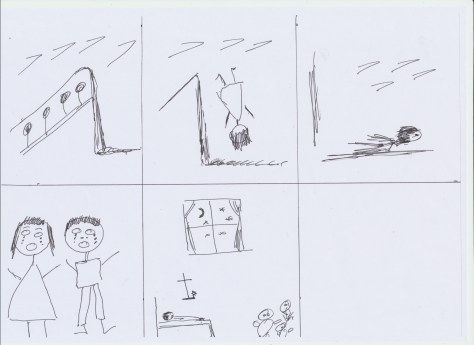
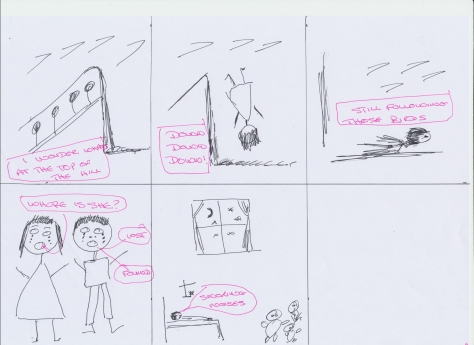
The brief was to create. A storyboard of about 10 images without text then add the text and see how it changes.

I am not good at drawing; I can do pastels to some extent – but have never tried anything like this a before. I started by making my storyboard as suggested. A very simple story of a young girl waking up , looking out the window, following her heart then it changes , it becomes a nightmare, she fall and drowns, the parents are distraught, the is laid out on her bed for viewing.

Scan_20200526Scan_20200526 (2)

With text: changed to a dream, starts the same – but dives deliberately, swims and gets home. It was all a dream.

Scan_20200526 (3)Scan_20200526 (4)

A very simple addition of a few words turned a very basic nightmare into a sweet dream! I gave a blank set to my son and he instantly interpreted it as the disaster scenario and added words to confrim that. He said the clue that made him read it as a disaster was the cross on the wall.

30 seconds on Ashley Gilbertson

Following on from the research talk by Andrea Norrington I decided to use her 30 second rule to take notes immediately after seeing or reading something. This way I might actually do it  (and remember things). So:

I watched a video on Ashley Gilbertson talking about his book Whiskey, Tango, Foxtrot about the 2nd Gulf War in Iraq on VII.

  • An intelligent, articulate, angry photographer
  • Images that show war not just in the gory details but in the personal snippets
  • ‘It was their war until someone died for me then it became my war’
  • What you do should not change things (for the worse)
  • Wait for something to happen rather than set it up
  • Hopefully bearing witness will allow people to understand that most people kill for an ideology not for the personal things (and that everybody has the same personal truths – family, home)

See:

http://www.ashleygilbertson.com/whiskey-tango-foxtrot-iraq

Politics of Portraiture

A zoom tutorial with Arpita Shar

I have just attended the fascinating and very informative zoom with Arpita Shar on Politics of Portraiture. I ended up taking 8 pages of notes over 2 hours! So, I will attempt to summarise them.

Arpita started by discussing the ethics of photography and the need for ethical responsibility. This was a recurring theme throughout the talk. She directed us to the work of Anthony Luvera and the website Photography as a Social Practice which I have just managed to take a brief look at. http://www.asocialpractice.com

Luvera said something like (unfortunately I was not quick enough to get the whole quote) – ‘Photographers are storytellers who speak about the world and can shake preconceptions.’ He is involved in a journal called ‘Photography for whom?’  about socially engaged photography. Arpita emphasised that when you were taking photographs of people there were several things you should consider, including:

  • Who is the work for?
  • Who benefits?
  • How do you measure the subjects experience?
  • What is the outcome?
  • Ownership
  • Authenticity
  • Consent

Everybody’s code of practice is slightly different – but you need to really think about what you are doing.

Consent is crucial. It should be informed and transparent. Parents should consent for children. The consent form should include everything that you are planning to use the images for and if you change that you need to revisit the consent – so you need to keep a way of contacting people. She kindly sent us copies of 3 consent forms, her own, the AOP one and the RPS one which are all slightly different.

Arpita also directed us towards the website of the Photography Ethics Centre which has many articles to make you think about what you are doing and why:

https://www.photoethics.org/

Words to remember are respect, integrity, accountability, dignity

Arpita then spent some time taking us through her work from her very early work as a student to what she is working on now. She is mainly interested in looking at migration and movement of families and the ensuing diversity that produces. She started this as she became aware there was little representation at women of colour in photography (more so nowadays – but still limited). Her work is clearly informed by art history, paintings, and miniatures as she is interested in how the past and the present can be layered within images. She uses nature as a metaphor for displacement in many of her photos. She also tries to challenge stereotypes where possible – such as Indian teenagers are always socially poor (obviously they are not) and the meaning of various head coverings that different races and religions use. She commented that it is important to be clear with people not just what you are using the images for but also what you are expecting of them. Are you going to move their furniture around? How long is it going to take? Inside or outside? Yes, they can see the images, but she will retain final choice of which ones she is using? Yes, they can back out – but please tell her.

We then went over several portrait photographers work, some in more detail than others as unfortunately we ran out of time. I will just summarise these very briefly as I want to do more research on most of them! (Time might be an issue).

We talked about socially engaged photographers and how they plan (but do they always?) empower the people to be involved in both the taking of the pictures and their use. Giving the voice back to the people. Challenging preconception. Use of dialogues.

  • Dawoud Bey: very long-standing photographer of black Americans, looking at marginalised groups, originally in Harlem. The images showed a proud people. Contrasted his work with the earlier work of Irving Penn (fashion photographer who in his spare time took images of people of ‘other’ races). Very different feel about the 2 groups. Bey reminded me of the work of Gordon Parks.
  • Dana Lixenberg with her fabulous Imperial Courts where she as a white woman from Europe managed to integrate herself enough with the coloured population in a poor area of Los Angeles over 22 years to make a BOW that is a stunning view of time in that area. Clearly thought about the background and how best to show the people. Note: she is an outsider
  • Mahtab Hussein – working with young adult Asian men in Birmingham – studies showing their Britishness but also (I thought) the sadness in some of their eyes You Get Me? He apparently picked the people by walking around the streets and making conversation, but he also gives them a degree of choice in what images are used. Note: he is an insider in the population
  • Maud Sulter – a very different type of work questioning black female identity and using staged portraiture to riff on ancient muses (need for knowledge of history and fables/ myths to interpret
  • Liz Hingley – a fascinating work on a street in Birmingham looking at the multiplicity of different faiths found there. Often photographed indoors. People not looking directly at her, looking either away from or into the light. (Under Gods).
  • Margaret Mitchell – working with her family and the children – showing the poor background against the rebellious teenagers they are becoming (social photography) – reminded me that I first saw this in St Andrew’s – major contrast.
  • Handsworth self-portraits – used a pop-up booth to get people to take their own images – consent may have been an issue. – but not really considered then.
  • Anthony Luvera – self assisted portraits of the homeless, he also included pictures taken by the subjects on disposable cameras. How much choice do they really have? Within the community the images make sense – but what happens when outsiders see them? Also consider the work of Julian Germain where he offers street children the cameras to express themselves alongside writing and interviews.
  • J.R. – photos taken, blown up and shown on the floor, on buildings, anywhere – a very playful use of the photography.
  • Bieke Depoorter – Agata – a Lon-term work about one person’s life, where she sometimes directs what photos are taken, ands when they are shown will come and write about them on the gallery walls. Very much a collaborative project.
  • Ashfika Rahman and Sam Ivin – ran out of time to discuss but thinking about ways to protect the identity of people who are at risk/have been abused.

As you see: a very long and wide-ranging tutorial accompanied by lots of further reading and links to follow up.

Thank you Arpita.

IAP Support Group Inaugural Meeting

Who am I

Today was the inaugural meeting (on-line of course) of the IAP support group. It was set up at short notice, so I was delighted that 6 people including me attended. Oddly enough a high proportion were from Scotland. As it was our first meeting, we started by telling each other a little bit about ourselves and where we are:

  • Zoe (me) – I am a retired paediatrician and live in Dunfermline and decided to take a degree to keep my mind awake. I have taken pictures all my life as my stepfather was a professional photographer. My long-term interest is in working with the stories of people with ASD (autism). At present I am waiting feedback for A3 and am working on A4.
  • Iain – from Edinburgh – says he has always been ‘into’ photography but having seen the work of someone he worked with that was different from what he was used to he was hooked. He’d started the degree as he felt he was in a rut and has learned more than he expected to. Presently on A4.
  • Julia – from Norfolk and also retired, said I love photography and started it following her grandmother’s footsteps who was a refugee, initially from Russia then Germany, and also a photographer. She is presently doing archival work with her grandmother’s images. She commented the OCA work has taken her to places with her photography that she would never have thought of going. A reluctant reader of formal texts. Presently on A5 and awaiting feedback for A3 and A4.
  • Caroline – living in the north east of England and recently returned from Dubai(?). Works for a graphic design company so very up-to-date and confident with all the technical stuff. Was initially frustrated as she couldn’t get the photos to tell the story she’s wanted. Likes the creative challenge given her by the OCA. All of her assignments have been autobiographical as recently returned to England and in ‘virtual lockdown socially’ even before the real one began.  Presently on A5.
  • Debra – from Brighton and works full time in the NHS. Has done photography since a child. She loves the creativity of the courses. She wanted to do a degree to prove she could. She is doing this to be able to be in contact with people who are of a similar mindset and also wanting to expand their knowledge. She is a member of a very supportive camera club having checked out several that were more rigid. Presently on A1.
  • Ben – from Devon but living in Glasgow at the moment is a military photographer and videographer which has taken him on several amazing journeys including to Antarctica where he worked with WWF and the navy. He has also done political photography. He is taking the degree because he wants to be able to move into teaching/lecturing and needs the academic side to back up the practical side. He finds the art degree far removed from his usual day to day work. Presently on A2 band just submitting CN (good wishes for that).

I then gave a quick plug for the Scottish OCA Study group as several people her are from Scotland or the north of England. Meetings will restart when possible:

https://www.facebook.com/groups/oca.photo.scot

We spent some time discussing tutors and their role. Most people have had generally good experiences. There is a general awareness that the tutors all have multiple students and little (not enough) time to give to each one and also that they work to a strict timetable – so if you submit work without it you may well have to wait. Iain noted that his tutor had helpfully suggested that he look ahead at all the up-coming work needed so if he had and opportunity to take relevant images he could. People are finding the additional tutorials given by Andrea Norrington very helpful. All her talks so far can be found at:

https://oca.padlet.org/andreanorrington/laq2kvhc5mpg

We spent some time discussing the new arrangements for assessment. Ben (who is going though it now) had the formal information to hand and will send it on to the group (has done, thank you). His tutor had suggested that he spent some time looking at other photographers’ websites to see how they lay them out and bring attention to their images with the pictures usually being the first thing you see. I suggested looking at the information that came up on the recent assessment zoom by Dan Robinson:

https://discuss.oca-student.com/t/photography-specific-adaptations-to-covid-19/11641/85

We all agreed that one of the difficulties is getting critical and informed feedback on out work (especially in the work up stages) and also when we had changed it in response to our tutors’ feedback. We thought this group would be a useful way of taking that forward.

Future plans for the group:

  • Next meeting in 2 weeks time (Sat 6th June at 1000). Ben will set this up via zoom.
  • Everybody to share blogs together with any specific questions they would appreciate feedback on before then
  • Everybody to look at those blogs!
  • Zoe to set up a Padlet to hold relevant information which should be easier than scrolling down a (very) long email trail. Done:


With thanks to all for attending. I had a great time and found it very helpful

Exercise 4.2

Brief: Choose a day that you can be out and about. Be conscious of how images and texts are presented to you in real life. Think about some specific examples.

 This was possibly a more limited and limiting experience than it was meant to be. Because of Covid there was only a small number of places that I could wander to, and much of the information was about this!

I start the day with the usual unwelcome pop-up to my tablet What Covid news have you missed overnight – I have put it in bold because that is how it hits you, nothing else is apparently important. A similar message comes several times because I keep forgetting to turn of news alerts from several different sources. My early morning reading is similarly contaminated. The pictures show either disasters or warnings with the occasional feel good story thrown in. On the particular day I went for a walk there was:

  • ‘PM quizzed over unexplained care home deaths’ – with an image of the PM in Westminster leaning forward looking (to my eye anyway) very aggressive.
  • Chancellor says UK facing a significant recession – set against an image (presumably stock) of a builder in a worksite. I am not sure how these link together – possibly look how great we were?

IMG_2890

So, I went for a walk, this was limited but I was still surprised to see how much text was about in the environment. I suspect I usually simply ignore it. They could be divided into several categories

  • Instructions such as Please keep this gate CLOSED AT ALL TIMES. NO SMOKING ON SCHOOL GROUNDS – accompanied by the no smoking sign and the council logo. The typeface is bold. It is very clear that this is an absolute instruction, no choice given.  Sometimes this was coded as a request ‘PLEASE BE A RESPONSIBLE DOG OWNER’ – together with an attractive picture of one of the local peacocks.
  • Information – I walked though the park and there were a number of signs telling you what you could expect to see, with the layout of the area and particularly interesting thing to look out for, together with other signs telling you the history of the area, what happened in WWII, the links to Andrew Carnegie and Malcolm Canmore (an early King of Scotland).
  • Simple signs – HEAVY DUTY PLASTIC WASTE ONLY on a skip.
  • Warning signs – PC T.V. IN OPERATION – this one was linked with a slightly humorous drawing of a guard in a room making up signs to tell you not to feed the peacocks.
  • Memorial – names on park benches, sometimes with a short phrase such as Forever Loved.
  • Titles – I passed one for a pub/club that is called Life, careful examination the sign has people doing gymnastics on the letters. I assume the implication is that when you attend their club you will feel uplifted and fit – or maybe it is that you will be swinging from the ceiling?
  • Advertising – IT’S THE NATIONS FAVOURITE over a bacon roll, WRESTLING SHOWDOWN – on a tatty poster on a window. Neither of these attracted me at all – however I can imagine that they would attract plenty of other people. The colours are bright, the pictures eye catching. Also the simpler We are still open (M&S).
  • Mysterious – on the way home my eye was caught by the sheer number of steel access plate inlaid into the road – all of which had varying combinations of words, numbers and names.

Much of the text used was capital letters with very strong contrasts with the background. The more it was seen to be a command the ‘SHOUTIER’ the text. There were few pictures as such, several were accompanied by symbols such as ‘no smoking’. In practice most of the text (+images/signs) I saw gave little room for personal interpretation. They were informative and often directive. In most of them it is clear that the creator wanted to give you information or instructions. Their choice – not yours.

The only ones that gave me any room for a personal interpretation were

  • The sign on the cash machines – Free Cash Withdrawals – and I suspect this is just my sense of humour, not a deliberate ploy by the bank.
  • The sign for the British Heart Foundation – a typical heart shape (connoting love), with a trace of an ECG (connoting death)on a bright red (blood red) background – when I think about it is a very clever logo – just enough to make you aware and think “Oh. Maybe I am at risk too. Maybe I should donate”.
  • The memorial signs on the park benches which always make me want to imagine the lives of the people commemorated. Who were they? What were they like? Do their family visit the benches and sit there and remember.

Research Zoom

I have recently attended a zoom meeting with Andrea Norrington on research. The PowerPoint for the meeting is available here: https://oca.padlet.org/andreanorrington/laq2kvhc5mpg  (Norrington, s.d.) and here: https://discuss.oca-student.com/t/tutor-led-zoom-for-level-1-2-photography-may-session-research-how-and-why/12031/19 so I will not repeat everything in it, just give my own thoughts and note the ‘activities’ it has caused me to do.

Why do research?

  • This seemed a rather superfluous question to me – but apparently some people don’t think it is necessary or relevant
  • The question about the ‘risk of copying’ other people’s work came up. Andrea pointed out that this is one of the best ways to learn. Certainly, I understand that it was always part of any Fine Art curriculum until recently.
  • It is actually hard to copy – everyone has their own style and ways of doing things. Copying something may well give you new ideas.
  • She showed the Rankin shoots Bailey clip and suggested that we should look at some of the others on the series
    • Note to self – do this
  • I was just looking at the work of Julia Fullerton-Batten (as she was one of a group of artists offering to sell prints in aid of charity) and saw the image Ophelia , which is directly based on the John Everett Millais work of the same name. She went to vast effort to copy it accurately. See here for the picture: https://www.juliafullerton-batten.com/gallery.php?gallNo=87&photoNo=4&catNo=1 (Fullerton-Batten, s.d.) and here for the explanation https://www.juliafullerton-batten.com/galltext.php?photoNo=603&catNo=1&gallNo=87 (Fullerton-Batten, s.d.)

Research:

  • Think laterally
  • Explore the whole time period
  • Use books, films, poetry (and presumably music) to inspire
  • Think outside the box, follow up references and footnotes – they may take you off on a completely different but productive stream
  • Be curious
  • Go down that rabbit hole (just remember to come up)!
  • Be critical of sources

Referencing:

  • Be rigorous
  • Use a rolling bibliography
  • I have been using MyBib – but had not realised that the version of Harvard the OCA uses is slightly different from standard
    • I am now checking all my references
    • I have installed Zotero (with some difficulty) and am trying that out

Be Practical:

  • Think about what you can read and when
  • Try setting up a regular time of day
  • Used the 30 second rule to take really quick notes after you have seen/watched /read things
  • Have an organised system for keeping notes and storing resources
    • Try Evernote
    • Try Notion
    • Problem is I do most of my immediate work on a tablet and not much seems to work with that,
      • Find one that does
    • Keep notes and mark if good or awful so you don’t waste time going back to something that is useless
    • Remember that something you read now may be useful later

Plan for myself:

References:

Fullerton-Batten, J. (s.d.) Ophelia ,. At: https://www.juliafullerton-batten.com/gallery.php?catNo=1&gallNo=87&photoNo=4 (Accessed  17/05/2020a).

Fullerton-Batten, J. (s.d.) Ophelia – Story,. At: https://www.juliafullerton-batten.com/galltext.php?photoNo=603&catNo=1&gallNo=87 (Accessed  17/05/2020b).

Norrington, A. (2020) Tutor Led Zoom for Level 1 / 2 Photography – May Session – Research: How and Why. At: https://discuss.oca-student.com/t/tutor-led-zoom-for-level-1-2-photography-may-session-research-how-and-why/12031/28 (Accessed  17/05/2020).

Norrington, A. (s.d.) Photography Zoom Talks 2019/2020. At: https://oca.padlet.org/andreanorrington/laq2kvhc5mpg (Accessed  17/05/2020).

.