This learning outcome is about technical achievement and its application to a piece of work.
The most difficult assignment I did in terms of meeting challenges was Assignment 4.
In assignment 4 I met several challenges:
I had to persuade family and close friends to give me words that described my mother’s without simply retreating to ‘she was a lovely person’
I then had to sort these words into themes without letting too much personal overlay change what was meant (see Assignment 4 – First images for details of this process).
I had to find appropriate pictures of my mother that fitted part of her life and matched with the themes that came out of the words
I had to set up small still life setups for each of the pictures
These then needed to be photographed
Sun and shadows effected the image
I learnt to remove the glass to avoid undue reflections
Focus need to be precise to point up the still life and throw the background out of focus
The titles needed to be appropriate (and in this case minimal).
Technical and development skills needed were:
Developing the process and ideas
Researching archival images and using a found image of my grandmother to focus my practice in a specific direction having initially considered several ways of developing this idea (see Assignment 4 – Initial Thoughts).
Setting up the still life images, choosing pictures and frames together with items that enhanced them rather than overrode them
Getting good final images
Making appropriate choices about final choice of images, colour versus black and white, backgrounds identical, similar or very different (I went with similar).
I was pleased with the final outcome as I felt that it had extended my thinking about photography and in using research to help me develop ideas. I also had to experiment technically to fulfil my ideas and get images that told the story I was wanting to tell.
The technical skills here were the practical ones of making the video.
I still struggle with this; I find getting the volume of the tape even very difficult
I have, however, learnt how to clean up unwanted background noise
Visually – this assignment was about picking images and memorabilia from an extensive and unsorted archive and making sense of them
I had to work out the best way to show the images, considering the use of black versus white backgrounds, text font, placement of text
I also considered framing each image within the slide to give more consistency but decided against it as an unnecessary complication that did not improve clarity
Quality of outcome:
I am generally content with the final video but –
It is probably too long; it does go over the recommended number of images for the brief. The only way to deal with this would to be to cut chunks out of the story
Demonstration of creativity:
The idea was creative – but the work ended up being very factual, really a documentary piece
There was a large emotional load when listening to the recording repeatedly
This video links directly with the earlier one from exercise 4.5
Context:
The assignment was based on the work done in part 4 and 5
The project was based on a personal event, described in the information.
The work sits within the framework of memory and families and I have done reading around this (referenced in the research).
Assignment 5 is the final piece of work for Identity and Place and is a self-directed assignment. Identity and Place as a unit is about thinking about how to tell stories of people, their lives and how the place they come from effects that.
While I was working on the unit my mother died and I found myself going though all her belongings. She never threw anything away. I found a massive collection of photographs from her childhood on, together with ones of her family, friends and all the places she had been to. Most of these I had never seen before. They were collected in the traditional manner- not filed or sorted in any way but left in old print envelopes and stored in shoeboxes. Very few were labelled (and of the labelled envelopes some were clearly wrong – presumably reused). There was one early album that had a few of the people named that went up to about 1945. Mixed in with the photographs were postcards, cuttings from newspapers, tickets, bills of sale for every house she had lived in and letters. I also found a written story of her and her family’s life up to the end of WWII that had partly been written by her and partly by one of her brothers and a copy of a dissertation done by my cousin which told the hidden story of the treatment of Germans in America in WWII and the internment of many of them which included quotes from my mother and her family.
My mother had always been very reluctant to talk about her past life and I knew very little of it. In the final months of her life she had agreed to talk a little and we recorded what she said.
Assignment 5 is made up of some of her verbal story, 7 minutes cut from 2 hours of recording, together with a small fraction of the vast archive of pictures and memorabilia she had collected. Some of the photographs are captioned with explanations from her written story.
This piece leads directly on from the video I made for exercise 4.5. In that case I was interpreting my emotions about her words though my own images, while here I am using her own archives to tell the story more directly. It is more factual, more telling and I find it almost unbearable to watch.
Research:
Much of the research for this comes from the work done earlier in IAP and is described in Assignment 4. I have also looked at archival work and read the fascinating essay on it Thinking about Archives by Susan Breakell. To some extent I approached this as a curator/archivist and so found the discussion I attended on this type of work – Susan Bright Lecture helpful for background knowledge. An essay I read much earlier in IAP Bates – The Memory of Photography discusses the complex link between memory and photography and also the changing role of photography to record family events. I have found several photographers work fed directly into my thoughts on how to present work that it essentially a memory piece and a tribute. Murmurs by Martina Lindqvist talks about what is important at the end of life. Mother by Paul Graham (Graham, 2019) I find impossibly poignant. Larry Sultan in Pictures from Home (Sultan, 2017) was inspiring in its mix of found snapshots, storytelling and new photography. Deborah Orloff, in Elusive Memory (Orloff, s.d.) talks about the connection between photographs and memory as do both Marianne Hirsch – Family Frames (Hirsch, 2012) and Annette Kuhn – Family secrets (Kuhn, 2002).
Planning:
I considered two ways of showing this
A video
A photobook with short quotes from her words
I eventually decided on a video because I felt that actually hearing her talk about her experiences was important, as her voice echoes her emotions.
Practice:
I did a written transcript of all the recordings, then ordered them in time and tried to pick out the most important pieces. This was difficult and the recording could have easily lasted 20 minutes or more to give the details.
The level of her voice varies, partly I think due to how tired she was at any given moment, but also to how difficult she was finding telling some parts of the story.
I then went through all her collected memorabilia and found the photographs and cuttings that were relevant to this time period.
The images were then attached to the relevant piece of the story and captioned when it made it clearer.
I made a version on a black background and on a white one. I eventually chose the black as it seemed to be clearer and fit the subject matter better.
The video was uploaded to Vimeo
Video:
Learning Points:
Looking though archives takes a long time, and you need to be ruthless about choosing images/memorabilia to use
This might have been a better project to do when I had achieved some emotional distance
It is very difficult to decide what is of more general interest against specific family interest
Small and old snapshots are to hard to enlarge successfully as every mark shows
But – are the marks actually part of the story?
I need to start to archive (note use of the noun archive as a verb) my own work more carefully with more tags and names attached to people
References:
Graham, P. (2019) Mother. London: MACK.
Hirsch, M. (2012) Family Frames: photography, narrative, and postmemory. Cambridge, Mass.: Harvard Univ. Press.
Kuhn, A. (2002) Family Secrets: acts of memory and imagination. (New ed) London; New York: Verso.
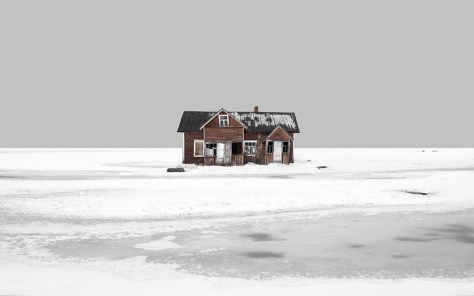
Martina Lindqvist series Neighbours consists of isolated houses on a background of snow and ice. There are no people or other dwelling places in sight and the houses almost look like toys. The title contradicts the images. Loneliness seems absolute. In a her artists statement Lindqvist says ‘The discrepancy between ‘objective reality’ and subjective experience has, for as long as I can remember , been at the forefront of my work…..It is in this vein, of attempting to make visible that which is not really there, that I approach my photography’ (Martina Lindqvist, 2017). These images of desolate houses, failed attempts to settle as people move towards the towns and away from the countryside are both beautiful and terrifying. This is what can happen to a place that loses its meaning.
Lindqvist has also produced Murmurs, a series of vanitas pieces that show dying flowers against a background of her grandmother’s wallpaper. Her grandmother was a proud person, ‘keeping up appearances’ but when the images were taken was suffering from Alzheimer’s and could not remember her past. The reflect on the coming of death, and what is – or is not- important at that time.
A third series A Thousand Little Suns also shows houses and buildings (possibly farms) that as set alone in the fields. This time they are shown at night, lit eerily. The source of the light is difficult to fathom. Are these ‘real ‘images? How has she made them? Are they an illusion?
Overall, her images riff on the frailty of life. The isolation of being old and deserted. Were these buildings ever a warm and loving home? What happened? What went wrong?
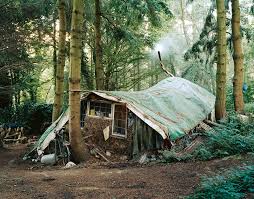
In Settlements (Spero, 2017) Spero takes pictures of some of Britains more unusual homes. Home made homes. Huts with canvas roofs. Communal areas. Informal insides and outsides. Gardens and vegetable patches. People living in groups and sharing equipment. These are people who have chosen to live outside the mainstream, with a minimal impact on the environment. There will inevitably be conflicts with authority, with planning and with people that simply do not approve of ‘off the grid’ living and self design.
Whatever you think of the chosen lifestyle the images show a thoughtful appreciation of the ethos of the people. Most of the images are from outside , taken, as noted in the OCA manual, with an eye for the privacy of the families but on his blog he also shows the insides of the houses, details of their lives (Returning from the Pub) and group images. It is a holistic look at their lives and makes for fascinating viewing (Spero, s.d.).
Spero has done another series Churches in which he shows images of churches, or rather religious dwellings where unusual settings have been utilised. For instance, the Christ Shalom Bible Centre in what looks like an old garage and the Truth of God Church in an old industrial building.
In both of these series Spero shows how people utilise what they have to allow them to live how they wish, not how the world expects them to live but what works for them. It is an unusual viewpoint and one well worth exploring. Too often we make assumptions about what is right, that is, what we do equals what everyone should also do. Showing alternative ways is a wake up. It undoubtedly helps that the images are fascinating and draw the eye – but that does not override the ethical import of these series. They tell about the people, whether or not the people are present.
Larry Sultan (1946 – 2009) was an American photographer who is probably best known for his collaborative work with Mike Mandel which of which the most famous piece is Evidence.
in Evidence Mandel and Sultan collected a series of pictures that were available in the archives at police and fire departments, government bodies and engineering corporations and showed them as fine art pictures. They then collected them into a book, which at the time was extremely controversial, as they claimed authorship of these found pictures. Since then the use of found pictures has become well established either by working with personal or family archives or by finding pictures online and manipulating them.
Sultan says about this work ‘it was very controversial because we had claimed authorship. At that time the word appropriation hadn’t been used in an art context. It came out of a Duchampian strategy of the found object, in this case the found photograph.’ The pictures in Evidence are interesting, not necessarily the most beautiful images, in fact they frequently are not. However, I find at least one of them, which shows the corner of the room and boards in it, fascinating and I could stare at it for hours. Evidence was initially self published however has been reproduced fairly recently in a facsimile version with added essays (Sultan and Mandel, 2018)
Larry Sultan has done much other work. One of his major pieces of work was entitled Pictures from Home which included his words, his own pictures that he took of his family. and also found family memorabilia and snapshots. Sultan describes this work as in his statement about it as ‘What drives me to continue this work is difficult to name. It has more to do with love than with sociology, with being a subject in the drama rather than witness. And in the odd and jumbled process of working, everything shifts; the boundaries blur, my distance slips, the arrogance and illusion of immunity falters. I wake up in the night stunned and anguished’.
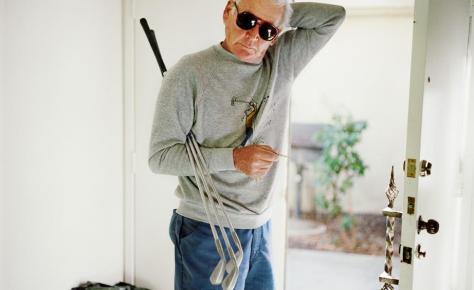
The images he takes of his family are sometimes staged, sometimes snapshots. They are not necessarily beautiful in anyway, although some are. There is a picture of lawn sprinklers where the light shines through the water. They are everyday images, things that might happen with any family; his mom and dad having a conversation in the driveway with his dad leaning against the car, his dad scratching his head while carrying a bunch of golf clubs, his dad’s desk scattered with the usual chaotic mess that most desks acquire. All interspersed with snapshots taken across time. He shows images that compare his dad at the same age as ones of himself and comments ‘I always looked younger than he did when he was my age. Perhaps people aged differently prior to the 1960s; can it be that the times we live in leave imprints on our faces and bodies?’
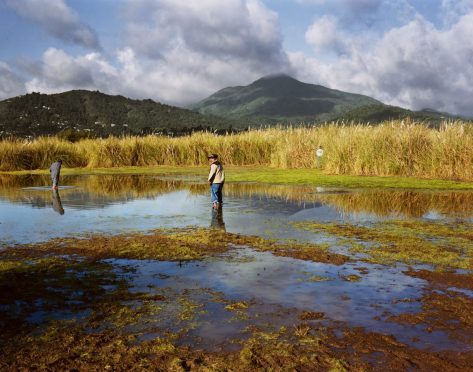
Sultan went on to make several other series of works, for instance, The Valley in which he examines the way pornography and pornographic pictures are taken and how they fit into an apparently suburban lifestyle. Homeland was his last major piece of work in which he hired day labourers as actors in landscape photography. This produced some sublimely beautiful images of people working in the countryside. Showing again the ordinary things of life. About this piece of work, he says, ‘The suburban terrain – both literally and also in terms of being an American photographer thinking about the daily, the ordinary – is what I to go back to’. One image from this group is simply entitled Creek, Santa Rosa 2007 shows somebody crouched at the edge of a creek with a bucket and some stones while another person wanders away in the background up towards houses. The light on this image is beautiful, it is a very peaceful image and it leaves me wondering what the men were doing with these buckets. Were they collecting water? Were they washing something? Were they trying to make a garden? Another image in the same series Corte Madera Marsh 2009 shows men wading through water against a background of mountains and tall grass. If you look at it very carefully one of the men is walking away into the grass which comes well above his head. Is it grass or are the trees? And does it matter? It is a very gentle picture and one I could look at for a considerable length of time.
I find the range of Sultans work fascinating. If, as he suggests he feels ‘alienated from where he lived’ he has managed to show the ordinary, the banal, and the magic of the part of America he lived in. A final quote, ‘Being a photographer allow me to be a witness, to participate in a way that felt right for my blend of being alienated’.
All quotes from the book Larry Sultan – Here and Home (Sultan et al., 2014)
References:
Sultan, L. et al. (eds.) (2014) Larry Sultan: here and home. Los Angeles, California: Munich; London ; New York: Los Angeles County Museum of Art ; Delmonico Books, Prestel.
Sultan, L. and Mandel, M. (eds.) (2018) Evidence. New York: Distributed Art Publishers, Inc.
John Stezakar makes photo collages using found work, pairing portraits, overlying postcards on images, cutting and pasting. He uses manipulation by hand rather than digital work. Altering and subverting the original pictures. An image of a man turns into a woman – or is it? Eyes are replaced by landscape. Is it what they see? Can you imagine the person behind the mask? Much of his work is based on old film stills and advertising photographs. A story turned into another story. What does his work say about the truth in photography? I find the images fascinating. Some are beautiful others disturbing. Modern Surrealism.
In 2012 he received the Deutsche Börse Photography Prize for a collection of his photo collages (John Stezaker, s.d.). His work uses old images, not his own. Does this make him any less a photographer? Which opens the question of what is a photographer? Do you have to take the images yourself – or can you utilise those of others? For the ultimate answer to this one can only look at the work of Sultan and Mandel in Evidence, reprinted as a facsimile cope in 2018 (Sultan and Mandel, 2018). It has been described as ‘one of the most influential photobooks of the last 50 years. If you are using other’s images are you rather a curator? –but again is a curator someone who keeps, rather than someone who uses? This work falls between, or overlaps, both these descriptions. Does it matter? The images make you (or at least made me) think.
A recent exhibition of his work was held in London at The Approach and the catalogue (Stezaker et al., 2019)gives two fascinating essays about his work together with an overview of images produced between 1976 and 2017. The first essay by Michael Bracewell discusses the source of the images from ‘industrially created romantic fantasies’ and how by the simple act of cutting Stezaker transforms them into ‘an oddly haunted psychological moment’. His art disrupts the image and forces the viewer to look repeatedly at an ‘illogical ‘scene to try and make it make sense. In one of his later series Love the apparently simple act of cutting through the eyes and duplicating them gives an eerie, intensity to the gaze. I would be interested to see them alongside the original images. I did manage to track one down. The original is a picture of Helen Walker by Everett in which the actress looks sultry and stares directly at you. In the altered image. She is shocked, even frightened. She has certainly lost her air of composure.
The finishing essay by Craig Burnett quotes from John Donne’s poem The Ecstasy’ – Our eye-beams twisted, and did thread/our eyes upon one double string…’ and questions (via the talking persona of one of the images) ‘does it lure you in, intrigue, astonish?’. They certainly intrigue and astonish me.
Deborah Orloff’s work Elusive Memory is a series of images of photographs that she found in the basement of her parent’s house. They are severely degraded, water damaged and stained, often stuck together in piles. She has taken these photographs and re-photographed them and printed them large scale so you can see all the details of the damage and the underlying surface. In her work statement on them she says, ‘these banal objects become simulacra of loss and speak eloquently to the ephemeral nature of memory’ (Orloff, s.d.)
My favourite on her website is simply labelled as MAR 65. I also love Madonna and Child. Third favourite is Guarded Smile. From this list you can gather that I am struggling to pick out individual ones that I really like more than any others. The most poignant is probably either Extended Pause or Lost Bridesmaid.
In an interview with Ain’t Bad’s Kyra Schmidt (Schmidt and Orloff, 2019) Orloff discusses her feelings about memory. They discuss whether our memories are our own and the fact that her mysterious images meditate on this question. Certainly, the images allow you to make up narratives, they are memories, but they are partially destroyed memories and therefore you can imagine whatever you like from them.
Orloff and Schmidt discuss the oft posed question of what is the connection between memory and photographs? Do we remember the past or is it because we have seen a picture so often that that becomes the memory? Orloff notes that she had been thinking about the connection between photography and memory since her father’s death when she realised just about every memory she had of him was connected to a photograph. When she salvaged the partially destroyed prints found in her father’s basement, she saw them as metaphors for loss and the ephemeral nature of memory.
This understanding of photographs contradicts the more usual reading of photographs when you see what you expect to see. In this case what you expect is not always what you actually get.
Orloff goes on to discuss the use of digital photography (especially phone digital photography) ‘ However, with the pervasiveness of digital technology, instead of trying to commit things to memory, we tend to pull out our phone and snap a picture, hardly paying attention to what we’re shooting. The visual reference is stored for potential use. We even use our cameras to take “notes” now. It’s certainly efficient, but I think it gives us license to forget as we’re not fully present in the moment. Instead of experiencing places and events we take photos, that we may never look at, often without really stopping. How can we expect to remember anything beyond the superficial? We process an overwhelming quantity of visual material daily, but we really don’t see most of it.’ The other problem is that everybody is so aware that the photographic image can be manipulated but often everybody assumes it is rather than thinking that it might not be.
The images in Elusive Memory are both beautiful and mysterious. They turn the usual meaning of archival images upside down. They are an archive in that they are a group of items that are found, stored and go together, but they do not give an easy explanation of the events they show. Rather they encourage multiple readings, and the use of one’s own imagination and memories to interpret them.
I attended a zoom discussion led by Suzannah Evans. I chose to attend this zoom because of the increasing amount of writing that is required in the photography course and my awareness that I have not done any formal learning on writing since school (a long time ago). She started by making some general comments about writing such as thinking about what we write, and, more importantly, why we write. This zoom focused on writing about place. She gave us three exercises:
Writing about a place you have been to regularly during lockdown. I chose to write about the walk out the end of my street, the same one I made images of for exercise 5.3 about a local journey. I will add this as an appendix to that exercise.
Thinking about some unusual place names and writing about those. I picked Arakan, which was both the name of the house I lived in as a child and also where my father served in WWII
A short piece that is very place specific. I wrote about the harbour where I lived as a child.
We also discussed poetry and how it differed from general writing, a more considered use of words leading to the production of a feeling. Also discussed avoiding the need to impress, to be pretentious and look clever rather than just using the words that are required.
I found the zoom helpful. It has made me think more about how I say things, and why I say them.
Sue Breakell on Negotiating the Archive (Breakell, 2008)– summary and my thoughts
What is an archive? A space where things are hidden? Rows of impenetrable boxes? A collective memory bank (the National Archive).
To deprive oneself of the archive is to lose one’s memory – but can the sheer volume become overwhelming?
If there is too much information does the ‘archive’ become more valuable, the most important part?
A professional archive is a collection of historical records relating to something and/or the place where the record is kept.
Popular meaning – any group of gathered objects
Ketalaar- ‘By the People, of the People, for the People’ (Ketelaar, 2003)
The significance of an archive can depend on what it contains, but also how it is arranged, and the relationships of objects within it (which may change).
An archive is (or should be) more than just a collection, a set of traces that each throw light on the rest
An archivist should describe, but not interfere. But looking at the archive cannot be unbiased, what you see depends on both your interests and what you are looking for.
Curtin University – archives are frozen in time… linked to the past but also carried forward ….as they are re-presented and used
The context of the items is important, where did it come from? how was it created? A document is what remains – but is only part of the original event. Parts of the event will always be absent leading to ambiguity (Derrida). There are always gaps.
Why do we want archives?
An illusion of truth?
Steedman’s point – ‘the past is searched for something …. that confirms the searcher in his or her sense of self’(Steedman, 2006)
They give layers of meaning to life
Archives can be used to create personal histories (Goshka Macuga) – to find one’s identity when creating something
The act of remembrance involves both storage and retrieval. Traces of things that we respond to, reflections of ourselves in the world.






 Identity and Place