Category Archives: Photographers

William Eggleston

William Eggleston is said to have interpreted his surroundings by the objects they contained rather than by the people. His pictures are often thought of as being devoid of people – however a look at the website of his foundation shows that this is far from true. See: http://egglestonartfoundation.org/

cocktail
© William Eggleston

His images are brightly coloured and are often about the small details. On the front page there are images of a car (and its advertisement),  a deserted shop (possibly a diner), 3 light fittings (on varyingly coloured backgrounds), landscapes (including a beautiful image of either coloured leaves or blossom), road signs, a glass on an aeroplane table, stuff on (probably a kitchen) table , dolls, a bowl of fruit, as well as six pictures focusing on people and another car. This covers most of the possible subjects of photography. The difference is that he thought to take these varied images in colour at a time when the norm was black and white and mainly either street images or formal photography, carefully considered and correctly viewed. I am not suggesting that Eggleston did not carefully consider each of his images – just that his eye for what made an image was different. His images use the items to tell about the place. The image of  the glass on the aeroplane table immediately makes me think of holidays, travel, excitement, and also fear – but it is a very simple image utilising the light coming in the window. Eggleston is said to have ‘legitimised’ the use of colour in art photography when, up to that point, it had mainly been used in commercial work. He used a dye-transfer printing process that gave vivid colour and makes things look hyper realistic. His images are often of the ‘ordinary world’, things left on the pavement, broken items, street signs. His composition includes skewed lines, odd perspectives, and unlikely items.

In the introductory essay to William Eggleston’s Guide (Eggleston and Szarkowski, 2014) by John Szarkowski which was initially published in 1976, Szarkowski is dismissive of the use of colour in most photography, for instance comparing it to paintings ‘ it is their unhappy fate to remind ups of something similar but better’ (p.9) and ‘Most color photography, in short, has been either formless or pretty’. But he goes on to say that the best of modern colour photography ‘derives its vigour’ from taking images of ‘commonplace objects’, the things found in life, the people and the ordinary places, ‘visual analogues for the quality of one life. This certainly describes Eggleston’s work. The book instantly takes you back, to mid last century America, neither rich or particularly poor. The life of the ordinary person. He does not make fun of it, it is a simple statement – this it what it is. The bikes and the cars, the barbecue, the rubbish in the streets. This is the way at it was.

Eggleston’s lifestyle was eccentric, he was rich, southern and did not need to work. He plays the piano, draws, paints and almost incidentally takes photographs. There is a fascinating extended interview answered life story by Sean O’Hagan (O’Hagan, 2017) which describes how people were originally offended by his work both because of the colour and the subject matter. The ordinary world. The world most people inhabit.

References:

Eggleston, W. and Szarkowski, J. (2014) William Eggleston’s guide. (2nd ed.,) New York: Museum of Modern Art.

O’Hagan, S. (2017) ‘William Eggleston: ‘The music’s here then it’s gone – like a dream’’ In: The Observer 19/11/2017 At: https://www.theguardian.com/artanddesign/2017/nov/19/william-eggleston-interview-i-play-the-piano-musik-photography (Accessed 06/07/2020).

30 Seconds on Margaret Mitchell

I listened in on the webinar at Street Level with Margaret Mitchell. I first saw her images on the railings at one of the St. Andrew’s Photography Festivals and they have been in the news since.

The talk explained her background, some of her major series and what she is doing now.

  • She started at Napier University and was interesting in community work from early on
  • Her major work has been with portraiture, mainly of her extended family In This Place
  • Works with charities – especially Shelter
  • Important to give something back to the people you are working with – so may teach or allow/encourage them to become involved
  • At present doing a long term project with Shelter on people who have been homeless
  • Pics that you took in the past may come back into play in the present
  • Listen and talk to people , give them a chance to think about where/how they want to be photographed
  • Think about how much choice people have had in their lives – may have been very little.
  • Think about the role of the environment in what people can do
  • Be respectful in how the images are produced and who sees them

See: https://margaretmitchell.co.uk/

And: https://www.theguardian.com/artanddesign/2020/jun/15/michaels-mission-helping-edinburghs-homeless-photo-essay for a recent discussion on her work with the homeless and one of their stories


Anna Fox

Anna Fox is a British photographer and a professor of photography at UCA, Farnham. She recently gave a talk on zoom to the OCA students. She has published several books including My Mother’s Cupboards and My Father’s Words (Fox, 1999). This is a small book that uses text to explain pictures – or pictures to illustrate text. They both have equal value. The text consists of words, aggressive, angry, violent, spoken by her father about the women in their family, more specifically her mother and the images are very quiet, simple images of the contents of the cupboards in the house. Sometime the two fit together – such as the words ‘She’s bloody rattling again’ set against a cupboard of glasses, other times less so. In a recent talk given by Fox to the OCA students she said that she collected the words surreptitiously, under the table – but simply went around the house taking the pictures. She did not attempt to illustrate the words but matched them together when they were all collected. She described the book as not simply about her mother and father but about the effect of couples living together in a patriarchal society and noted that whenever it is shown other people come out with similar stories about their families.

In another book Work Stations (Fox, 1988) Fox took a series of photographs of people in offices in London which are presented along with a line of text that she gathered from magazines and newspapers. She used the same technique in Basingstoke 1985-68 (Fox, s.d.), where the apparently banal images of Basingstoke life are matched with a series of texts culled from local papers. In both of these works sometimes the text matches the image (although with a slightly sideways match) in other the text seems to almost contradict the information in the photograph. In the same talk she said that she simply collected the texts but did not try and illustrate them – as, for her, that did not work. Fox is clear that image and texts when used in a piece of work should be seen as both parts of the work, not simply an image + a caption.  She used the work of Sophie Calle to illustrate this – where the words are crucial to the understanding and are often shown as more important (or at least more dominant) than the pictures. In another work Cockroach Diary (Fox, 2000) she made two separate books, one the diary – a copy of the diary she made which told the story of what was happening in a group of ‘dysfunctional’ people living together, and one a book of images of cockroaches – often scarcely visible (as they move so fast) and presented them together. In an exhibition of the work the pictures were shown on the walls, and the diary shown under them so you could read it all.  

In all of these works the text is important. Equal not subordinate. It needs careful thought from the very beginning of the project, it may actually precede the images and inspire them. It is not added as an afterthought, that will not work.

 In the lengthy and fascinating talk, she made several important points which I have attempted to summarise:

  • Women in photography have not often been represented enough which she and a group of other people are trying to balance in Fast Forward, which holds conferences, acts as a research project and has an online journal (Fast Forward: Women in Photography, s.d.) .
  • Women are not good at networking – possibly because focused on struggle to get seen and not enough energy left, men are better at this
  • She is inspired by fiction – fills the mind with ideas, which then become embedded and inform your work
  • Photography resembles reality – but it’s not real. Time and memory are important Are these things captured, recorded or posed in time?
  • Does it matter if the photo is ‘real’ or fictional – no but it does matter that you are honest about it if asked. Some authors embed found images in their work to make the story appear more real. Other photographers construct images from the ground up to tell a fictional story that may be more real than an actual image ever could be (Crewdson, Wells, possibly Capa).
  • All your work has a degree of fiction because you choose what to include and what to crop out – the story says as much about you as anything else.
  • She said the photographs that inspire her are the ones that surprise her.
  • You have to make yourself a good enough photographer to make the story the right way for the subjects – gives the people a voice. You need to know why you take them and use them – context is everything.

More of her work can be seen on her website: https://annafox.co.uk/

References:

Fast Forward: Women in Photography (s.d.) At: https://fastforward.photography/ (Accessed  08/06/2020).

Fox (s.d.) Basingstoke 1985 – 86 – Anna Fox. At: https://annafox.co.uk/photography/basingstoke-1985-86/ (Accessed 08/06/2020).

Fox, A. (1988) Work Stations: office life in London. London: Camerawork.

Fox, A. (1999) My Mother’s Cupboards and my Father’s Words: a short story in words and pictures. London: Shoreditch Biennale.

Fox, A. (2000) Cockroach diary 1996-1999. London: Shorditch Biennale.

Aaron Schuman – Slant

Aaron Schuman’s book Slant (Schuman, 2019) came about from looking at police reports in the local newspaper in a small American town. They varied from the banal: ‘10.13p.m. – A boy peeping into a window at The Boulders fled before the police got there. The woman who lives at the apartment was given advice on how to pull down her shades so no one could look into her home’ to the odd: ‘1.47p.m. – Police were notified by a downtown resident concerned with a neighbour who allegedly is keeping a ”green monkey” as a pet’ to the downright weird: ‘9.51 p.m. – a woman called the police to respond to her North Amherst home after her son placed urine on a hot plate in the shed as part of an experiment in alchemy. The actions of her son are allegedly a violation of a court agreement’. Many of the reports focus on strangers and show phobic leanings (anti- feminism, anti-foreigners, strange accents or sounds, odd things in the sky). They are rarely of anything important and one wonders why the police were ever involved.

slantphoto11
© Aaron Schuman

Schuman spent some time trying to think of ways to illustrate these odd statements and eventually came across the work of Emily Dickinson and her use of ‘slant rhyming’ – which is  where the rhymes do not really match, they are close and give an inharmonious sense of sound. She also wrote a poem called ‘Slant’ which starts “Tell all the Truth but tell it slant – Success in Circuit lies”.  Working from this Schuman took a series of photographs in the area that are partially paired with the words, that tell stories, that might be the truth – or might not. The images themselves, black and white and often beautiful also often have something slightly askew, a small boy burning something – but what. A notice for a Bible Study Group – that says Happy Resurrection.  Schuman says he chose black and white for these images as it echoed the “black and white” tone of the police reports.

slantphoto33
© Aaron Schuman
slantphoto19
© Aaron Schuman

In an interview in the BJP, Schuman says, ‘Slant is about telling the story gradually……it’s the idea that the truth is malleable, ever-changing and diffused in a way……I like the slow burn…..there’s something here, but you’re going to have to find out’ (Pantell, 2019) .

He was also inspired by the book Time in New England by Paul Strand and Nancy Newhall where Newhall searched for texts that reflected New England and the texts and the images were put together to make a complete story (Strand and Newhall, 1980) .

The book is fascinating and shows yet another way of integrating text and images. In this case they hold equal value, but the images do not directly link to the text and the text does not explain the images. Together they tell a story of a place in America, a rather scary place. A beautiful place – but one which clearly has some unusual people residing there.

To see more images, look on his website: https://www.aaronschuman.com/

There is a fascinating (and very long) interview on ASX that is well worth reading which explains his thought process in detail (Feuerhelm, 2019).

References:

Feuerhelm, B. (2019) Aaron Schuman: Slant Interview. At: https://americansuburbx.com/2019/05/aaron-schuman-slant-interview.html (Accessed 02/06/2020).

Pantell, C. (2019) ‘Parallel Lines’ In: British Journal of Photograohy (7885) pp.68–77.

Schuman, A. (2019) Slant. London: Mack.

Strand, P. and Newhall, N. W. (1980) Time in New England. Millerton, N.Y.: [New York]: Aperture ; distributed by Harper & Row.


David Favrod

David Favrod is a Swiss-Japanese artist that now lives in Spain. A combination of cultures that has shaped his photographic practice. He uses a mixture of styles; photography, drawing and video. Much of his work is influenced by manga/anime. He says, ‘I don’t restrain myself with only photography……my question is just “How can I tell this story?” …. I need to push the boundaries to find the right/best way for what I want to show/express’. He also notes that ‘memories are fictions …  easily malleable (Newman, 2015).

Hikari (meaning light in Japanese) is a work based on memory – but not his own, but that of his Japanese grandparents, told to him on one occasion – so a memory of memories told. It is overlaid with his own feelings of growing up as a mixed-race child. In an interview with Sharon Boothroyd (Boothroyd, 2014) he explains his working process (thinking of the idea, drawing sketches, looking at the balance of different images then constructing them).  He also uses sound – or the visual representation of sound – added to the images. He does not explain his images in detail and hopes that each viewer will bring their own memories to them. For Hikari he tells a story that is part fact, part fiction using found images and objects collaged together with drawings and photographs leading to ambiguous images re-creating fragments that might be memories or dreams.

In another series Gaijin (Japanese for foreigner) he blends Japanese symbols with portraits and Swiss mountains. This project was made in response to his feeling of rejection having been declined dual Japanese nationality.

When looking at his work online I found it difficult to differentiate what comes from which series. They are often shown together and have a similar feel, Favrod himself notes that his series are often linked, and he flows from making one into making the next – which probably explains my dilemma. His website  (Favrod, s.d.) shows many of his images but, even there, they are just titled and dated, not separated out. Many of the images are beautiful low key scenes such as Une averse, an image of a snow covered mountain (it could be in Japan or Switzerland) part covered with diagonal black and white stripes. Others clearly reference Japan – Pour Sadako – a river with coloured paper cranes instead of reeds and leaves. Did he make them and position them before taking the image or is it a collage? Either way it is evocative. Some are portraits – La pluie noire –shows a girl covered with mud and surrounded by Japanese characters. Is this referencing the bombing in Japan? Is it a more personal memory? or both? It is ineffably sad.

Une+averse
Une averse – © David Favrod
Pour+Sadako
Pour Sadako – © David Favrod
Pluie+noire
Pluie noire © David Favrod

References:

Boothroyd, Sharon, S. (2014) David Favrod. At: https://photoparley.wordpress.com/2014/09/23/david-favrod/ (Accessed 28/05/2020).

Favrod, D. (s.d.) DAVID FAVROD. At: https://www.davidfavrod.com (Accessed 28/05/2020).

Newman, C. (2015) Looking Back and Forward Interviews #6: David Favrod. At: http://www.gupmagazine.com/articles/looking-back-and-forward-interviews-number-6-david-favrod (Accessed 28/05/2020).

30 seconds on Ashley Gilbertson

Following on from the research talk by Andrea Norrington I decided to use her 30 second rule to take notes immediately after seeing or reading something. This way I might actually do it  (and remember things). So:

I watched a video on Ashley Gilbertson talking about his book Whiskey, Tango, Foxtrot about the 2nd Gulf War in Iraq on VII.

  • An intelligent, articulate, angry photographer
  • Images that show war not just in the gory details but in the personal snippets
  • ‘It was their war until someone died for me then it became my war’
  • What you do should not change things (for the worse)
  • Wait for something to happen rather than set it up
  • Hopefully bearing witness will allow people to understand that most people kill for an ideology not for the personal things (and that everybody has the same personal truths – family, home)

See:

http://www.ashleygilbertson.com/whiskey-tango-foxtrot-iraq

Dorothea Lange – MoMA Exhibition

Coincidentally, or you might say serendipitously, I came across the virtual exhibition on Dorothea Lange at MOMA  (Meister, s.d.) just as I am starting Part 4, Image and Text of Identity and Place. In spite of her fame I know little of Lange’s work. There is the overriding image Migrant Mother. She worked for the Farm Security Administration.  She was American. I am now going to have to travel down a long exploratory road.

The virtual exhibition shows installation views, where you can click on the images to see some, possibly not all, of the pictures displayed. There are also a series of videos discussing her work, a fascinating live Q & A session with Sally Mann  and a work by Sam Contis Day Sleeper  that shows the way her work has developed from exploring Lange’s work ‘ a fragmented, unfamiliar world centred around the figure of the day sleeper – at once a symbol of respite and oblivion’ (Contis, 2020). The images are available on the MOMA website. (Contis, s.d.)

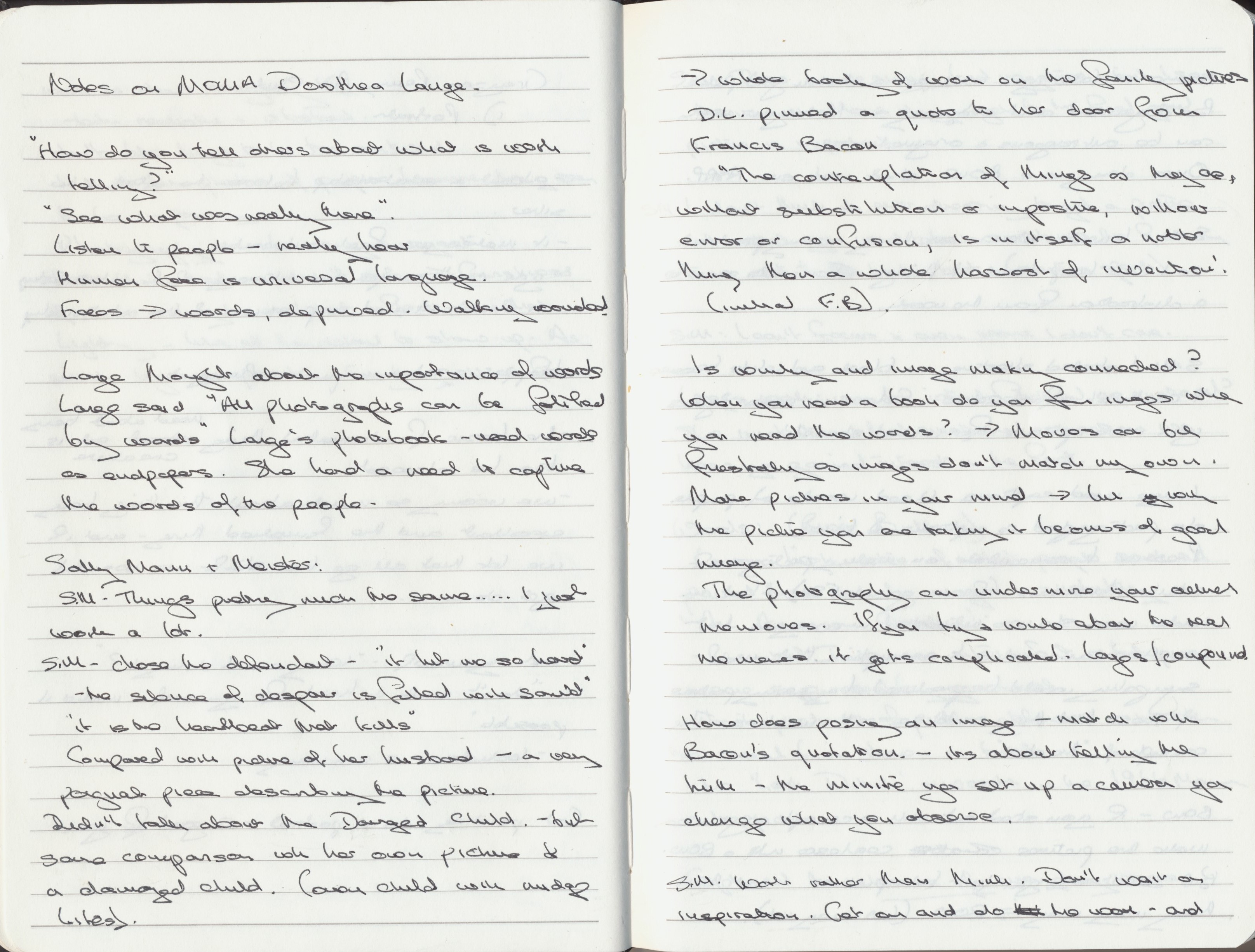
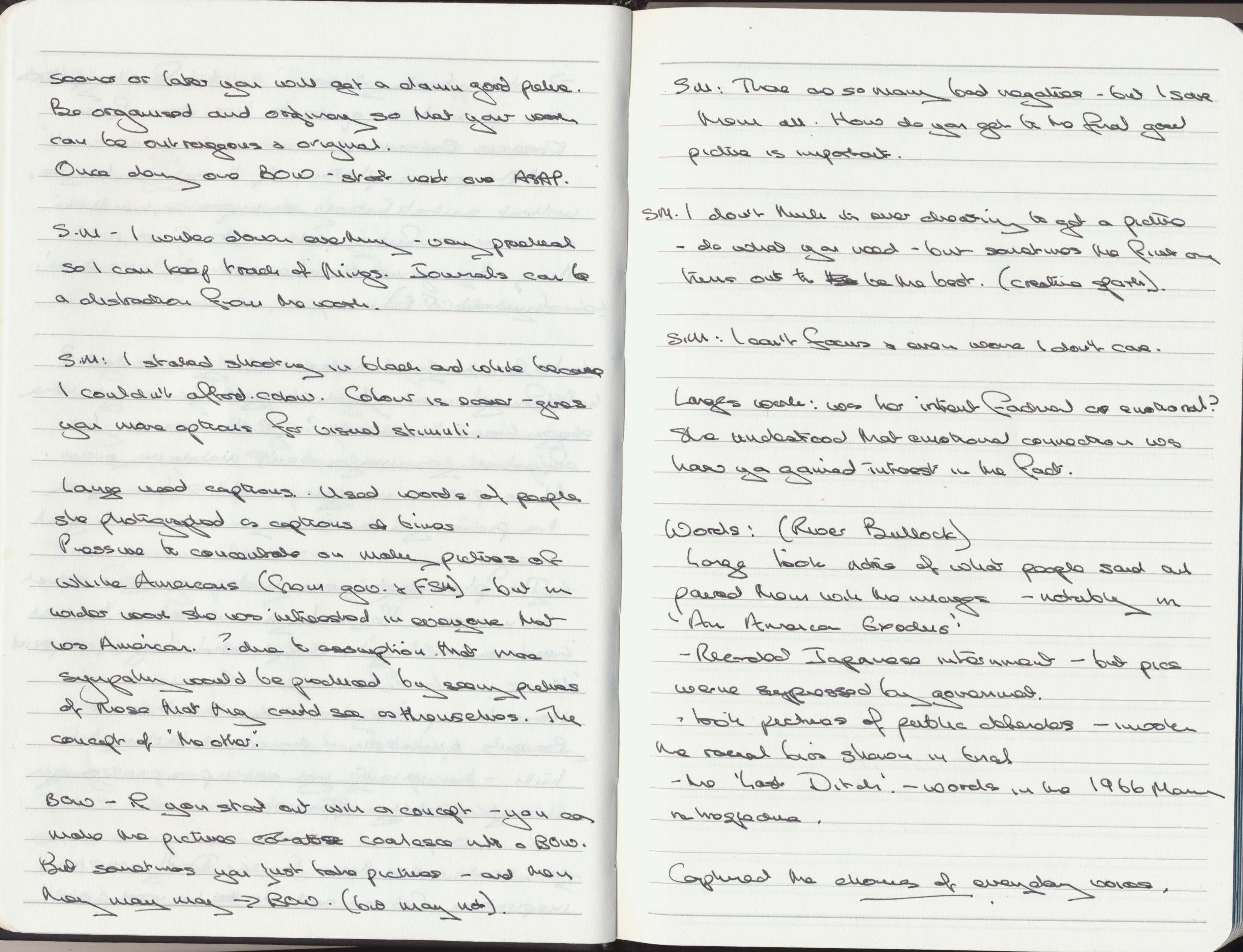
I took extensive notes (appended below). In summary the main things I took from the videos were:

  • See what was really there. Listen to the people and really hear
  • The human face is a universal language
  • All photographs can be fortified with words (Lange did this extensively)
  • Mann’s description of The Defender “it hit me so hard…the silence of despair is filled with sound”
  • The quote from Francis Bacon ‘The contemplation of things as they are, without substitution or imposture, without error or confusion, is in itself a nobler thing than a whole harvest of invention’ (Bacon lived 1562 – 1626).
  • Photography can undermine your actual memories of an event or a place. You remember the image not the reality. Writing about it further compounds the confusion – layers on layers
  • Work and get on with it
  • Be organised and ordinary so that your work can be outrageous and original (a slight twist/modernisation on a Flaubert quote
  • Lange was interested in everyone – not just the white Americans that the FSA wanted her to show

In the piece by River Bullock  (Bullock, s.d.) she gives two quotes from Lange:

 “I am trying here to say something about the despised, the defeated, the alienated. About death and disaster. About the wounded, the crippled, the helpless, the rootless, the dislocated. About duress and trouble. About finality. About the last ditch.”

“You see it’s evidence. It’s not pictorial illustration, it’s evidence. It’s a record of human experience. It’s linked with history. We were after the truth, not just making effective pictures. To tell the truth is in some people’s nature and it can be a habit, but you can also get in the habit of not telling the truth.”

There is a very poignant book of poetry by Tess Taylor Last West (Taylor, 2020) that has been written to coincide with the exhibition. It consists of a college of words from Lange’s own diaries, words spoken by the people she met and Taylors own words that she found while following Lange’s footsteps across California. It finishes:

                you might walk for a while

                as the road grows distant;

                might feel in the silence

                how you’re just walking –

                might feel           for a moment

                how                       it’s just earth again.

I have also taken the opportunity to look at the exhibition catalogue (Meister et al., 2020) which contains a fascinating series of essays along with the images. In the first essay Sarah Meister talks about the use of words alongside images and how important Lange thought that to be. However, despite its importance, the words could change – Migrant Mother was only the last of a series of titles and descriptions given to that image. The story of this is told in the book including copies of Lange’s thoughts on it in Popular Photography (pp.134-145). Meister notes ‘In the hazy middle ground of truth and invention are the carefully selected truths that hold the powers to persuade’ (p.21). The book also contains a series of essays in which writers, photographers and philosophers talk about their favourite image in the exhibition. They make fascinating reading – the choice of Kimberly Juanita Brown is simply titled Grayson, San Joaquin Valley, California, 1983. It shows a clapboard building and only when you look closely you realise it is a church with a dead body on the porch. A surprising choice? – But when you check her online you discover that she is a professor specialising in gender studies, slavery, and the images of the dead. Other essays talk about the history related to the images ‘a ten-year apocalypse of dust, human suffering, and folly’, ‘will history continue to repeat until the torturous cycle collapses in on itself?’ (p.65) by Wendy Red Star (a Native American multi-media artist) on Tractored Out, Childress County, Texas, June 1938.  Sally Mann’s writing about The Defendant, Almeida County Courthouse, California,1955-57 reads as a prose poem. ‘But the defendant’s heart: there is no warming sun, no warming spirits, no comfort of companionship’ (p.126).  Much of the catalogue shows pictures of the books and magazines that Lange’s work was published in. It is, therefore, possible to read the text that they were originally shown with, alongside some comments that Lange or her co-workers  made about them, for instance: “the Mormon story turned out very sour indeed” by Ansel Adams as the pictures they had chosen were severely cut down.

I am also reading the fascinating biography of Lange by Linda Gordon Dorothea Lange; A Life Beyond Limits.(Gordon, 2009). I think I may be a little Lange obsessed.

Notes:

References:

Bullock, R. (s.d.) Written by Dorothea Lange. At: https://www.moma.org/magazine/articles/245 (Accessed  08/05/2020).

Contis, S. (2020) Day Sleeper. London: Mack.

Contis, S. (s.d.) A Portfolio of Photographs from Sam Contis’s Day Sleeper | Magazine. At: https://www.moma.org/magazine/articlCes/293 (Accessed  08/05/2020).

Gordon, L. (2009) Dorothea Lange: A Llife Beyond Limits. (1st ed) London ; New York: W.W. Norton & Co.

Meister, S. (s.d.) Dorothea Lange Words & Pictures/MOMA. At: https://www.moma.org/calendar/exhibitions/5079 (Accessed  08/05/2020).

Meister, S. H. et al. (2020) Dorothea Lange: Words & Pictures. (1st ed) New York: The Museum of Modern Art.

Taylor, T. (2020) Last west. (1st ed) New York: The Museum of Modern Art.


Mark Steinmetz

Summercamp-3
© Mark Steinmetz (with thanks) – from Summer Camp

Mark Steinmetz (born 1961) is an American photographer who spent 11 years working as a photographer in a variety of summer camps. He would take pictures and act as a photography tutor. Out of that body of work came Summer Camp (Steinmetz, 2020) which is a collection of images taken between 1986 and 1997. They were collected into book format in 2019. Steinmetz comments for the book information that ‘certain things never changed …. there isn’t much difference between them in 1990 or 1965’. Despite the pictures being taken over a considerable time they maintain a consistent look, they are all black and white and mainly low key, however, some are portrait and some landscape format. The book tells a story from arrival at the camp, though the daytime activities, to evening to night-time and then departure and saying goodbye. There are no captions – but the story is clear. In most of the images the children are not looking at the photographer, simply getting on with having fun (or not). The book is divided into sections by blank pages, a pause in the story, a shifting mood. The overall feeling is one of wistfulness, of a gentle melancholy. Steinmetz himself had been to summer camp as a child/teenager and notes ‘At summer camp you find yourself in a different, unfamiliar world and you have no choice but to adapt’ (Rosen, 2020). This experience has a undoubtedly influence the images he took and the engaging mood of the book.

Steinmetz has also published another series on American youth – The Players (Steinmetz, 2015). These images are of teenage baseball players and were taken at a similar time to those in Summer Camp. The images have a similar feel, a mixture of awkwardness and bravado, together with the intense involvement in the moment that young people often show.

His other recent book – Carnival (Steinmetz, 2019) – concentrates on the people who are involved in the country fairs, and small circuses that travelled around America. The images were taken from 1982 – 2001 and appear timeless. They capture both the workers and the people there to have fun and show the same ability to be there but not be noticed, to take images that show the life, not the people looking at you. The book tells a story, moving though the day, with people outside the fair to night-time, (to see a range of images from this book see the Guardian article referenced below).

Almost all Steinmetz’s images are back and white. An exception seems to be some of his fashion images, although, even then, the majority are monochrome. They have a timeless feel, a gently told story. Even the images of an airline terminus and a flight remain quiet – a real challenge given the amount of noise in that environment. He is a wonderful storyteller with a gift for being anonymous to those around him.

Reference list:

Carnival: capturing all the fun of the fair across the US – in pictures (2019) In: The Guardian 14 November 2019 [online] At: https://www.theguardian.com/artanddesign/gallery/2019/nov/14/carnival-capturing-all-the-fun-of-the-fair-across-the-us-in-pictures (Accessed on 22 April 2020)

Rosen, M. (2020) Vintage scenes of life at an American summer camp. At: https://www.huckmag.com/art-and-culture/photography-2/vintage-scenes-of-life-at-an-american-summer-camp/ (Accessed on 22 April 2020)

Steinmetz, M. (2015) The Players. (s.l.): Nazraeli Press.

Steinmetz, M. (2019) Carnival. (s.l.): Stanley/Barker.

Steinmetz, M. (2020) Summer Camp. (s.l.): Nazrali Press.

Research for Assignment 3

When thinking about how to present this assignment I was aware that the brief included you can create as many pictures as you like …. the set should be concise and not include repetitive or unnecessary images. This means thinking about how to reduce a large number of images into a manageable piece of work that tells a story about the group of people I have chosen to work with.

In Short’s book Context and Narrative (summarised in Context and Narrative – Maria Short) she discusses the narrative that one might read in an image and points out that while it might be linear (beginning, middle and end) it does not have to be. The story should hang together, this might be because of use of similar tonal ranges, lighting or format – but might be because of the topic and that you need to be clear about your intention. Exploring the subject over time can end with you changing what you want to say and how you say it. The story may also depend on what order the images are shown in – so do you have control over that if it is important. (Short,2018).

With his information in mind I went and looked over my collection of photobooks to see which ones told a (fairly) concise story. Many that tell a story are long (book length) and involve many more images than I want to use, although this project could easily lengthen to a full book.  However, some of the books were shorter and told a relatively clear story.

 In this I have summarised the stories I read – concentrating on the ways the books and series were presented rather than on the whole import of each book. This is no attempt to do them justice – simply to pull out some information about how and why they were produced in a particular format, and the effect that’s those choices have had.

Julia Borissova white blonde – is telling a story of a place and a time, using a combination of archival images and altered self portraits. On her website it is also shown as single images and a slideshow. The order of the images varies though the sites (book versus slideshow) as does the format. In this case the series depends on the totality of the images, their tones and the feeling they evoke rather than the order in which they are viewed.  (Borissova, 2018) See Julia Borissova – white blonde for more detail.

 Margaret Lansink – Borders of Nothingness-On the Mend – tells about the emotions that were linked with her loss of contact with her daughter and subsequent re-engagement. The book is physically small. The paper is rough and the images low key, black and white with occasional flashes of gold. Little is clear. The order is important as it moves from despair through nothingness to repair and hope. The feel of the book is also important as it is very tactile, rough, and evokes the feelings described (Lansink, 2020). See Borders of Nothingness – On the Mend for more detail.

Bettina von Zwehl – Made Up Love Song – consists of a series of portraits done of the same person over 6 months, set in the same place and with similar light. The variations are minimal, her hair and clothing show subtle changes. The images are shown against a black background opposite a simple statement of the day and time. This is a very simple presentation where you gain from the repeated images showing the gradually increasing intimacy. While a single image is effective, the story gains by the repetition (Chandler and von Zwehl, 2014). See Bettina von Zwehl for more detail.

Robin Gillanders  – A Lover’s Complaint – takes the short Fragments written by Barthes, has them translated in haiku by Henry Gough-Cooper and then interspersed these with still life images, mainly of glass and material, shown as fragments against a dense black background. The haiku are presented 12 to a page, organised alphabetically, other than a final short poem about silence and love. There is no immediate obvious connection between the haiku and the images.  The viewer/ reader needs to make their own links. However, each group of images is linked, variations on a theme. As a whole, they start minimalistically, become more complex, then fade away – following a pattern. The words and the images give equal weight to the story (Gillanders and Gough-Cooper, 2016).

Dayanita Singh – Go Away Closer – is a series of 40 images in a small book. They are all square, and all black and white, and, other than the fact that they all tell about India, those are the only linking factors. Singh says she deliberately does not try to make a narrative but puts images together intuitively. In her work she collects her images into ‘museums’ – which she them changes around for different displays, even with the same exhibition. The work is about a feeling, rather than a story Singh, 2007), See Dayanita Singh – Go Away Closer for more detail.

All these photobooks are really about emotions rather than facts.  They may be based around a story, such as the Lansink’s Borders of Nothingness – On the Mend, or actively avoid a narrative like Singh’s Go Away Closer. In spite of this they all have a clarity about the way they have been put together, an internal consistency. The tonal values are similar, the feeling derived from the images are similar. They are clearly carefully considered. In two, Go Away Closer and white blonde, the order of the images is not crucial, while it has been, inevitably, fixed within the books, it is changed in other formats (a slideshow and an exhibition). These are all fairly short books, although longer than the series I am planning, but they taught me a lot about the type of consistency required to make a book hold together, and, even more importantly, to make the reader/viewer return to it.

I then decided to look at some of my photobooks that do tell an active story, that is about groups of people and what they are doing. These all seemed to be rather longer, and often physically larger – I am not sure about the reasoning for that.

Mark Steinmetz – Summer Camp – is a collection of images taken at American summer camps between 1986 and 1997. They were collected into book format in 2019.  The book is a gentle reminiscence of a past time, although he comments there has been little change in that environment over years. The images are shown in black and white, are varying sizes and formats. However, the overall feel is remarkably consistent. There is a mixture of images that concentrate on the activities and other that concentrate on portraits of the children. See Mark Steinmetz for more detail.

J.A. Mortram –Small Town Inertia – this is a collection of images and  paired stories about people that struggle with their lives in a small town in Britain. It could be (and has been) described as poverty porn – but what makes it stand out is that Mortram lives within the community, has his own personal struggles and is clearly both sympathetic with and understanding of those he photographs, never patronising. The images are all black and white, often harshly lit with marked contrast and shadow. Some are close up portraits, some show the environment, but all concentrate on the people. The book is laid out with an almost full-page image on the right page and the corresponding information including the name and usually a short explanatory passage on the bottom of the left page. This has the effect of concentrating the eye initially on the portrait and only secondarily looking at the words (Mortram, 2017).

Nan Goldin –The Ballad of Sexual Dependency –probably the most famous of all the lifestyle stories, taken very much from an internal position. The book is a small part of the whole work which also includes film, large scale exhibition works and talks. Goldin calls it as ‘the diary I let people read’ in  the beginning essay and virtually at the end of the copy I have ‘a volume of loss, while still a ballad of love’ (Goldin, 2012). The images are harsh with often an odd colour cast. They are not all in focus and are presented with a short title, usually of who and where. Every time I look through it I notice different details. It holds the eye without any pretence at conventional beauty.

I also looked at a variety of short series online, picking them from the links that regularly pop up on my tablet, including Lenscratch, Aperture, BJP, Photographic Museum of Humanity and FOAM. This exercise could actually fill an entire book – so I have just picked out four that really caught my eye!

B. Proud Transcending Love – is the latest series by the American photographer B. (Belinda) Proud. It is about Transgender and Gender Non-conforming Couples in America, who are a mainly forgotten and mistreated group of people. The portraits she shows are of families and couples who are clearly proud to be together. The portraits are formal, in colour, deliberately chosen to represent the full spectrum of the relationships she is describing, and she says ‘This project is about the validity and fluidity of gender expression. The location for each portrait, chosen by the couple in discussion with the artist, is significant and provides the viewer with another level of understanding into the relationship’ (Smithson, 2020a). The portraits are shown with a simple title, some tell the gender/status of the people, others do not. From the website it is difficult to tell if the order is important – overall I suspect not. Each image could be first or last. The importance is in the group as a whole.

Mulugeta Ayene – Ethiopian Airlines Flight 302 Crash Site – World Press Photo Story of the Year Nominee, – this is not the same as many of the series/stories talked about above as it is a very factual piece of documentary work. However, it shows many of the points I have been thinking about. It is in colour, the images are factual but varied, from wide area shots, to details of the objects collected, to harrowing images of the people involved and those who lost friends and relatives. They are shown with dates and brief explanatory notes. Oddly, the images are not shown in date order, I think this may be to concentrate on the story – but it is then distracting to know the dates. (www.worldpressphoto.org, 2020).

Bowei Yang – Soft Thorn – is a dream or an illusion that tells the story of a gay boy/man growing up in a Christian community in China. ‘A journey of nostalgia’. It contains a mixture of staged portraits of his friends and slices of the environment, together with still life images. Some are portrait, some landscape but they are all linked by the muted tones and subdued and at times sad atmosphere that pervades the series. It gives a clear feeling of how difficult his teenage years must have been.  I will watch for more work from him – or hopefully an extension of this (Yang, 2020).

Cathy Spence – Crooked Eye – shows a very personal project about a young man, Wesley, her son, who has albinism and visual problems. It consists of a series of heartbreaking portraits which mainly show him facing away from the camera or covering his eyes with his hair. They are high key, in keeping with the subject. At some points they are almost burnt out – but this just emphasises the story. Some are blurred, reflecting on Wesley’s poor vision. Several formats are used but this does not distract from the consistency of the series. The series is highly effective at showing the difficulties of growing up with an obvious difference that few people probably understand (Smithson, 2020b).

What have I learned from all this?

  • You need to know what you want to say
  • You need to be passionate about it
  • You need to be internally consistent to hold the story together, either in colour or size or format or feeling
  • There are as many formats for storytelling as there are photographers
  • The order of the images may depend on the place they are being shown (book/exhibition/slide show online)
  • Black and white is still widely used – especially when the point of the story is about emotions – but not always
  • Precise focus and lighting are not always important (but possibly less so the more famous you are) – but this does depend on what you are showing – Goldin’s Ballad versus Ayene’s work on an air disaster.

Reference list:

Borissova, J. (2018) White blonde. (s.l.): Bessard.

Chandler, D. and Von Zwehl, B. (2014). Made up love song. London: V & A Publishing.

Gillanders, R. and Gough-Cooper, H. (2016) A Lover’s Complaint. Edinburgh, Scotland: Dingle Press.

Goldin, N. (2012) The ballad of sexual dependency. New York, N.Y.: Aperture Foundation.

Lansink, M. (2020). Borders of Nothingness – On the Mend. Belgium: Ibasho

Mortram, J. (2017) Small Town Inertia. (s.l.): Bluecoat Press.

Mulugeta Ayene SOY-DJ | World Press Photo (2020) At: https://www.worldpressphoto.org/collection/photo/2020/39610/4/Mulugeta-Ayene-SOY-DJ (Accessed on 29 April 2020)

Short, M. (2018) Context and narrative. London ; New York: Bloomsbury Visual Arts.

Singh, D. (2007). Go Away Closer. Göttingen, Germany: Steidl.

Smithson, A. (2020a) B. Proud: Transcending Love: Portraits of Transgender and Gender Non-conforming Couples. At: http://lenscratch.com/2020/04/b-proud-transcending-love/ (Accessed on 28 April 2020)

Smithson, A. (2020b) Cathy Spence: Crooked Eye. At: http://lenscratch.com/2020/04/cathy-spence/ (Accessed on 2 May 2020)

Steinmetz, M. (2019) Summer Camp. China: Nazraeli Press.

Yang, B. (20AD) SOFT THORN. At: https://phmuseum.com/Boway_Yang/story/soft-thorn-ecea0f8693 (Accessed on 2 May 2020)

Interview with Maisie Cousins

finger_web-copy-1200x1800
© Maisie Cousins from Grass, Peony, Bum

I watched the recent interview by Shoair Mavlian of Photoworks with Maisie Cousins which centered around her latest book and show Rubbish, Dipping Sauce, Grass, Peony, Bum. I have seen some of her images before and have not been altogether sure about my feelings, however, listening to her talk about them made more sense. Cousins explained how she had not enjoyed either school or university as she felt too constrained by other people choices and the need to be able to explain exactly what she was doing and why. However, her present way of working is probably a direct result of that, she left and immediately felt unconstrained.  She said, ‘I like to collect things over years and then to figure out what is going on’. She feels that putting images out as a book or a show is important as it sums the work up, allows closure and allows you to see the images at the scale she imagines them as. Many of her images are macro, then shown vastly blown up. The images in the latest book are full bleed, showing no white and very vivid. The cover is shiny gold, to echo the floor from one of her exhibitions at T.J.Boultings. Her images are often full of decay, gross, phallic and repulsive (although strangely beautiful). She uses intense lighting, and everything is in sharp focus and does minimal post-production work.

She spent some time discussing her feelings about photography. She mainly takes still-life at present. She said ‘I don’t take photos of people because it can seem you are imposing yourself on them …. Photography can be very arrogant’. She rarely uses a tripod in her personal work as she like to feel the camera as part of her, a third arm. ‘The lens becomes an extension of my body’.

Overall, this was a fascinating interview and I then spent some time looking at her images. They are lush and vibrant. Surprisingly uplifting given that many of them are of decayed objects.  I have added her book to my ‘wish list’.

In Addition:

I have now managed to acquire a copy of the book discussed above and it is just as lush as I expected it to be. Some of the images I love, others less so, probably because I have a phobia about slugs, but oddly enough not about snails, either to touch or to eat. Maybe if I put it on my wall, I can manage self-therapy! The cover is a deep and shiny gold, smooth and tactile, highly reflective – I want to somehow balance it in front of me and take my reflection in it. In the initial essay Simon Baker describes her work as ‘decadent and seductive’. It is certainly that, the cherries look so ripe I want to eat them. If it wasn’t impossible just now (lockdown), I might have found myself going to the nearest supermarket to buy a punnet, then consume them all. But then I see the ants, and somehow my appetite is gone.

IMG_6943

Serendipitously, in the same post, I received a copy of Bernard O’Donoghue’s The Seasons of Cullen Church. (O’Donoghue,2018) A quiet, calm book of poetry, wrapped in brown, that talks about the life in Ireland in the past. A meditation. Just the opposite. Or is it? It talks about death and the breaking down of life, and near the end is a short poem entitled Dublin Bay, which includes the lines

       To begin with, tight knots, dark bruises

the colour of drying, hardened blood.

So where does that flare of folded red

come from, that parachute silk

of layered satin

A perfect pairing of poems and pictures.

The interview can be watched at:

https://www.instagram.com/p/B_Mzz-rjKV2/ [Accessed 28 Apr. 2020]

See her website for more of the images:

https://www.maisiecousins.com/ [Accessed 28 Apr. 2020]

Notes:

References:

Cousins, M. (2019) Rubbish,Dipping sauce,Grass peonie bum. (s.l.): Trolley Ltd.

Cousins, M. (s.d.) grass, peonie, bum. At: https://www.maisiecousins.com/ (Accessed on 28 April 2020)

Mavlian, S. (2020) Photoworks’s Instagram profile post: “Shoair Mavlian, Director, Photoworks, in discussion with Maisie Cousins in the latest in our series of virtual book launches on the….” At: https://www.instagram.com/p/B_Mzz-rjKV2/ (Accessed on 28 April 2020)

O’Donoghue, B. (2019) Seasons of Cullen Church. Padstow: Faber & Faber, Limited.