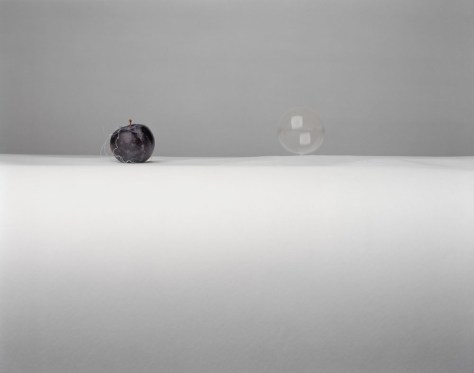
Sarah Lynch is a Scottish photographer who makes still life images by building up small sculptures, wire, fruit, pieces of paper and then photographing them and showing them at large scale. There is one that grabs my attention, a plum with some pieces of thread in a deep damson colour on a white surface with a bubble floating just above the same surface. It contrasts dark and light, solid and ethereal, permanent, and fleeting. Another shows a raspberry on a pile of torn white paper suspended by a string and wire. The images are delicate, appearing simple. Fragile but balanced. The fragments of colour stand out against a predominantly white and grey background.
In the interview in Photoparley (Boothroyd, 2012) she says her goal is to make ‘people stop and pause for a while’, to spend ‘a moment contemplating everyday objects as beautiful and fragile’ and to ‘put our small selves into perspective’. Not a bad goal to aspire to.
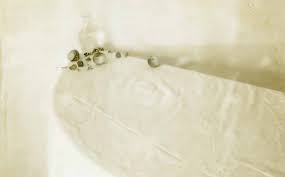
Laura Letinsky is a Canadian artist and photographer, who lives and works in Chicago. She is best known for her still life images, mainly using soft pastels colours. Initially she mainly used objects, fruit, china, tables, and napkins but more recently has added in photographs, magazine clippings and similar objects to her oeuvre. The pictures often show the end of things, the leftovers, the crumbs on the table. The images are surprisingly beautiful for all that they show the debris of life. In her interview with Brian Sholis (Sholis, 2013) (quoted in the OCA manual) she talks about her interest in still life as a genre that enables her to explore ‘the tension between the small and minute and larger social structures’. She describes how she uses images ‘already in the world’, including her own. She notes that ‘images are promiscuous……. they don’t care what we do with them’ and that ‘photography can help access the feelings that are intrinsic to being human’. In another interview she says, ‘Instead of inviting the viewer to partake in the traditional still life, I was interested in what remains. What gets left over, what you can’t get rid of, or what you try to hold onto’ and references Barthes’s comments about photography being always after the fact (Herrara, 2017).
In Ill Form and Void (Letinsky and Tillman, 2014) it is often difficult to be sure whether she has photographed real items, or pictures of real items or a mixture. The delicate colours of the images are set against white, cloths nd paper. Much is torn and broken. The colours are smudged. They talk about the small things, the left-over things, the left behind items. It is similar to the series Albeit – however in this case the colours are harsher and the use of torn pictures more obvious. One shows a bird on a branch with an ivory handed knife, the kind of knife I grew up with, and that are still in my mother’s drawers.
Time’s Assignation and Other Polaroids 1997 -2007 (Letinsky and Herschdorfer, 2017) is a series of Polaroids of still life’s. The surfaces are damaged, the colour is washed out. They are blotched and blurred. Some are barely visible. They are beautiful, show the small unimportant things in life. The images were made on Polaroid Type 55 film, now partly decomposed as part of her working process – but have become images in their own right, time worn.
I had only seen the occasional image by her previously but, having looked at it extensively I find myself wanting to acquire it, to hang it on my wall, to be able to stare at it when I am tired. To luxuriate in the colours. To bring back the past.
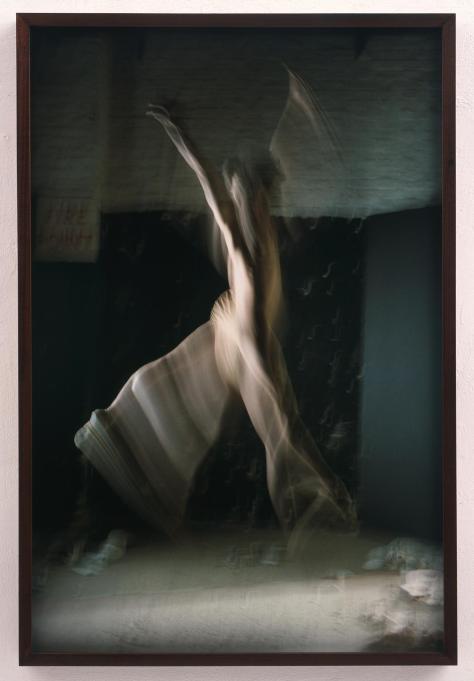
Sam Taylor-Wood (now Taylor-Johnson) works across photography and film both commercially and within the fine art world. She has directed Nowhere Boy (about John Lennon) and 50 Shades of Grey. Her website (Taylor-Johnson, s.d.) shows a mixture of short film clips and still images. All make use of time, time suspended or sped up. There is an arresting photograph of a dancer in mid leap, set against a languid looking female on a couch –After Van Halen. Another image shows a dancer – Speed – where a slow shutter speed has caught her clothes swirling around her and there is the well know Suspended Self Portrait series with her hanging upside down, seemingly in mid-air, no obvious supports.
She says in short video interview Brief Applause (Brief Applause: Artist Sam Taylor-Wood, 2008) ‘I have ideas and they wouldn’t go away…. they are very photographic, very strong. A lot of my photographs take a lot of organisation and set up. Suspended self portraits are images of me bound and hung from my studio …. there was a lot of pain and constriction …. Yet when you see them…. You sense more freedom than the constriction, …. (it is) frozen in time’.
Still Life (Still Life, 2001) is a short film of fruit in a bowl that shows the fruit decaying over time. It is set to music by Keith Kenniff in a piece called Preservation Devine. In 4 minutes, it shows a bowl of apples, pears and cherries gradually disintegrating. They first shimmer, become surrounded by a blue glow of fungal spores and then collapse. All to the accompaniment of soothing piano music. It is surprising beautiful and relaxing to watch. In another piece A Little Death (A Little Death, 2002) she shows the gradual collapse of a dead hare via the life of insects into the remains of bone and skin. All the while a peach sits alongside, remaining seemingly whole. This time it is set to a short piece of chamber music by Royksopp. This is equally mesmerising although more horrific – I suspect because of the awareness that this was once a living animal.
Both of these pieces are related to the painters frequently chosen objects for still life, fruit, game, death and decay, carefully posed and translated into film. In an interview with Wendt (Wendt, 2019) Taylor-Wood says ‘A still life is still a still life, even in the transformation from painting to film. I am interested in ideas connected to mortality and the passage of time, as were the Dutch master painters’ . The films make use of time passing and alteration in states of being to tell a very carefully composed story. They talk about life and death, now and then, time and standing still. The whole world in a compressed space.
Karen Bullock is a young documentary photographer from Alabama, USA. She has produced a body of work called Presence Obscured (George, 2020) which explores the changing nature of Christianity and faith in the south of America, and her own experiences within that setting. She says ‘Through these photographs, I share what I perceive as an ethereal sense of presence alongside themes of longing and loss. They are an open-ended offering to the viewer to ponder experiences of faith which sometimes arise in our lives, especially in the midst of trauma or crises such as the world is enduring now.’ Bullock made the images to after a severe personal difficulty and found that they helped her to cope.
The images show buildings, old churches (inside and out), abandoned statues, and religious icons. There are no people, just the traces left behind. It asks is faith still active, or has it long gone? Where is it now in people’s lives? The colours are vibrant even though the subject is occasionally sad. The lack of people is poignant. It asks another question – if she went back tomorrow would there be someone there – or not?
Bullock’s use of absence lends strength to the work. It talks about the forgotten things, the things that may, or may not, have lost importance. People would dilute the message. It tells me about a life that is strange to me – I live in the cold and austere north. The colours are different. The story is similar.
Elliott Wilcox is primarily a fashion and sports person portrait photographer, working for some of the big names, Converse, Nike, Urban Outfitters. In his website (Elliott Wilcox, s.d.) the first thing you see is people, people standing, people jumping, people in your face. Saturated colours. Moody glances. However, as you work down the page, past all the glitter and the glamour, you come across three very different pieces of work. More personal, although absent of people.
Courts is a series of images of sports courts. They are hyper saturated with colour, while remaining quiet and reflective. The walls show multiple marks were the ball (and bodies) have hit. The energy of the players has been transmuted into these tiny marks.
Walls shows climbing walls, or rather the close-up details that you would probably only usually see if you were close up and personal with them, hanging on. If you saw one of the images out of context mots people would not know what they were. They are abstract patterns, areas of light and shade. But with the minimal context given by the title they make sense. I can imagine (with terror) balancing on a point, clinging to the surface. The sheer strength required to do so.
There is a third piece Inhalers where he pictures the inhalers used to treat asthma, enlarged and isolated against a blue background, seemingly hanging in mid air. They show traces of life in the dirt and lipstick. They are lifesavers to many people.
The contrast between this work and his commercial work is startling. They use the same techniques, large format, highly coloured images. They tell about the person in their sheer absence of people.
Richard Wentworth was originally a sculptor who used the everyday world as his model and his photography uses the same source. He looks at the objects found in the environment – often incongruous- and makes them into a piece of work that describes the place and time.
In an interview with Ben Eastham (Eastham, 2011) he talks about observational intelligence. ‘that’s something of what an image is – it has to have a component which is unaccountable, which sweeps over you.’ He thinks (I think) that we are made up of instinct and curiosity – which sometimes work against each other. That we recognise the spatial environment and respond to it unconsciously, use things as we need them. That words (and their origins) are important. That things happen to him.
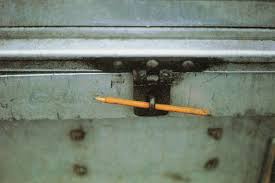
The work Making Do and Getting By (Wentworth, 2015) documents small found sculptures where an item has been used beyond its intended purpose (a boot as a door wedge), something that has been mended with a purely functional method (twine or gaffer tape to fix an open gate), a pencil to secure a lock. The images tell a story, not so much individually, but en masse, a story of the practicalities of everyday living. A story about the people who make and mend. A story of what you do to fix the small inconveniences. A quick walk around my local neighbour can produce similar images. As can my house. Flowers from the roadside in a plastic water bottle. The difference is that he sees them and records them.
William Eggleston is said to have interpreted his surroundings by the objects they contained rather than by the people. His pictures are often thought of as being devoid of people – however a look at the website of his foundation shows that this is far from true. See: http://egglestonartfoundation.org/
His images are brightly coloured and are often about the small details. On the front page there are images of a car (and its advertisement), a deserted shop (possibly a diner), 3 light fittings (on varyingly coloured backgrounds), landscapes (including a beautiful image of either coloured leaves or blossom), road signs, a glass on an aeroplane table, stuff on (probably a kitchen) table , dolls, a bowl of fruit, as well as six pictures focusing on people and another car. This covers most of the possible subjects of photography. The difference is that he thought to take these varied images in colour at a time when the norm was black and white and mainly either street images or formal photography, carefully considered and correctly viewed. I am not suggesting that Eggleston did not carefully consider each of his images – just that his eye for what made an image was different. His images use the items to tell about the place. The image of the glass on the aeroplane table immediately makes me think of holidays, travel, excitement, and also fear – but it is a very simple image utilising the light coming in the window. Eggleston is said to have ‘legitimised’ the use of colour in art photography when, up to that point, it had mainly been used in commercial work. He used a dye-transfer printing process that gave vivid colour and makes things look hyper realistic. His images are often of the ‘ordinary world’, things left on the pavement, broken items, street signs. His composition includes skewed lines, odd perspectives, and unlikely items.
In the introductory essay to William Eggleston’s Guide (Eggleston and Szarkowski, 2014) by John Szarkowski which was initially published in 1976, Szarkowski is dismissive of the use of colour in most photography, for instance comparing it to paintings ‘ it is their unhappy fate to remind ups of something similar but better’ (p.9) and ‘Most color photography, in short, has been either formless or pretty’. But he goes on to say that the best of modern colour photography ‘derives its vigour’ from taking images of ‘commonplace objects’, the things found in life, the people and the ordinary places, ‘visual analogues for the quality of one life. This certainly describes Eggleston’s work. The book instantly takes you back, to mid last century America, neither rich or particularly poor. The life of the ordinary person. He does not make fun of it, it is a simple statement – this it what it is. The bikes and the cars, the barbecue, the rubbish in the streets. This is the way at it was.
Eggleston’s lifestyle was eccentric, he was rich, southern and did not need to work. He plays the piano, draws, paints and almost incidentally takes photographs. There is a fascinating extended interview answered life story by Sean O’Hagan (O’Hagan, 2017) which describes how people were originally offended by his work both because of the colour and the subject matter. The ordinary world. The world most people inhabit.
References:
Eggleston, W. and Szarkowski, J. (2014) William Eggleston’s guide. (2nd ed.,) New York: Museum of Modern Art.
Zoe, Caroline, Debra, Julia, Ben and Michael, apologies from Mark.
We started by welcoming Michael who is based in Cambridge and has just sent in A4 and plans to go for assessment in November.
There was some discussion about tutors and their role. We would all like more input, although we are aware that they are only paid for specific work around doing a report on the assignments. Everybody prefers face to face (well, on-line) reports rather than just a written feedback as it allows a fuller discussion about the pluses and minuses of the work together with what can be improved (and possibly how). We noted the very useful zooms from Andrea Norrington (links available on IAP Padlet and next one on 15th July) and also the library webinars (also see IAP Padlet). We all also found the recent zooms from Anna Fox and Susan Bright inspiring. I reminded people about the Scottish Group – we are having a zoom meeting on 07/07 at 1900 as we have missed our usual meeting due to lockdown.
Reports:
Zoe – just sent in A4. Work on family memories using archive photos. Caroline and Julia were both positive about it although somewhat conflicting views – Caroline liked the chronological theme, Julia wondered if it would be better random! This led onto a long discussion about family work generally, and the making of family trees. We discussed that many of us have boxes of family photo in attics or garages, what will happen to all the memory photos when they are all taken digitally and not printed? Will they just disappear? Should we make summary photo albums for our descendants?
Caroline – just sent in A5 (!). Fascinating work on memories and the loss of a previous home (Dubai). She noted that she had wanted the work to be more about the emotions of the place rather than specific images. I (Zoe) found the research fascinating especially the photographers she used and will go back to them in more detail. The video was a new move for me – worth investigating further. She had also made a 3D Art Gallery to show all her work. This gave a great overview of the course – but some of the posted videos were glitchy.
Ben – has mainly been working on his CN assessment. He found the digital assessment worked well for him although he did have to go back over his blog posts and rewrite some for the learning outcomes. He told us about the assessment
Work related to the learning outcomes with 2 pieces of work to demonstrate each, these can include things that did not go so well and how you improved them.
6 – 12 creative pieces
Tutor reports
An artist’s statement
This is a significant change in that we are responsible for making the decisions about what we think is good! And also working out whether or not we have met the learning aims and how to demonstrate that.
Ben – sent in A1 – which is his work based on the photos he took at the Glasgow City Mission. Do note, taking pictures of strangers is Ben’s job – so unlike the rest of us he did not struggle with that. We discussed a number of strategies we had used
Bribing with cake
A dog making the initial choice of person
Using Facebook groups to link with local people
Putting notes through doors
Debra – has now submitted A1 and got immediate feedback. She used the Facebook page for her contacts and took people on their doorstep using a standard set up of lens and tripod. She found talking to the people she met the most interesting thing. She is planning to continue the Covid 19 theme throughout her IAP work. Of note, it may change as lockdown eases/lifts – but these will still be a before/during/after theme available.
Michael – submitted A4 (canals and newspaper headlines). It expressed what he feels about the present situation with Brexit. Is now working of A5. Thinking about doing work related to his family and words they use to describe themselves
Julia submitted A4 and working on A5. She lives in North Norfolk where her husband has strong roots. She has been listening to a poet she knows (Kevin Crossley Holland) and is thinking about a mixed media presentation, including photographs (possibly overpainted with watercolours) and some video work. She noted that she herself is rootless – due to her family history of refugees. That took us back around to the idea of roots and family and a photographic response to that.
Most of this group are nearly at the point where we will need to choose our Level 2 modules and we are all conflicted
Julia – possibly moving image and landscape
Caroline – possibly landscape and self and other – but interested in all
Zoe possibly self and other and documentary or DIC
Michael – documentary and landscape
Ben – movie and documentary
We all agreed that it would be useful to have more info on all the courses so thought we would set up a specific zoom meeting to discuss them further and hopefully invite people ho were further along to talk about the pros and cons. We came up with some possible names and Caroline will try to arrange.
I don’t seem to have done a reflection at all this month. I have been struggling to work or concentrate still.
Reading and watching:
Finished reading Michael Freeman – The Photographer’s Eye –a useful reminder of what I covered when I initially did TAOP several years ago
Memories – AS Byatt – lots of essays on memory – useful general reading especially in context of IAP
Watched the Susan Bright lecture and the following zoom – very interesting – separate post on that
Aaron Schumann –Slant – again a post done
Watched Anna Fox zoom and wrote up
Read Batchen Forget Me Not very relevant for the work I am doing for A4
Read Paul Strand New England and posted
Watched a talk by Margaret Mitchell done by Street Level – wrote up and posted
Thinking and doing:
Attended study visit for London’s Hottest postcode – written up
Finished MoMA Coursera on Modern Art – very useful as background knowledge, mainly painting based but did discuss some photography such as Migrant Mother , gave me some useful ideas about emu of text
Redid A3 following tutor report
Transcribed tapes by my mother for my work on Exercise 4.5
Zoom meeting with IAP group. These are very useful . Posted full report to IAP Padlet
Photography:
Made up video of Mother’s word and images for Exercise 4.5
Printed images and made up album as above
Sorted out images for use in A4
Printed out
Randomised words
Made a series of images of ‘still life ‘setups – this took ages as had to keep redoing, steep learning curve here.
Time in New England (Strand and Newhall, 1980) is a book by Paul Strand and Nancy Newhall that came out of an exhibition of Strand’s work in MoMA in New York in1945. The book consists of pictures taken by Strand set against the history of New England in a series of pieces of writing chosen by Newhall. It tells the story of New England from 1630 to 1945. The writing contains diary excerpts, fiction, poetry and history. It demonstrates the changes in attitudes towards people, nature and race over the years. Some of the writing is horrific, at least to the modern ear, some is gentle, and some is funny. I particularly liked the information about ‘bundling’ (the process of getting to know someone during courtship by sleeping (mostly) clothes in bed with your incipient partner (p.87), the Diary of the Learned Blacksmith – who reads Arabic, German and Garlic in between shoeing horses (p.121), the poem By the Morning Boat by Sarah Orne Jewitt (p.218) and the almost final piece by W.E.Burghardt du Bois which I will quote as it is particularly pertinent today.
I dream of a world of infinite and invaluable variety; in human variety in height and weight, colour and skin, hair and nose and lip. And far above and beyond this in the realm of true freedom: in thought and dream, fantasy and imagination: in gift, aptitude and genius – all possible manner of difference, topped with freedom of soul to do and be, and freedom of thought to give to a world and build with it, all wealth of inborn individuality. Each effort to stop this freedom is a blow at democracy – that real democracy which is reservoir and opportunity and fight against which is murdering civilisation. There can be no perfect democracy curtailed by colour, race or poverty.But with all, we accomplish all, even Peace (p.248).
The images are all black and white, beautifully composed straight photography. They are interposed between the passages of writing, some link in clearly, such as the nautical images (masts, the sea) with the sea stories (passages from Moby Dick and a disastrous story of a shipwreck). Others have less obvious links. They show the countryside, close-ups of tree bark, houses, churches, and the occasional person. There are leaves and gravestones, local woodcarving (a duck), doors and windows. My favourite (today) is a very calming image of the sky over a small sliver of sea (p. 231).
Stieglitz’s famous description of Strand’s photography “brutally direct. Devoid of all flim-flam; devoid of trickery and of any ‘ism’” still stands today. His images look like what they are. A window is a window, the glass looks like glass, the wood like wood. The images are clear and serene. Calm and quiet. They bare repeated looking, or rather demand it, even so many years after his death and all the changes in style that have come since.
The book is an exemplary example of the use of both words and text to tell a story. The images are not directly illustrative. The words are not simply descriptive. The two together are synergistic – greater than the sum of the parts.
Reference:
Strand, P. and Newhall, N. W. (1980) Time in New England. Millerton, N.Y.: [New York]: Aperture; distributed by Harper & Row.






 Identity and Place