Category Archives: Learning Log

Clare Strand

Clare Strand (born1973) is a British photographer. In her website she describes her practice as “rolling in the grass and seeing what you pick up on your jumper”. And says she ‘brings together intensive research, deadpan humour and insights into culture’ (Strand, 2015). Sean O’Hagan says, when talking about her exhibition The Happenstance Generator ‘There is always something odd – in a good way – about Strand’s work. That oddity rests in the tension between her often personal, always playful take on conceptualism and her wilfully old-fashioned methods – the archive images, black-and-white tones and kinetic machines here are a case in point’ (O’Hagan, 2015). In her latest work The Discrete Channel with Noise she looks at how the act of communication can lead to misinterpretation, starting with the issue that as information is transmitted digitally it is split into multiple minute pieces and these can be altered into process of reformation to a whole. This piece of work has just been shortlisted for the 2010 Deutsche Börse Photography prize. In an interview with Chris Mullen, Strand says, ‘all my work is about the nature of the medium of photography, its uses and its limitations’ and ‘the question is always ‘how much to give away to the viewer?’ it is possible to explain the image away and allow the viewers no space for their own interpretation…..there are issues throughout my work I want to leave unsolved ’ (Drew et.al., 2009).

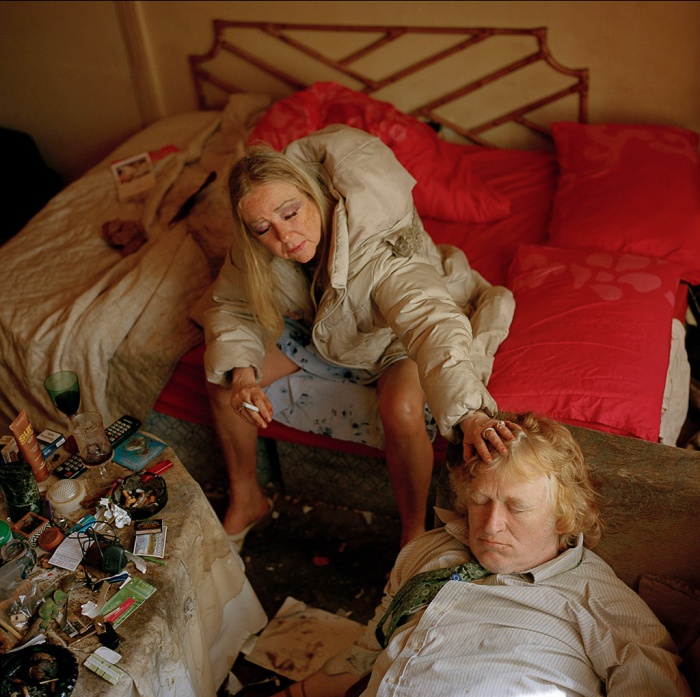
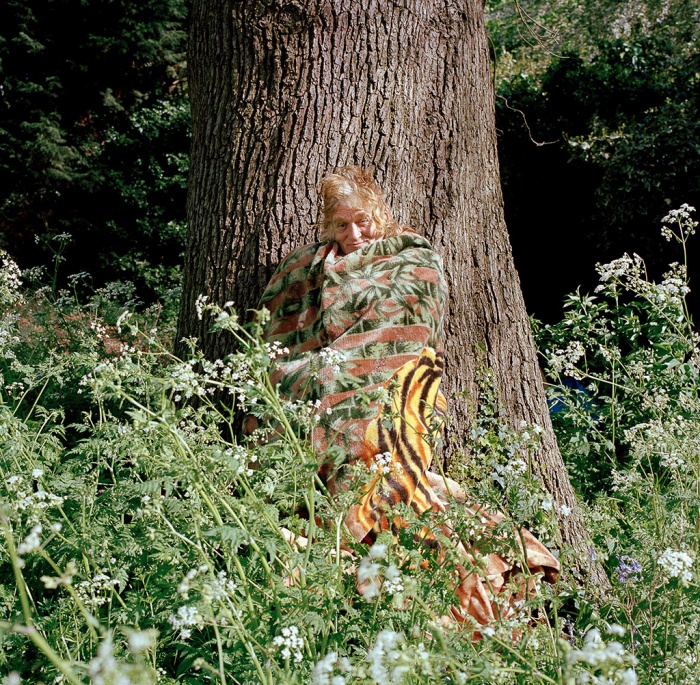
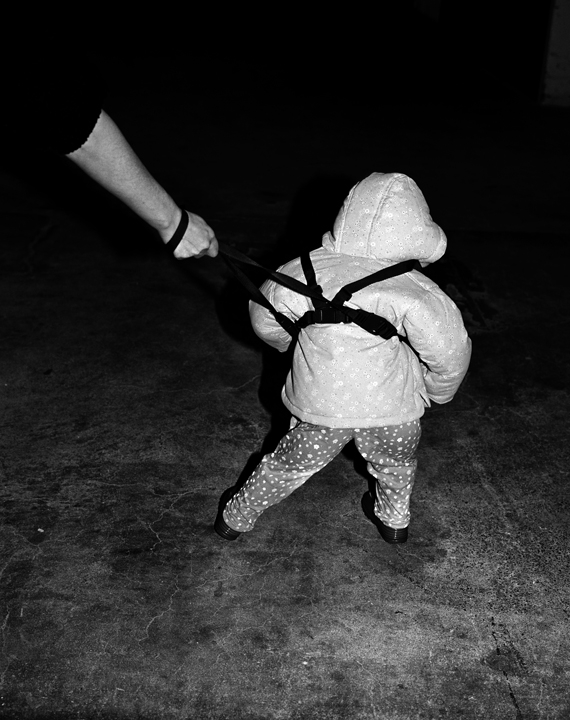
In one of her much earlier pieces of work Gone Astray Portraits she uses a 19th century convention of using painted backdrops to photograph someone against. She took a series of portraits of people, all of whom show a degree of distress or damage. The title comes from a story by Charles dickens which tells of a child lost in London and the anxiety that provokes. The background shows an apparently idyllic scene while the people are AK troubled. They look away from you, either sideways on, on with a failure of eye contact. They seem disinterested, both in the photographer and in their own problems. Chandler says ‘the ambiguities and cul-de-sacs in Strand’s work, qualities that leave the viewer on a continually slippery surface. Her art is in many ways an intensely private world, her projects are a way of resolving obsessions, of processing thoughts that simmer and won’t go away, many of them arising from the most ordinary of encounters and the most routine situations. Like the best photographers, Strand is a great and meticulous observer of details, and yet her work is rarely about that: the details are simply the things that lead her on, to enquire and to investigate, the work itself is then positioned at a point where her, often conflicting, evidence collides (Chandler, 2015). In this work there is the collision of the old with the new, the Acadian with the downtrodden, the photographer’s gaze with the lack of gaze of the subjects. There is said (in the OCA manual) to be a constructed backstory to go with each of these images, but I could not find them. In reality I wonder whether it is better to apply one’s own imagination to each of the somewhat surreal images and invent one’s own story.  Gone Astray Portraits was accompanied by Gone Astray Details in which she shows a series of images of details of happenings in the city, a child pulling on its reins, the legs of a woman, someone holding a dog’s tail. Looking at the two sets of images together which tells more about the city? Which is less staged – the people against the backdrop or the apparently real snapshots? Gone Astray Details is accompanied by a series of ‘short stories’. Small snippets, just a few lines long. An example is ‘1. On the corner of Bowling Green Lane, a Middle Ages woman suddenly fell to her knees on the pavement. There was no apparent cause. In the previous six months over twenty women have fallen at this spot.’ In my book Clare Strand (Drew et. al., 2009) the words run along under the full-page images or along the bottom of occasional blank page. The is no obvious connection between the words and the images shown. There is, in fact, an image of someone crawling on their knees but it is not placed above this particular story. Are they linked? Are they too beread as entirely separate meanings? The reader/viewer is thrown into confusion. She has, as she wants to, left an open question, an unsolved mystery.
References:

Chandler, D. (2015). Vanity Fair r. [online] Clare Strand. Available at: https://clarestrand.tumblr.com/post/142841300931/vanity-fair-text-by-david-chandler [Accessed 31 Oct. 2019].

Drew, R., Chandler, D., Eskildsen, U., Jeffrey, I., Mullen, C. and Strand, C. (2009). Clare Strand : a Photoworks Monograph. Brighton: Photoworks ; Göttingen, Germany.

O’Hagan, S. (2015). Things fall apart: the photographer who destroys her work for fun. [online] the Guardian. Available at: https://www.theguardian.com/artanddesign/2015/apr/30/clare-strand-photographer-getting-better-and-worse-at-the-same-time [Accessed 31 Oct. 2019].

Strand, C. (2015). Clare Strand ~ Photographer ~ about. [online] Clarestrand.co.uk. Available at: https://www.clarestrand.co.uk/about/ [Accessed 31 Oct. 2019].


Irving Penn

© Estate of Irving Penn – from Worlds in a Small Room

Irving Penn (1917-2009) is an American photographer who is probably best known for his fashion images, often taken for Vogue magazine together with portraits of the rich and famous of that world. However, he also took the opportunity to photograph other people while travelling. Penn set up a simple outdoor studio, using a grey or whole cloth and only natural light. He then invited people to pose against it, using no props. He describes it as “The [portable tent] studio became for us both a sort of neutral area. It was not their home, since I had brought this alien enclosure into their lives. It was not my home since I had obviously come from elsewhere far away. But in this limbo was in us both the possibility of contact that was a revelation to me and often I could tell a moving experience for the subjects themselves.” (McLaughlin, 2013).  Initially Penn worked by locating studios and hiring them and asking people to come and have their photos taken. He then moved on to developing his own portable studio which could be set up outside. The images he took have a timeless quality as he used a very simple background cloth. When talking about the series of images taken of the Cusco people,  Kozloff describes it as ‘It is as if his subjects had stepped, not onto the stage to which theory were accustomed, but onto one of his imagining, a bare environment intended to set off their picturesque shabbiness to graphic effect’ (Kozloff, 2007). The images are studied, there is no apparent feeling for the individuals involved, just the costumes and masks the people wear. He went on to take other series of images such as those of the people from New Guinea and even groups of Hell’s Angels. His pictures of the celebrities, while more individual, show use of similar techniques of use of a simple backdrop and harsh light and shadow such as that of Woman with a Handkerchief (Jean Patchett) a Vogue cover from 1950. His images of the various native populations have often been described as exploitative as he used them as ‘fashion pictures’ rather than serious studies of the ethnography of the regions. However, he said about them ‘the people I photographed were not primitive. The primitive people are in New York’ (Goldberg, 1991).

© Estate of Irving Penn – Woman with a Handkerchief (Jean Patchett) New York

Penn was an eclectic photographer. As well as his portrait work, both personal and for fashion magazines,  he took pictures of flowers where he said he was ‘drawn to flowers considerably after they’ve passed their point of perfection’ (Smart and Jones, 2019) , cigarette butts and things found underfoot (a series of marks on the pavements). Penn was also famous for his printing, often utilising platinum/palladium techniques to give a soft but intensely detailed finish.

Whatever you think of the ethics of his photography there is no doubt that he produced an astounding and varied body of work. Penn’s vision for his project that is shown in Worlds in a Small Room was ‘These remarkable strangers would come to me and place themselves in front of my camera, and in this clear north sky light I would make records of their physical presence. The pictures would survive us both and at least to that extent something of their already dissolving cultures would be preserved forever.’ (McLaughlin, 2013). This has come to pass and is a remarkable epitaph to a man who worked at his passion almost until he died.

References:

Goldberg, V. (1991). ART; Irving Penn Is Difficult. “Can’t You Tell?” The New York Times. [online] 24 Nov. Available at: https://www.nytimes.com/1991/11/24/arts/art-irving-penn-is-difficult-can-t-you-tell.html [Accessed 30 Oct. 2019].

Kozloff, M. (2007). The Theatre of the face : Portrait Photography Since 1900. London: Phaidon.

McLaughlin, T. (2013). Worlds in a Small Room. [online] Image on Paper. Available at: https://imageonpaper.com/2013/07/21/review-worlds-in-a-small-room/ [Accessed 29 Oct. 2019].

Smart, A. and Jones, R. (2019). How Irving Penn ‘changed the way people saw the world.’ [online] Christies.com. Available at: https://www.christies.com/features/Guide-to-Irving-Penn-9751-1.aspx [Accessed 30 Oct. 2019].


Regular Reflections October 2

Week ending 25/10/19

Reading:

  • Mary Ellen Mack – on the Portrait and the Moment
    • Interesting workshop on her thoughts about what makes a portrait work, heavy on the images, light on words – but very informative
  • Sian Davey – Looking for Alice
    • Reread – one of the books I am collecting that show images of people with disabilities and how that impacts on their or their families/friends lives

Online:

https://www.artsy.net/article/artsy-editorial-artists-share-advice-preventing-burnout?utm_content=st-V-picks&utm_medium=email&utm_source=18238497-nl-ntf&utm_campaign=ntf&fbclid=IwAR1X_aSKpHMhlioIhTk7txw44V0Lmjs1Bg6fhQUBsUvEGXS9JNsk9QUryC8

  • about burnout and how to avoid

https://www.bjp-online.com/2019/10/portrait-of-humanity-defying-the-myth/?utm_campaign=Portrait%20of%20Humanity%202019&utm_source=hs_email&utm_medium=email&utm_content=78427269&_hsenc=p2ANqtz-8k8Kv2S–hXLmSINoLm4hMAqgkb93VIc–U9X4fHG3In6WfJBbdDxRYG4znQiq4MXlFEaUwk_N11sdWkiBs7HJtZm9OB-hVgM3vFT1lkZn-c6el0s&_hsmi=78427269

  • an article about people with disabilities

Photography:

  • Initial work up on images of 3 people with some trial runs looking for good viewpoints around our local abbey
  • Taking images of 3 people – at the abbey, unfortunately limited by very poor light conditions so very dark inside the abbey, not practical to use a flash even if I had a set up
  • Some general images of the abbey to show historical background
  • Phone photography of the area and the lovely autumn colour (+ some heavy rain)
  • Started working on a long-term project of taking random images of unusual rubbish on the streets – this is for personal interest and as a play project!

Work done:

  • Finished initial write up on the aware and summary piece

Thinking:

  • Still lacking in mojo so decided just to take pictures rather than thinking about it!
  • Considering how to start working on long-term plan on showing mental health and its effects on the families


Daniel Meadows

Daniel Meadows is a British photographer, a contemporary and friend of Martin Parr, who taught and worked in collaboration with him. He describes himself on his website as ‘I am a Documentarist, I have spent a lifetime recording British society, challenging the status quo by working in a collaborative way to capture extraordinary aspects of ordinary life, principally through photography but also with audio recordings and short movies’ (Meadows, 2019) and says his story is about the England he comes from. An archive of all his work to March 2018 is held in the Boddleian Library in Oxford and has been used to study how UK photographers can make their work and studies publicly available.

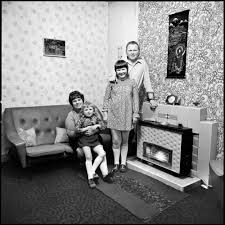
The June Street series was made in collaboration with Martin Parr in 1973, as series of pictures of the residents of houses in June Street, Salford, that were awaiting demolition. They took photographs of families in their sitting rooms, all looking at him, seated in similar positions. The project was taken up by the BBC and the verbal stories and comments of the people were added. A short Vimeo talk, Daniel Meadows – June Street by Meadows explains how he went back to see some of the residents of June Street in 1996 and how the photographs brought back memories of the past. He also talks about the comments of some bloggers on an exhibition in 2011 talking about how his photographs of June Street brought back personal memories of their own childhoods and says ‘ ..that something so rooted in a specific past can speak so powerfully in an ever-changing present and with such a range of meaning is, I think, magical’ (Meadows, 2014).

In the introduction to his recent book, Now and Then, England 1970-2015 Meadows says ‘My rule of thumb when doing documentary work is to try and treat people as individuals, not types’ (Meadows 2019). This is completely opposite to the rule of typology that Sander used and leads to a very different kind of image. He quotes Karl Ove Knausgaard who says ‘; Should our culture not …. establish difference, which is the stuff of all worth in which value resides and from which it is released’ (Knausgaard, 2018). The book starts from his very early work as a student when he set up a free photo-studio in a disused room in Graeme Street. Even these early images show the individual nature of the people he took, the cheekiness of the children and the serious adults. He moved on to travelling with a bus, still taking free pictures of anyone who wanted their picture taken, single people, pairs and groups – building up an early version of a portrait of England. He made contact with some of the people photographed in both these projects many years later and took their stories and re-photographed them – hence Now and Then. It makes fascinating reading. Among other things, in 1975 he was photographer-in -residence for the Borough of Pendle, where he took images of what was then the industrial heartland of England, the people, the machines and the scenery. All in black and white – colour was generally too expensive then. The photographs in Now and Then are accompanied by the stories of the people, not (definitely not) politically correct – but extremely funny. He has always made audio recordings to go with the images – to extend the story.

References:

Knausgaard, K.O. (2018). My Struggle. London: Harvill Secker, p.p.626.

Meadows, D. (2014). Photobus ~ Daniel Meadows. [online] Photobus.co.uk. Available at: http://www.photobus.co.uk/daniel-meadows [Accessed 17 Oct. 2019].

Meadows, D. (2019a). June Street, Salford by Daniel Meadows. My photography stories #4. [online] Vimeo. Available at: https://vimeo.com/110983025 [Accessed 17 Oct. 2019].

Meadows, D. (2019b). Now and Then: England 1970-2015. Oxford: Bodleian Library.


Regular Reflections October 1

Week ending 18/10/19

Further to discussion with another OCA student who commented that she was advised to do weekly summaries by her tutor I remembered that i used to do exactly that and found it helpful. So, I will try again.

Reading:

  • Theatre of the Face – Max Kozloff
    • Fascinating if hard going at times
  • The Autobiography of Miss Wish – Nina Bernard
    • Depressing – important tale to be told, a long-term history of a person struggling with life
  • Big Brother – Louis Quail
    • Rereading, love this book
  • Now and Then, England 197- 2015 – Daniel Meadows
    • Summary of life’s work with additional stories
  • Mother – Paul Graham
    • Loads of thoughts here, wish I had done similar, poignant images that show that focusing on the face is not always essential

On-line:

Photography:

  • Mass of archive boxes and photo albums
  • A cat in a box
  • Random things in the street
    • Should I have another go at a daily photograph? And see what I can see? Practice at looking.
  • Looking at and starting to sort archival photos from my husband’s family

Planning:

  • How to take images for Vice Versa
    • Possibility of using curtain as a backdrop
    • Can I use Sam and family? – against an animal background possibly?
  • Organising shoot of 3 people in same place – delayed for practical reasons, availability of subjects and weather

Thoughts:

  • I wish I hadn’t missed the opportunity of doing a similar project to Paul Grahams mother.
  • Wondering about taking pictures of slowly dismantling her house and belongings, sacks for the charity, rubbish, empty cupboards etc. Again, a partly missed chance as process already started and maybe too raw.
  • Struggling to get my mojo together at the present. Too many changes recently and too much time spent doing nothing.


Paul Graham

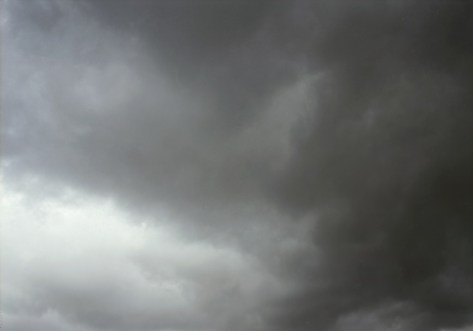
Paul Graham (born 1956) is a British photographer (although he has lived long term in America) who uses documentary photography to explore, not just what is happening, but why it happened and the associated emotions. One of his recent books a shimmer of possibility shows images taken on his travels around America. The book shows 12 visual stories of the small pieces of life that make up the America of the ordinary people that live there. In an interview he says  “it has steadily become less important to me that the photographs are about something in the most obvious way. I am interested in more elusive and nebulous subject matter. The photography I most respect pulls something out of the ether of nothingness… you can’t sum up the results in a single line. In a way, ‘a shimmer of possibility’ is really about these nothing moments in life.” (O’Hagan, 2011).  In another book, Cease Fire he shows images of the sky over Northern Ireland’s troubled areas such as the Shankill Road. What is he saying? And how do you interpret them?

Paul Graham 1
© Paul Graham – from Cease Fire

His most recent book Mother (Graham, 2019) is more personal. It shows a series of apparently simple images of his mother in her care home. The images are dark, the light only glancing of the edges of her cheekbones or her hair. Often her face is not in focus, rather the focus is on the edge of her blouse or the sinews in her neck. There is only one image where she is looking at him and that look (to me at least) reads ‘What are you up to now?” Many of the images show her sleeping. The images are large, shown in groups and interspersed with pink textured pages, which echo the pink that his mother frequently wears. The book is described as showing ‘mortality and the slow unravelling of late old age……the watched-over becomes the watcher’. It is a series of images that I wish I had taken of my mother; they are his tribute – but will stand in for mine.

Mother_Paul_Graham-61_aeb7f40c-0c73-444e-81ad-d434800398d8_1024x1024
© Paul Graham – Mother

References

Graham, P. (2019). Mother. S.L.: Mack.

O’Hagan, S. (2011). Paul Graham: “The photography I most respect pulls something out of the ether.” [online] the Guardian. Available at: https://www.theguardian.com/artanddesign/2011/apr/11/paul-graham-interview-whitechapel-ohagan [Accessed 18 Oct. 2019].

Louis Quail

Louis Quail is described as a documentary photographer, but that tends to imply a photographer who looks at something from the outside with an analytical voice. Some of his earlier projects such as Desk Job in which he explores office life across the continents, showing the similarities of how the workers in a large office exist and how there is a common culture of the office worker versus the big bosses can be described in this fashion.

However, his latest project Big Brother is deeply personal. It tells the story of his brother’s struggle with schizophrenia and the ongoing difficulties this causes. It shows the difficult side of having a severe mental illness, and how negotiating the pitfalls of state, welfare and hospital treatment is fraught with anxiety both for the person and his relatives – but it also tells an ongoing love story about Justin and his long time girlfriend Jackie. The book is both fascinating and terrifying. I was constantly torn between laughing and weeping while reading and seeing Justins story.  The book contains photographs taken over 7 years interspersed with text telling the story and drawings and pieces of writing by Justin. It includes a small booklet of paintings and poems by Justin which make it clear that however damaged Justin is by his schizophrenia he is also a very creative person. One of these poems begins:

Boxed in clever on a psychiatric ward

It’s no wonder I am bored.

The fatigue sets in

The eternal light won’t go off

Before its off.  (Quail and Quail, 2018).

© Justin Quail

Quail says on his website ‘This book did not set out to be a political polemic; rather, my intention was to fight stigma and share Justin’s story so we can understand, empathize and celebrate Justin’s individuality. However, inevitably by studying the problems affecting my brother, the work speaks of and draws attention to the crisis in mental health care, raising important questions about how we look after our most vulnerable citizens’ (Quail, 2019).

The book is worth a long look – for the story, the images and the increased understanding of a person’s difficult world. For this story the long-term engagement was essential to avoid a superficial glance and to give the meaning to the story. It would have been simple to just show the ‘bad bits’ but Quail succeeds in showing both these and the joy that even a difficult life can encompass.

References:

Quail, L. (2019). Big Brother – Introduction – Louis Quail Photography. [online] Louis Quail Photography. Available at: http://louisquail.com/big-brother-introduction/ [Accessed 17 Oct. 2019].

Quail, L. and Quail, J. (2018). Big brother. Stockport: Dewi Lewis Publishing.

Julian Germain

Julian Germain (born 1962) is a British photographer who often combines his own images with archival images to look at the effects of change in society. He works in Britain and abroad, especially Brazil, where he gave cameras to the street children and collected their images – showing the lives of marginalised people. In For every minute you are angry you lose sixty seconds of happiness, which was originally shown at the Baltic gallery, accompanied by a book (Germain and Snelling, 2005), he made a series of photographs taken over 8 years of an elderly gentleman called Charles Snelling which he then published along with pages from Snelling’s own photo album. Germain says ‘He showed me that the most important things in life cost nothing at all. He was my antidote to modern living’ (Germain, 2005). The images are a straightforward story telling that combines photographs of Snelling in his house, on the beach and out walking with images of items that he owns, such as an old kettle steaming on the hob. The work acts as an ‘extended portrait’ – a story of the later part of someone’s life where the photographer has engaged over considerable time – thus giving a richer view than a flying visit could give. This is an excellent example of the additional information time spent on a project gives you, and I find it fascinating.

Germain mostly works by producing books. He says ‘A book is such an excellent way to really look at a body of work over a long period of time. Of all the visual arts the book is suited to photography. Of course, much of my work is not about the single image, my pictures work on each other, placed as they are in sequences and a book is the perfect framework for that. A photo book is a work of art in its own right…’ (Skerrett and Germain, 2010).

References:

Germain, J. (2005). Julian Germain “For every minute you are angry you lose sixty seconds of happiness” project. [online] Juliangermain.com. Available at: http://www.juliangermain.com/projects/foreveryminute.php [Accessed 16 Oct. 2019].

Germain, J. and Snelling, C. (2005). For every minute you are angry you lose sixty seconds of happiness: portrait of an elderly gentleman. London: Mack.

Skerrett, P. and Germain, J. (2010). INTERVIEW: “In Conversation with Julian Germain” (2005) – AMERICAN SUBURB X. [online] Americansuburbx.com. Available at: https://americansuburbx.com/2010/09/interview-in-conversation-with-julian.html [Accessed 16 Oct. 2019].

Harry Callahan

Harry Callahan (1912 – 1999) was an American photographer based in Chicago. He taught at the Chicago Institute of Design and then at the Rhode Island School of Design. He took many street photographs with a heavy contrast of black and white. However, he also took images of his wife and daughter, often set in the distance against the city. This contrasted with other very simple images of trees against the sky, patterns in the sand. He also combined many images to make multiple exposure prints – although it is not clear whether this was done by multiple in-camera exposures or by overlaying prints. He shot thousands of pictures but produced very few finished prints. He was an experimental photographer, trying out a range of possibilities for the subjects he was interested in. He is reported as saying ‘I guess I’ve shot about 40,000 negatives and of these I have about 800 pictures I like” (Artnet.com, 2019). He also said, “The difference between the casual impression and the intensified image is about as great as that separating the average business letter from a poem. If you choose your subject selectively — intuitively — the camera can write poetry.” (Cassidy,2006).

Eleanor
© estate of Harry Callahan – Eleanor

References:

Artnet.com. (2019). Harry Callahan. [online] Available at: http://www.artnet.com/artists/harry-callahan/ [Accessed 16 Oct. 2019].

Cassidy, V.M. (2006). Harry Callahan: The Photographer at Work – Photographs by Harry Callahan | LensCulture. [online] LensCulture. Available at: https://www.lensculture.com/articles/harry-callahan-harry-callahan-the-photographer-at-work.

Project 1 – The unaware – 2

Tom Wood (born 1951) is an Irish photographer who spent much of his life in Merseyside, and who now lives in Wales. He was photographing in New Brighton at the same time as Martin Parr and Ken Grant, but the three photographers produced very different work. Wood is an obsessive photographer, never going anywhere without his camera and constantly taking pictures. He works in series, but the series are not separated by time, rather than by how and at what time of day he takes the images. He travelled widely by bus and took pictures on the bus. He also took images at the local shipyard, and, possibly most famously, the images in the Chelsea Reach nightclub – which became the book Looking for Love (Wood, 1989).  Wood returned week after week to the nightclub (and all the other areas he was interested in) and having taken pictures of the people there one week would offer them copies of the images the next week.  He was extremely well known in the area and became their ‘Photie Man’.

Wood photographed people close-up. He said in an interview with Sean O’Hagen “I’m not trying to document anything. It’s more about deciphering and transforming. I make what you might call real-life photographs” (O’Hagen, 2015).  Wood’s work is taken over years, usually with no specific plan in mind. He said “I take pictures all the time, if did a project, had a plan, it would be self-conscious. It’s very different to go out looking for something. All that stuff can get in the way, whereas if you take pictures all the time, it’s no big deal because that’s what you do all the time. And because I was always doing pictures, going to the same places year after year, I became part of the scenery. I was just the guy who takes pictures.” (Smith, 2018). Wood does not describe himself as a documentary photographer, even though most of his series tell stories about the place they are taken in. He works long term, over years rather than weeks and makes images that are enjoyed by the local people. His pictures do explore the place, and the time (both time of day and the era) but he was more interested in taking a good photograph than in documenting a specific event. The is an interesting detailed interview In Paper Journal that was done alongside an exhibition at The Bradford Media Museum (Manandhar and Karallis, 2013).

In Photie Man (Wood, 2005) – he said, ‘I’m interested in good photographs, and if they document something, so much the better’. This statement is very different from the one by Parr ‘I am a documentary photographer, and if I take a good photograph in the process, that’s a bonus’ (quoted in OCA manual, Identity and Place, p.46). The same words (or very nearly) but in a different order and with a completely different emphasis. A good picture – or an accurate document. What takes priority? It is fascinating that two people, working in the same place, at the same time can produce such different images. Wood’s images are kinder, more caring and less satirical than Parr’s. Even the images in Looking for Love, which show people often at their worst, drunk, tired and often being groped have a sense of good humour. He was there. He was close up, and he went back time after time, so the people knew him. He did not want to exploit the people and says he made very little money from his photography at that stage. Parr’s images are harder, they are often funny, the colours are harsher, and, of course, he makes a substantial living from it. Overall, I prefer Wood’s images, although I am very aware that I was familiar with Martin Parr’s work while only came across Tom Wood when researching for this topic.

My personal preferences aside, the two photographers have a different style of work and a very different way of thinking about what they are doing and why they are doing it. At this moment, and this might change over time, I feel I am more in tune with Wood’s way of thinking. My experience is that I am looking for a ‘good’ photograph, and hopefully that will also say what I am trying to say. What is ‘good’ is, in itself, an interesting concept. Does it mean sharp, correctly exposed and so on? Does it mean truthful (itself a slippery concept)? Does it mean something that people will like and respond to (and, if so – is it the proverbial ‘man on the street’ or a population of informer viewers) ? That will depend on your planned purpose for the image or series of images, what story you are trying to tell and who it is for.


Reference list

Manandhar, N. and Karallis, P. (2013). Interview: Tom Wood – Paper Journal. [online] Paper Journal. Available at: https://paper-journal.com/tom-wood/ [Accessed 1 Oct. 2019].

O’Hagan, S. (2015). Girls (and boys) just wanna have fun: smoke, sticky carpets and snogging in the 80s. [online] the Guardian. Available at: https://www.theguardian.com/artanddesign/2015/may/08/gareth-mcconnell-tom-wood-looking-for-love-80s-photos [Accessed 1 Oct. 2019].

Photography 1 – Identity and Place. (2015). Open College of the Arts.

Smyth, D. (2018). New Brighton Revisited by Martin Parr, Tom Wood, and Ken Grant. [online] British Journal of Photography. Available at: https://www.bjp-online.com/2018/07/new-brighton-revisited/ [Accessed 1 Oct. 2019].

Wood, T. (1989). Looking for Love. Manchester: Cornerhouse Publ.

Wood, T. (2005). Photie man. Göttingen: Steidl.