July Reflections

Reading and watching:

Still suffering from the problem that there is so much out there to watch at the moment that I get overwhelmed.

  • Watched Street Level talks with Graham McIndoe and Sakai Machache. Very different photographers but equally fascinating to hear talk about their work
  • Watched part of a TPG talk on surveillance in the digital age but got very confused (and my system kept cutting out) so gave up. It is something I am interested in though- so need to think about further
  • Read Justine Kurland – Girl Portraits
  • Continued to read Dorothea Lange autobiography
  • Looked at photographers for A5, Eggleston, Wentworth, Shore, Frank, brill, Lipper, etc (all written up in main posts.
  • Reread Charlotte Cotton – Photography as Contemporary Art – it made much more sense this time around (3rd go)
  • Read Perec’s book on Exhausting Paris – actually found fascinating
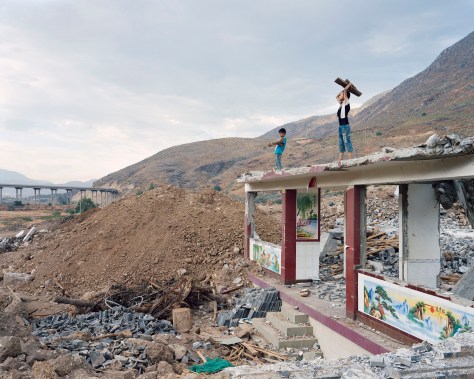
  • Looked at Obsessed by San Yunchu – really enjoyed this, A vision feeling about modern China and the people there
  • Looked at Lullaby for a Bride by Julia Borissova. A hand-made book/rat work (not bound but in a small folder) of images that tell the story of a Russian folk tale – minimalistic images interspersed with more archival looking ones
  • Continuing to read Siri Hustvedt essays on all things to do with arts and writing
  • Looked at Julia Crockett’s website o9n her grandmother – all archival work and fascinating reading
  • Reading a lot about travel photography – from early to right now. Change in ethos about the subject – new less straight documentary and more about feelings and emotions
  • Looked at Jonathan Levitt’s Echo Mask – loved it, telling about a place via emotive pictures and prose poetry.
  • Reading Diary of a Young Naturalist by Dara McNulty – not directly related to photography but his words are as good as pictures

Thinking and doing:

  • Attended IAP zoom – these are very useful – partly for support and partly as a way to float ideas that may or may not pan out
  • Started a Padlet for collecting learning outcomes for assessment
  • Attended zoom for crossover between IAP and level 2. Had several people who are doing/have done Level 2 talking about the different courses available. Useful information and lots of helpful advice that amounted to as long as you are prepared to put the work in they are all valuable, and can all work into your specific interests
  • Attended zoom for the OCA Scotland (or whatever it is) group
  • Had tutorial for A4 – went much better than I expected
  • Spent time working out how to show Polaroid type on the blog – you really miss out the feel of the actual piece in your hand
  • Started to think about A5. Planning to do a further archival series on my mother mixing words and images
    • Could be either a book /PDF or a video
    • Lots of research needed
  • Attended OCA zoom on Write where you are – very interesting, looking at ways of writing about things, on this case places, fits in well with the IAP work, writing differently

Photography:

  • Finished images for A4 and sent to tutor
  • Took pictures of eggs(!) for still life exercise
  • Pictures of dead flowers – also for still life
  • Images for Exhausting Cameron Street to go with the observation of the same
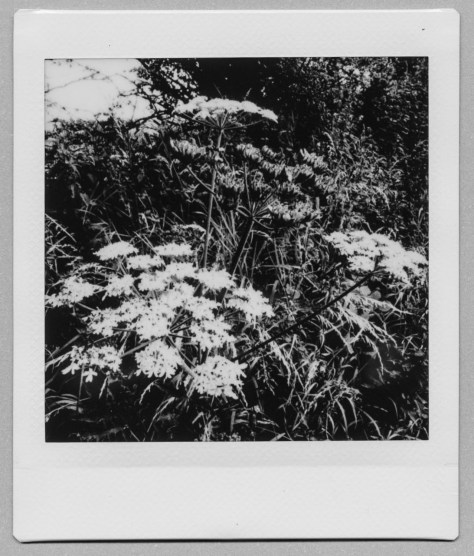
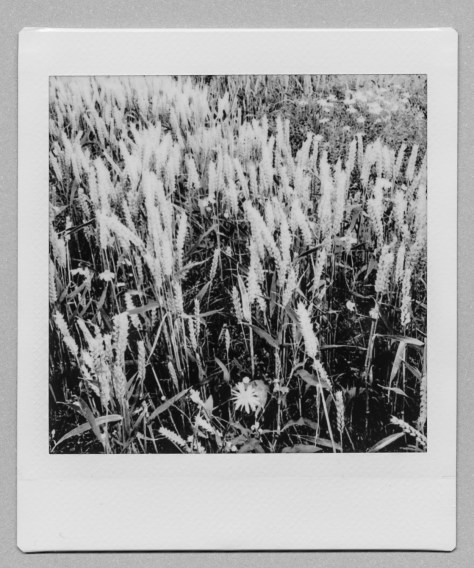
  • Polaroids type images of local journey- enjoyed doing this – point, shoot and pray – so very important to previsualise what you are trying to take .


Exercise 5.3

While we have been on lockdown there have only been a very limited number of walks I have been able to take. I have walked around my house. Lately I have walked down town to do some shopping. I have gone on some walks around our local park. The journey I have done most frequently and taken most pleasure in has been to walk to the end of our street, cross the road, and walk along the path though the fields. It makes a circle of about 2 miles. I have walked this on sunny days and under heavy, threatening clouds. From early spring to mid summer. I often carry a camera or my phone. I take random pictures but have not previously been organised about this.

I decided that I would try an experiment. I took my Instax Square and allowed myself 10 prints. A whole cartridge. I admit that I did take rather more images as it needed some experimenting. Previously I have only used the Instax for images of people and the lens is wide angle, very suitable for close ups of people – but you get rather more than expected on a distance shot. There is no focus control or choice of f-stop or shutter speed. Point, shoot and hope.

The idea came from the images of Paul Gaffney in Perigee  (Gaffney, 2017) who first went walking with his Polaroid to explore the area before going back under moonlight – but ended up using them as part of the project. I have also recently looked at the work of Laura Letinsky who also used a Polaroid camera for planning images, and then, when they were old and distorted (and somehow strangely beautiful) published them in Time’s Assignation and Other Polaroids (Letinsky and Herschdorfer, 2017).

 The Instax allows for either automatic printing, just as taken, and on the spot, which could work out very expensive, or for manual printing at a later date. If you chose manual printing you have the choice of several filters, one of which is monochrome. I decided to print a set of 10 monochrome images that took me on a walk around the circle, starting with the signpost and ending up with the telegraph post at the end of the path. En route I saw sky and clouds, barley and wheat, thistles (very Scottish) and Rosebay Willowherb, paths and trees. It was difficult to reduce the selection to 10.

For showing on here I am scanning the original prints. I could take the images from the SD card and put to  Lightroom and use from there but I would be tempted to fiddle, and it would loose the effect of the white surround that mimics the old Polaroids, which I like and wanted for this series. The scanned images show the idea of the series but they are not as crisp and do not have the sheer tactile pleasure of looking at the images in the original prints. It is interesting using only the 10 images that you get from one cassette, making the choice and no going back.

Images:

Scan_20200728 (5)Scan_20200728 (19)Scan_20200728 (16)Scan_20200728 (13)Scan_20200728 (12)Scan_20200728 (10)Scan_20200728 (3)Scan_20200728 (8)Scan_20200728 (18)Scan_20200728 (6)

I have just attended a zoom ‘Write where you are’ and used this path as a subject. This is what I wrote:

The path is at the end of my street. In winter it is bleak. The trees are bare, the fields are empty. The sky is heavy, but you can see for miles. Spring comes late here. Yellow flowers along the edges. The earth breaks into shoots. What has the farmer planted this year? Summer changes again. The path is surrounded by tall grasses, by cow parsley and rosebay willowherb. The colour has changed to white and pink. The fields grow barley and wheat. Barley for whisky, wheat for bread. The two essentials.  Last year it was oilseed rape, heavy yellow smells. Soon autumn comes. The fields will turn green to gold. The cycle turns. Sometimes there are poppies but not this year. I will walk again tomorrow and look for the deer, listen to the birds. Be free.

The words tell the other half of the story about theplace.

References:

Gaffney, P. (2017) Perigee. Ireland: Self-published.

Letinsky, L. and Herschdorfer, N. (2017) Time’s assignation. Santa Fe: Radius Books.

Reflection point – Journeys

Ihave been asked to reflect on what I would do if I had a chance (and the money and time) to do a journey on the scale discussed in Journeys – 1  and Journeys – 2.

The first question is where?

Then how?

Then (and most important) why?

When I am thinking about where I dither between exploring somewhere I already know and going somewhere completely new. I love travelling. I would like to travel to China or Japan. However, I am not sure I know enough about either culture to do more than a very superficial gloss over the possible images and the places. I would need a lot of time, and the opportunity to go back repeatedly.

I have had a long-standing interest in the fortifications that surround Scotland’s coast. I took images of some of them for TAOP. They range from early prehistoric ruins, though the middle age castles to the buildings that were put up to protect our coast from invasion in the 1st and 2nd world wars.  I would like to travel around the coast in a more coherent way and map these against the history.

The 3rd possibility is more personal. I would like to explore the journeys my mother took over her life, a modern take on what she might have seen. Starting in Germany to USA – Germany – England – Scotland.

The how depends on the where. The Scottish coast is relatively simple. A camper van would do it. And a lot of maps and research.  If I went to Japan, I would consider doing one of the pilgrimages around the temples. There are many possibilities. This would be on foot. To minimise the intrusion on the place and feelings the photography needs to be simple. One camera. One lens. One shot at each place.  Slow photography. Slow and concentrated. Similar to the walking journey undertaken by Paul Gaffney. My mother’s footsteps would be a major undertaking. Planes, trains and automobiles.

Why? Again, this depends on the where. Following my mother’s footsteps is very personal. She moved a lot. She followed her family. I cannot think of a single place she lived that she chose for her own wishes. This journey would be another attempt to understand her in death as I rarely did in life.

Japan would be personal for me. Something to use as a growing point. The Scottish coast is about the history of a place. This has been looked at many times. Could I add anything? Possibly not – but still worth considering.

Journeys – 2

In the mid-20th Century the mindset appears to have changed. There are still many photographers who travel and take the sort of images described in Journeys – 1.  But there are a group who travel for different reasons. Some travel just to look (and take photographs along the way). Some travel to tell stories about the places, not just the famous places and the rich people but the ordinary places, the ordinary lives, the little things.

Many of the American photographers have been motivated by a road trip. It became easier with the advent of cars and lighter weight equipment available from the early to mid-20th century. The start of this was probably the travelling done with the FSA by Lange and Evans among others. Evans turned his work into the show at MoMA and then the accompanying book American Photographs. (Evans, 2012) He then accompanied Robert Frank on his American trip to make the photo-book The Americans. This was first published in 1959. Jim Casper said, ‘This is the photo book that redefined what a photo book could be – personal, poetic, real’ and quoted Kerouac (who wrote the introduction) as saying ‘Robert Frank… he sucked a sad poem right out of America onto film’ (Casper, s.d.). Unfortunately, this is a book I have not seen in its entirety. The images I have seen are stunning. I particularly enjoy looking at Funeral – St Helena, South Carolina, 1955 which shows a group of black Americans standing by the cars. Are they participants? Or chauffeurs?

© Estate of Robert Frank

All the photographers mentioned so far worked in black and white. Stephen Shore chose to move into colour for his book Uncommon Places (Shore, 2014). In many ways it is similar to the work of William Eggleston. Shore also shows small, inconsequential places, untidy crossroads, cars and diners which add up to an image of America in the 70’s. The images that I have seen are objective. The light is clear. A single image is interesting but unclear as to purpose. Looking at a string of them, they build up to tell the story of a particular place – America and a particular time – 1970’s.

3 shore
© Stephen Shore

More recently Alec Soth has travelled the Mississippi and shows the people and places in the early 21st Century. He also utilises the ordinary things of life. Many of his images are vividly coloured. I find the one Fort Jefferson Memorial Cross, Wickliffe, KY, 2002 particularly amusing. It shows four workmen standing around by a decrepit car. One carries a chainsaw. Are they tidying up the surroundings? Or planning to cut the cross down? In today’s climate the latter is entirely possible. Another Bonnie, Port Gibson, MS, 2000 shows a proud lady, seated, showing off her picture of sky and trees in an elaborate gold frame. The type of frame I associate with a museum piece, possibly a portrait in jewel colours.

2000_04zl0010-f
© Alec Soth

It is not only the Americans who have chosen to use the metaphor of a journey to tell about a place. There are (at least) three books on the rivers in China.

Yan Wang Preston’s Mother River (Preston, 2018) tells the story of a journey along the Yangtze, from source to mouth about 6300 kilometres. She identified points every 100 kilometres along its length and went as nearly as possible to each of these points to photograph whatever she found. She made no attempt to take images at any famous way points unless they happened to fall on one of her predetermined markers. The series traces the social and geographic changes along the river. At one point she was bitten by a dog, at another refused access as (illegal) gold mining was taking place. As part of the project she did a series of performances though which she thought about the locality and the myth of a mother river. For example, she made a hand-drawn red circle, she carved stones and swam in the river. The images themselves vary from stunning landscapes, bleak and desolate, to snatches of dust laden roads. Where she could not reach the spot, she has included a blank page in the book. Sometimes she shows the people, playing pool, lounging in boats. She makes no attempt to prettify the scenes. It is what it is. You travel from the mountains, though plains and cities to the sea.

Y25-1 preston
Y25 – © Yan Wang Preston

The Yellow River has recently been photographed by Zhang Kechun, where he shows a series of images that contrast the massive countryside with (usually) tiny people. In his description of the series he says ‘Mountains and rivers are very significant for the Chinese people. In this country there is a cultural awareness that says mountains are “virtuous” and rivers are “moral” …..I decided to take a walk along the Yellow River in order to find the root of my soul (Kechun, s.d.).

zhang kechun
© Zhang Kechun

The Yangtze has also been photographed by Nadav Kandar who also chose to show humans as small against the vast surroundings. He is aware of the speed of change occurring in China, the beginning of a new era, the ‘smallness of the individual’ (Kandar, s.d.). He, like Kechun and Preston, has taken images of places that have been since changed beyond recognition by construction work.

Chongqing-XI-Chongqing-Municipality-2007
© Navad Kandar

These three works on China are talking about travelling, about change, about finding yourself against the backdrop of a vast land. They are almost the opposite of the American series discussed above. The immense versus the small, the country versus the individual. The impersonal versus the personal. Preston comes nearest to linking them with her images of the people she finds on the way, the bedrooms and eating places.

There are as many ways of photographing journeys as there are photographers who are willing to undertake them. These are a small snapshot, and mainly of   the epic journeys. The ones that take years, and multiple visits. Small and private journeys can be equally revealing of the place, the people, and the photographer. In Echo Mask (Levitt, 2019) Jonathan Levitt shows images, mostly black and white with a few colour, interspersed with blocks of text that read as prose poems. They were taken in the Maritime Northeast of Maine and Newfoundland.  Many of the images are blurry. They evoke a mood. A memory.  They tell a different type of story, but it is also a journey, this time in the mind.

563_img_3439 jonathan
© Jonathan Levitt

The work of Paul Gaffney in We Make the Path By Walking is also a slow meditation on time and space. He talks about the experience of moving slowly though the countryside, being in a ‘continuous dialogue’ with it.  His latest work Perigee was made at night, under moonlight having previously documented his travels by Polaroid. In an interview for ASX Gaffney talks about the difference between the western approach to landscape as a linear perspective rather than the Eastern approach of trying to get across the essence of the place (Shinkle, 2016).  His images are superficially simple. But the longer you look the more you see. This is something I would want to be able to do.

Paul-Gaffney_Perigee-Polaroids-4-web1
Paul Gaffney -Perigee – Polaroids – © Paul Gaffney

References:

Casper, J. (s.d.) The Americans – Photographs by Robert Frank. At: https://www.lensculture.com/articles/robert-frank-the-americans (Accessed 22/07/2020).

Evans, W. (2012) American photographs. (75th-anniversary ed ed.) New York, NY: Museum of Modern Art.

Kandar, N. (s.d.) Yangtze: The Long River. At: https://www.lensculture.com/articles/nadav-kander-yangtze-the-long-river (Accessed 24/07/2020).

Kechun, Z. K. | (s.d.) The Yellow River. At: https://www.lensculture.com/articles/zhang-kechun-the-yellow-river (Accessed 24/07/2020).

Levitt, J. (2019) Echo mask. Turkey: Charcoal Press.

Preston, Y. W. (2018) Mother River. Ostfildern: Hatje/Cantz.

Shinkle, E. (2016) An Interview with Paul Gaffney. At: https://americansuburbx.com/2016/04/an-interview-with-paul-gaffney.html (Accessed  25/07/2020).

Shore, S. (2014) Uncommon places: the complete works. (2nd revised edition) (s.l.): Thames and Hudson.


Journeys – 1

Victorian and early 20th Century travels.

Journeys and travelling have been associated with photography from its very early days, well before Jack Kerouac’s work On the Road was conceived. In the Victorian era it was common to take a Grand Tour, and not unusual for the tour to be accompanied by a photographer.

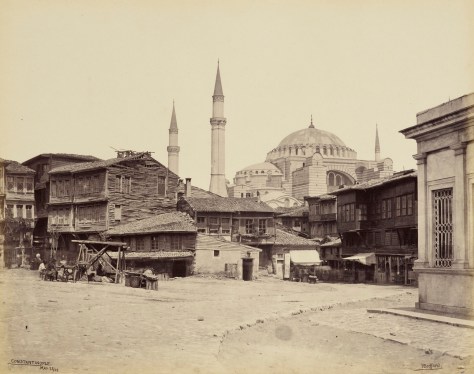
One of the most famous of the tours was that of Queen Victoria’s son, the future King Edward VII. He took a major journey around the Middle East and was a accompanied by the photographer Francis Bedford (1815-1984). A book of images from this tour has recently been published Cairo to Constantinople (Gordon et al., 2013) which shows many of the images accompanied by a travelogue and short excerpts from the Prince of Wales diary. One typical example shows the mosque Hagia Sophia alongside the comment, [the Prince thought Hagia Sophia] ‘the finestI have seen in the East. It was formerly a Xtian church’ (p.199). It is interspersed with maps showing the journey and gives a real feel for how the wealthy English found the Middle East in that era. Some of the pictures include people, although, unless famous they are rarely the focus of the image and may well have been included simply to show the massive scale of the monuments. On return to England the pictures were made into a portfolio produced by Day & Son and were also published more widely. This was definitely a commercial venture by Bedford, given extra kudos by the presence of the Prince.

Mosque of St Sophia - from the Hippodrome [Hagia Sophia, Constan
Mosque of St Sophia – from the Hippodrome [Hagia Sophia, Constantinople – Francis Bedford

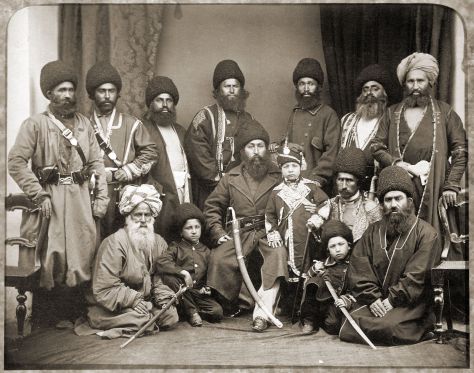
John Burke (1843 – 1900) traveled widely in Afghanistan where he took many images of the British forces during one of their earlier invasions of that land. Burke took pictures of the landscape, (devastated by war), some rather beautiful images of the countryside and portraits, both of the English soldiers and the local people. In From Kashmir to Kabul (Khan, 2002)  Khan shows many of the images but also points out the the attribution of many of the images is unclear as another photographer, William Baker, was his partner and they published (and sold) images jointly as Baker & Burke. The images have recently seen recreated in spirit by Simon Norfolk in Burke and Norfolk  (Burke and Norfolk, 2011) where he returned to Afghanistan in 2010 in a plan to respond to Burke’s Images. There is a fascinating interview between Norfolk and Paul Lowe which explains his aims in detail (Lowe, and Norfolk, s.d.).

John Burke
Group of the Amir Shere Ali Khan, Prince Abdoollah Jan and Sirdars

Francis Frith (1822-1895) also travelled widely abroad across the Middle East but his main focus was Great Britain. His plan was to take accurate records of as many of the towns in Great Britain as possible, and then sell them to people looking for souvenirs. Although he took many images himself, he also employed a team of people to both take some of the images and to sell them. His work was continued after his death by his family and has now been formed into the Francis Frith Archive (Francis Frith: Old Photos, Maps, Books and Gifts, s.d.).

JS70046035
Bridges in Newcastle – Francic Frith

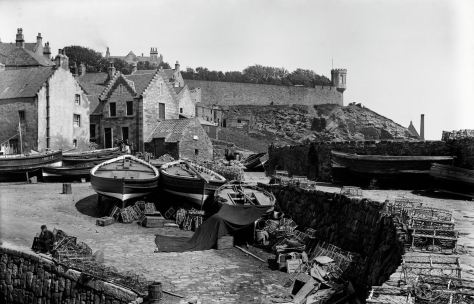
More locally to me, Erskine Beveridge (1851-1920) who was an industrialist and an amateur photographer/historian travelled widely in Scotland, documenting the building as and the people. It is surprising how little many of the places have changed over 100 years. He succeeded in his wanderings of building up a record of the places and both the important historical and domestic architecture. See Wanderings with A Camera in Scotland (Beveridge and Ferguson, 2009) for a record of his images.

Crail Harbour, Fife – Erskine Beveridge

Although all these early photographers travelled widely and took many photographs, it seems likely that for many of them this was their business. It is difficult to know now how much they were inspired by the love of exploring rather than the needs of the business. One exception to this may have been John Thomson (1837 – 1921) who travelled in China and was fascinated by the place and the culture, taking images of both scenery and the people.

John Thomson
John Thomson

Travel in this period was difficult, expensive and the cameras were all large, heavy, and cumbersome. They all initially used wet collodion plates, which needed to be developed immediately, and even when that technology moved on, glass plates were fragile, and many were broken in transit. In reality, it is surprising that we have as wide an archive of the early photographers travels as we do.

Unlike later photographers these images are about the specific place. They are rarely loaded with emotion. They tell a story, but it is limited. It says, “I went there”, “I did that”, “I met those people (usually the well-off)”. They showed the strange and different, the things that would excite the people who had never travelled. The images that would sell. And the images that would make their names by being included in important research publications such as those of The Royal Geographical Society.  The Victorians and early 20th century population had just started to travel en masse. It was no longer kept to the very rich. They wanted to see where they might go. They wanted souvenirs. They liked the picturesque. Catering to this need was the reason many of these images were made. Nowadays, they are historically interesting. The changes over time are important to see. Sometimes, like the `Burke images of war in Afghanistan they give a frightening view of how things have not changed. But they come from a different mindset and type of photography than the journeys that are taken now.

References:

Beveridge, E. and Ferguson, L. M. (2009) Wanderings with a camera in Scotland: the photography of Erskine Beveridge. Edinburgh: RCAHMS.

Burke, J. and Norfolk, S. (2011) Burke + Norfolk: photographs from the war in Afghanistan by John Burke and Simon Norfolk. Stockport: Dewi Lewis Publ.

Francis Frith: Old Photos, Maps, Books and Gifts (s.d.) At: https://www.francisfrith.com/uk/ (Accessed 22/07/2020).

Gordon, S. et al. (2013) Cairo to Constantinople: Francis Bedford’s photographs of the Middle East. London: Royal Collection Trust.

Khan, O. (2002) From Kashmir to Kabul: the photographs of John Burke and William Baker 1860-1900. Munich: Prestel.

Lowe, P. and Norfolk, S. (s.d.) Burke + Norfolk – In conversation. At: https://www.simonnorfolk.com/burkenorfolk/conversation.html (Accessed 22/07/2020).


Exercise 5.2

Brief: to read Georges Perec’s book ‘An Attempt at exhausting a place in Paris’ (Perec and Lowenthal, 2010). To repeat his exercise and think about the results.

 I chose to sit on my balcony and look out over the street. It is a quiet backstreet in a residential area, so I was not expecting much activity. I was surprised.

An attempt at exhausting the view from my balcony.

DATE:  21 July 2020

TIME: 11:50 am.

LOCATION:  CAMERON STREET

WEATHER:  COOL, VARIABLY SUNNY

The environment is cool with a slight breeze, noisy with seagulls and the chattering of sparrows. A seagull flew past me

Someone just walked up the street carrying a backpack and entered number 20 (the house with a bright Irish green door). Another man with a blue shirt walked down the street from right to left.

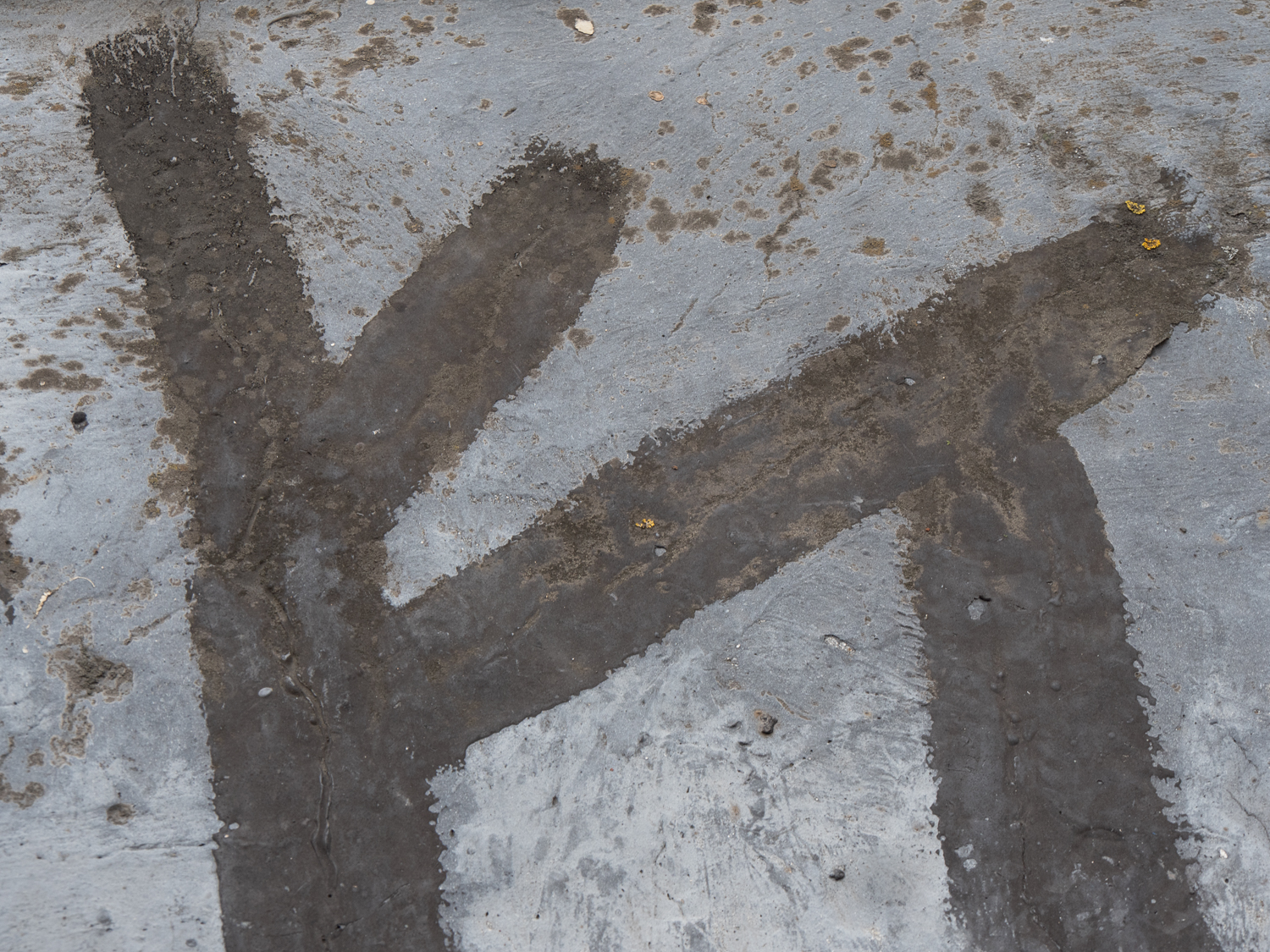
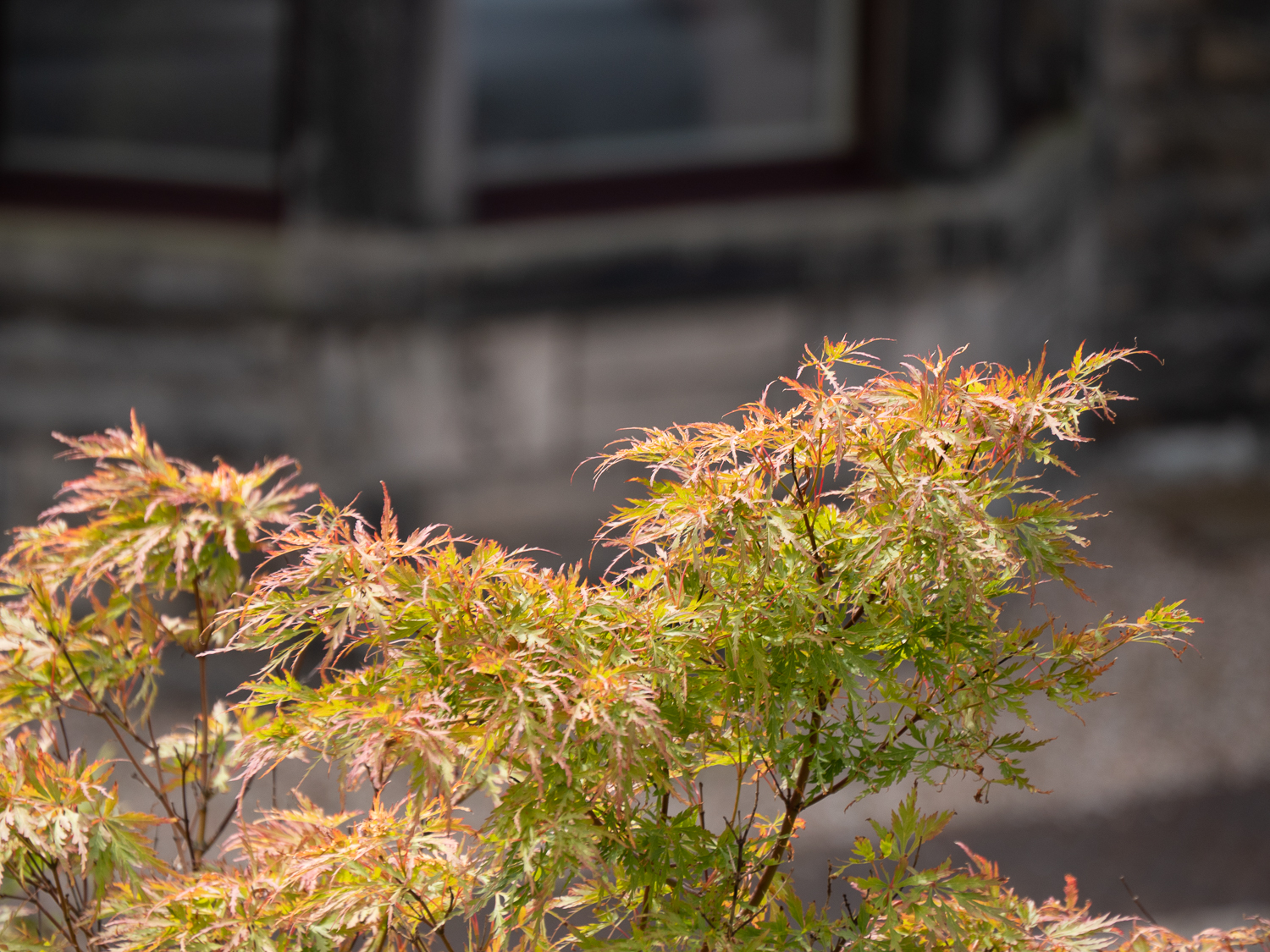
In front of me there is the balcony with  broken tarmac, the balcony railing, ornate white and heavily rusted, the top of tree in the front garden, an Acer just starting to turn colour,  the road with parked cars, front gardens of the terrace opposite, the terraces houses and  the sky, bright blue with clouds.

12:00: Heard voices and conversation from next door. A female walked along the street, probably connected.

21 cars are visible; 2 white 4 red, 2 light blue, 3 grey and the rest black. A white Belfield van drove past the end of the street.

It’s getting warmer I might have to take my jumper off

The hydrangeas next door are out, a deep pink, the orange hanging basket opposite is beautiful, there are pink flowers in pots on the fence shielding the dustbins at number 16 with the grey door.

A white van (unmarked) drove up the street.

Next door has a football in the garden and a mat, a bracelet, a penny and a BIC pen on the adjoining balcony.

I cannot see any TV discs and only two aerials, so I suppose most people have gone digital.

12:10:   A boy with a blue hoodie and a black dog on a lead walked down the street from right to left, probably heading for the park

The seagulls have settled down. The sound always reminds me of childhood.

Sparrows are chirping. A pigeon (or dove as I cannot see it) is cooing. Blackbirds are singing rustily. Somebody started up either a hedge trimmer or a mower, very noisy but not disturbing the birds.

A pigeon just flew over. Now a blackbird. Now a sparrow.

A woman in a white top spotted with blue walked left to right carrying a bag of what seemed to be rolls.

All the chimney pots vary. You could do a study of that alone.

Hearing a car, but distant, the hedge trimmer has stopped.

There is a seagull perched on one of the chimneys opposite but it’s quiet.

I need to learn more about birdcalls, there are two I can hear but not see. I can hear geese flying over but not see them.

12:20: Next door’s two children came home. Waved at me. Carrying bags but no idea what was in them.

A black car, a saloon, drove up the street.

The sun temporarily obscured by the clouds has come out again.

A dark red hatchback drove down the street. Now a UPS van has arrived with the parcel for number 7, the van is diesel and very noisy. The spaniel started barking. It’s a 13 number plate so shouldn’t be so noisy.

Three people walking down the street on the opposite side of the road, 2 males one female, in probably their 70s, they have been walking, wearing backpacks, and carrying walking poles. They said they had come from the Dean plantation and are on the way home.

12:30: The sun is gone in again.

A dark grey estate car drove right to left. More pigeons are flying over.  The keys on my door are swaying with the breeze.

There would be different ways of explaining this visually: the layers you see in space or the layers you see in time.

A young man with a ponytail and black tee shirt ran right to left at the street.

The sounds are important and the breeze, now slightly chilly on your face.

A dark blue De Rose van drove down the street followed by a small white nondescript van then a small silver hatchback. The street is busy all of a sudden.

12:40: Quiet again except for the birds.

Two men in about the late 60s or early 70s separately walking dogs went down the street. One with a white Westie, one with some form of a spaniel. Neither appeared to be looking at anything except the ground.

The sun is out again.

The geese have flown over again, but it is against the sun so I cannot identify the type, probably Canada Geese.

The seagull has flown away from the chimney pot, I did not see him leave.


Reflections on the exercise:

  • I read the Perec book almost in one sitting. It is short. The translation is fluent. It becomes a meditative exercise. There is a combination of direct observations and the thoughts that the observations have produced. A prose poem.
  • I was surprised at how much I saw in one hour. I was also surprised how enjoyable it was.
  • This exercise could easily be transformed into a photography project. In fact, the possibilities ran though my head while sitting there and I have done so (see below).
  • The problem with changing it into photography is you then miss many of the stimuli. The sounds of the birds and the cars, the people talking, the wind.
  • From where I was, above the street there was no problem with discretion, my camera phone would not have taken the images I wanted, so I used a zoom, wide-angle to telephoto lens to get all the subjects I wanted. I considered going downstairs and into the street to get the details, but it would not have reflected my experience of the hour spent. I could take a lot more images from the same place – but thought these gave the flavour of what I had seen
  • I considered changing the images to monochrome, which would echo much of the street photography done in the era the book was produced but felt much of the experience was enhanced by the colour. That was the way I saw things. I noted colour at several points, the cars, the clothing, the flowers. Black and white would give a totally different feel – not a bad feeling, but different.
  • The writing is important to the project. To me, the images and words go together. They play of each other. If I was making it into a book, I would intersperse the images between sections – but you could separate them. I would need to try both options and see what made most sense.

Images:

Reference:

Perec, G. and Lowenthal, M. (2010) An attempt at exhausting a place in Paris. Cambridge, MA: New York: Wakefield Press.


Reflection on Tutor Report for A4

I had a positive and interesting Hangout review with my tutor for A4

He was happy with my research and reading both directly related to the course and around it. He commented that the writing was ‘intelligently done’ and appropriate. We spent some time discussing my interest in both looking at and collecting photobooks and how that could be helpful in extending my work especially with thinking in a more contemporary framework.

  • Pleased with this. I find looking at a range of photobooks both useful and interesting. The types of books available at present vary widely, from the spare, contemporary approach used by Mack, to the dark, dense books produced by many of the Japanese/Chinese school.

For A4 he felt that I have extended my practice and worked using a more conceptual approach. It is not a ‘new’ piece in that other’s have done similar work but has been thought about and fed on from research and thinking about memory and time. He felt that I had ‘let go’ to some extent and been more experimental with my approach. Technically consistent and thought /worked though problems.

  • Again happy, I did a lot of reading around the topic of memory and archives for this, and about how to incorporate text into the work – or how to use it to develop the themes
  • This was a difficult and very personal pieced of work and I think that comes though in both the images and the way I got to them via interaction with family and my mother’s archives.

We discussed the video I made for Exercise 4.5 and the accompanying album. We looked at taking this on further for A5, either as another video, this time using archival images to accompany the words, or as a pdf photobook. He reminded my that working from intuition is part of the process and my feelings/thought around this become part of the work.

  • 3 possible ways forward
    • A video
    • A photobook
    • The idea of using the archival images outside – but this would be limited at present as I cannot get to many of the places she thought important
  • Keep is simple and contemporary
  • Keep it short
  • Make it personal and include the history around it
  • Make text (if included) contemporary (I seem to be using that word a lot) and readable.

He gave me 3 helpful links which I will follow up about family work and archives.

Altogether very helpful and the discussion has helped clarify my ideas for A5.

No reworking needed for A4!

Reflection Point for Project 2

The question is how often do you see people totally absorbed in their phone or other electronic device rather than looking at what is going on around them? They may be reading, texting, searching the internet, social messaging (in a zillion possible variants) or watching themselves though the phone and taking selfies in a place instead of experiencing it. In earlier work in IAP – Exercise 2.2 – Covert  – I looked at just that, taking images of people who were more interested in their phones than what was going on around them – this was in spite of the fact that they were on the streets in the Edinburgh festival, and there was a lot going on to see.

My family have been known to comment that I am attached to my camera and only see things through the lens. Is this different? I once spent a long (7 hour) train journey taking pictures though the window every 30 minutes and at every stop (they are not very good photos). This did make me focus on what was happening outside. My normal habit would to have been to get out a book and hide from the world.

When I sit and think about it, many, (most?) people are attached to their electronic devices. I have been trying to reduce the use of them. To spend an evening unattached. To leave my phone behind. To use paper and pens to make notes. It is very hard. To be fair, they have been a godsend during Covid and the inability to get outside. I have used them to have conversations, to build up friendships, to see things that I cannot otherwise get to.

The problem with electronic devices is that while you can read or listen to music you do miss out on input from the other senses. They cannot (yet) let you smell things. You do not feel the wind. You do not touch the rusted rail to check out the texture. They are also extremely focused. If you are reading a real book, you feel the pages, but you are also more aware of the environment around you. If you are listening to live music you feel it on your skin, it vibrates though you, you see other people’s reactions.

Life is becoming more digital – yes, there are some advantages. Two days ago, I was on a zoom with someone in Canada. Today I have been looking at an exhibition in London. Tomorrow – who knows where I might be. But – it is equally important to live in the real world; to smell the roses, feel the rain, see the whole picture, the glances out of the corners of your eyes – not just the view though a phone lens. Concentrate on one thing at a time – if you are walking in the park – look at the flowers not your texts. If you are having a coffee – smell the aroma (then maybe read your book).  Look at the world. Look a second time. Absorb it. Then maybe take your pictures.

IAP to Level 2 Discussion Meeting

The IAP group had a very useful crossover meeting with people who had done some level 2 courses to discuss the options in more detail than is easily available.

Present were:

  • Zoe, Iain, Caroline, Julia and Michael from IAP
  • Lynda W., Lynda K., Andrew, and Simon from level 2 and 3

We discussed all the options available in some detail. Everybody seemed to have enjoyed the ones they had done. Simon was particularly enthusiastic about DIC! Everybody said to be aware that Level 2 involved more research and reading and generally less practical work and it was easy to go down the ‘rabbit hole’ of research (a problem I have at the best of times).  There is opportunities in all the courses to investigate things you are specifically interested in, such as archival work, abstracts, landscapes and people. There is a lot of theory involved in all of them.

Everybody said that the courses are not defined by the titles and you can ‘bend’ them to fit your particular interests.

Simon was very clear that he felt DIC was essential as it had completely changed how he looked at photography and had allowed him to become more adventurous and think more about why you take photos and what they mean. What is truth in photography? He commented that he had ended up using all sorts of media, including collage, to extend his work. He had thought it would be very 3rd person based – but it actually became very personal. Certainly not all photoshop.

Lynda W. Re Landscape, noted that the time scale had really allowed her to extend her work and think about things in more depth, crystallised her thinking, experimented with abstract

Lynda K. Reminded us not to see the genre names as boxes and pointed out that you might completely change what you were doing part way through. Landscape does not have to be outside, might be on a tabletop, or archival. Documentary is also not strictly reportage – but is being rewritten at present. Documentary needs a lot of research (but so do they all).

Andrew commented that SAO was initially very photo intensive and might (but could be done) be difficult at the present – but there is a lot of opportunities within it to meet with people and have discussions about their lives.

The big differences between Levels 1 and 2:

  • More time
  • More freedom
  • More academic work

Noted – none of us are teenagers (!) – therefore have more life experiences to help ground the work and the essays. The essays can be difficult to keep to the limits – so title and subtitle to narrow down exactly what you are talking about. Possibly write the introduction last when you know what. You want to say.

It is useful to have a side-project to work on as otherwise you might not actually do a lot of photography!

Lynda K. – gave 2 useful references

https://www.youtube.com/watch?v=ZBJR23iD5T4&t=6s

https://aub.cloud.panopto.eu/Panopto/Pages/Viewer.aspx?id=d232a5bc-0058-4472-bfd2-abed00e42582

Thanks to all the people for sharing their time.

Graham MacIndoe

Interview with Graham MacIndoe by Street Level Gallery, Glasgow 16/7/20

Graham gave a long discussion about his background and his work. In summary:

  • Born in Scotland but now works as an associate university professor of photography in America.
  • Early influences were punk rock, protest music and protests against racism (late 70’s, early 80’s)
  • Initially studied painting at Edinburgh Art College
  • Started taking photos on a trip to New York and has never stopped since, carries his camera everywhere he goes
  • Went to Ireland and photo’d a horse fair (recently released on Café Royal
  • Likes being both in the middle of the action and finding the quiet places on the outskirts
  • Always been intrigued by people, the expressions on their faces, the weird moments
  • Initially not interested in commercial work but got involved with it – money – drugs – Coming Clean & Chancers, dicussed at length in Coming Clean
  • Took pictures throughout drug scene but doesn’t show the pictures he took of other people – ethical dilemma
  • Just take the pictures – put them away – may make sense later and fit with others to make a piece of work
  • Early pics are relevant to your life, chunks are missing, but use what you have
  • Went to concerts, got backstage passes, now works a lot with band The National.
  • Interested in running – so takes pics of that
  • Protest photography ongoing – been involved since early days – feels that most of the images should come from the Black photographers
  • Racism/ colonisation/slavery/poverty/injustice/incarceration needs to be addressed
  • Quoted Robert Frank – black and white are the colours of hope and despair
  • Documentary – are we overwhelmed by all the images. Much is just wallpaper. Need to engage – but how much effect does it really have
  • Everybody lives in their own bubbles

10_6_2017-The-National-Forest-Hills-10008272-1024x708
© Graham MacIndoe

Suggested photographers to look at:

  • Kirsty MacKay
  • Matt Black
  • Neil Greer
  • Disturb (?)

Advice:

  • If you are passionate you will get there
  • Make pictures all the time
  • Just keep on shooting
  • Engage with the world to find out how your personal trauma fits in
  • Who are you making things for?
  • What’s the takeaway?
  • You want people to think about what you have done

A Learning Log by Zoe