All posts by scottishzoe

Study visit – London’s Hottest Postcode

I attended the study visit (or possibly better described as the exhibition opening) of Hazel Bingham’s work on buildings and their environment. Before the discussion we were given the opportunity to look at the images on a virtual exhibition site: https://artspaces.kunstmatrix.com/en/exhibition/747105/londons-hottest-postcode-n1c

Hazel has also set up a Padlet  with a huge amount of extra information about the background of the project: https://oca.padlet.org/hazel281660/an34kjlm61vzil61

 We started with a brief discussion of who was there and our work then the tutor -Andrew Conroy – talked about his interest in making connections between the micro and the macro to tell you about the politics of everyday life. He briefly described Hazel’s work as the development of a commercial space, with a large amount of surveillance and unusual use of nature.

Hazel then showed the images as a slideshow with a brief additional description of the images. Later on in the talk she commented that these images were meant to be seen large (I think, although I didn’t write it down, A1). This is a very different scale to looking at it on an tablet (as I did) or at best a computer screen (as I had previously done when looking at the virtual exhibition).  Although we got the gist of the images – I do wonder what it would have been like looking at them full scale – the detail would be much more compelling.

Hazel talked briefly about how she started from the concept of social planning and urban regeneration. But what does this actually mean? The people that move in are those that the planners want (because these are the only people that can afford to) and all (most) of the original inhabitants are moved out. So where do they go? In theory there is some ‘social housing’ included, but very little. There is little resource in the development for teenagers. The group discussed this problem at length including:

  • How much do developers play the system?
  • How much are plans changed when the building starts?
  • How real is the idea of a ‘trickle down’ effect of money and property?
  • Need to remember that these types of developments are commercial ventures – therefore money is crucial!
  • In reality who lives there?
  • How much is it policed? – guards, surveillance etc
  • Will the need/desire for these sorts of communities change with the effect of the pandemic? Many of the units are used by foreign students – will they return? Or businesses – what will be the effect of home working?

Throughout the images Hazel had made significant use of the words that were seen in the area, sometimes they changed over time. They also acted as a controlling mechanism. Go there. Do that.

We also discussed the fact that external spaces in this area are no longer public – they have become privatised. Although, in reality, the rich have always had more access to outside space than the poor (example the New Town in Edinburgh with the locked gardens versus the tenements, or the King’s Forests  – where if you went without permission it was potentially a hanging offence). We also discussed how the use of ‘nature’ – or at least growing areas was used to make a building attractive to buyers. But the other side of that coin is that it can also be used to cover up social problems and avoid questions about the use of an area.

Hazel described how she had chosen this area as a BOW for practical reasons. Building where she lives is slow. In London things happen fast – so within a manageable time scale. She did not ask for permission to take pictures – but this would probably have been different if she was there with a film crew, or even seen as ‘lingering’ (or do I mean loitering?).

Hazel gave useful advice when thinking about long term work:

  • Network (other people may have useful resources or helpful ideas
  • Research
  • Think about what you really want to do (you may be spending a lot of time on it)
  • Think about costing, books will rarely break even, publishers typically want more images than OCA does.

This was an important study group, both for the images that Hazel showed and the extended conversation around them and the problems you might encounter. It was clear that as a group most of the people there were socially aware and concerned about the social environment and use of space.  The images themselves were fascinating. I would have loved to have seen them in a larger format and close up to enable detailed examination – however we might have lost out on the extensive conversation they provoked.

With thanks to Hazel and Andrew for this resource and the learning it provided.
30 Seconds on Margaret Mitchell

I listened in on the webinar at Street Level with Margaret Mitchell. I first saw her images on the railings at one of the St. Andrew’s Photography Festivals and they have been in the news since.

The talk explained her background, some of her major series and what she is doing now.

  • She started at Napier University and was interesting in community work from early on
  • Her major work has been with portraiture, mainly of her extended family In This Place
  • Works with charities – especially Shelter
  • Important to give something back to the people you are working with – so may teach or allow/encourage them to become involved
  • At present doing a long term project with Shelter on people who have been homeless
  • Pics that you took in the past may come back into play in the present
  • Listen and talk to people , give them a chance to think about where/how they want to be photographed
  • Think about how much choice people have had in their lives – may have been very little.
  • Think about the role of the environment in what people can do
  • Be respectful in how the images are produced and who sees them

See: https://margaretmitchell.co.uk/

And: https://www.theguardian.com/artanddesign/2020/jun/15/michaels-mission-helping-edinburghs-homeless-photo-essay for a recent discussion on her work with the homeless and one of their stories


Assignment 4 – Initial Thoughts

Words and Memories

Since my mother died, I have found that I have surprisingly few memories of her from my childhood. There are the occasional snippets; walking to the top of The Trundle, overlooking Goodwood Race Course wearing an orange fluffy jacket (but that might be because I have a photograph from that occasion), going on holiday to London where she bought a very expensive umbrella from Harrodsburg and promptly lost it, searching rubbish tips with my her and my stepfather for a piece to fix his broken refrigerator (another photo), her burning one of my dolls in the furnace because it was tatty and I was too old for it, Christmases in bed with bronchitis. There are a few from my teenage years; bringing stray kittens home and attempting to hide them under my bed, writing long letters from boarding school (which I recently found in the bottom of a drawer when we were emptying her house, time in Spain for my stepfather to take photographs, and being sent home early to get back to school. There are more as an adult, but they are unclear; having lunch in her dining room, telling her she should sell my stepfather’s car after he had died (she had one of her own), being told I needed to lose weight (that was a repeated theme). And, of course, there are the recent ones of her illness; hospital visits, arguments about living alone, her telling us she loved us. Very little in total from more than sixty years.

We now have some of her words telling us about her memories, some of which I have made into a short video (see Exercise 4.5 – My Mother’s Memories). I wanted to make another half to that story, using the memories of people who were close to her – but using those memories in a more sideways, elusive fashion.

Plan:

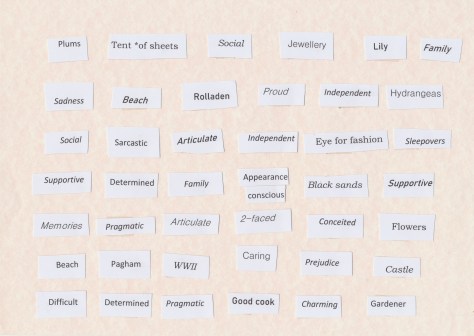
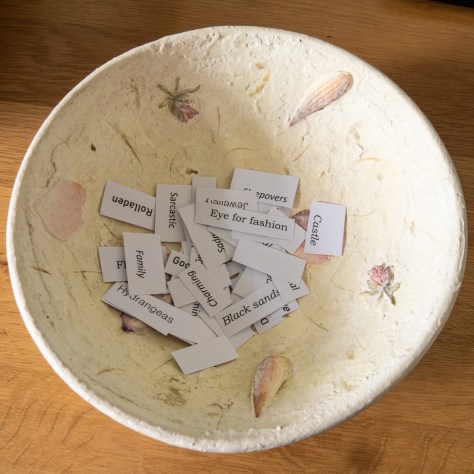
  • I asked the six people who were closest to her (my husband, three grandchildren, a niece and her best friend) to give me two sets of words. For the first set I just asked them to give me three words/thoughts that came into their minds immediately they thought of her and then after two week I explained why and asked them to give me another set of three words. I added my own six words to these, making a total of forty-two. There were a mixture of emotions, items and places. Several of the words were repeated.
  • I then randomised the words, so they lost the connection with any particular person. I did this very simply by printing them out in a grid, using a varied selection of fonts, cutting them up, putting all the words into a bowl and pulling them out without looking.
  • Unlike my normal way of doing things I didn’t draw lines or take measurement to cut along, I wanted the final words to feel more organic, random, less formal.
  • I then stuck the words onto paper in the order I drew them out, creating another 6 x 7 grid of unevenly spaced words.

Images:

  • I now need to make images that come in some ways from these words.
  • I have thought of several options
    • Use the places that are mentioned and go and take photos there (difficult at present practically)
    • Set up still life arrangements that echo the way she has been described – a gardener, a cook, social
    • Still life images that show the more factual items – flowers (lily and hydrangeas), jewellery, food
    • Find old images from my and her extensive photo archives that echo some of the feelings
    • Look for images of her that come to mind when I see the words – family, fashion conscious

I am going to put the words aside for a little while at allow some thoughts to simmer and to play with some trial ideas.

Initial word list:

Family Memories Sadness Beach Sleepovers Castle
Difficult Jewellery Pagham Rolladen Sarcastic Flowers
Supportive Articulate Pragmatic Articulate Pragmatic Social
Determined Caring Appearance conscious Good cook Gardener Eye for fashion
Conceited 2-faced Charming Family Prejudice WWII
Plums Hydrangeas Determined Lily Beach Tent *of sheets
Independent Proud Social Supportive Independent Black sands

Randomising process:

-2006_untitled001001

Scan_20200618 (2)

Exercise 4.5 – My Mother’s Memories

Find words that have been written or spoken by someone else. You can gather these words from a variety of means – interviews, journals, archives, eavesdropping. Your subject may be a friend, stranger, alive or dead. Select your five favourite examples and create five images that do justice to the essence of those words.

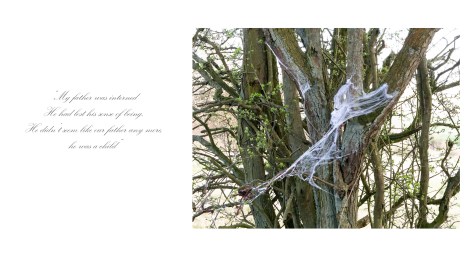
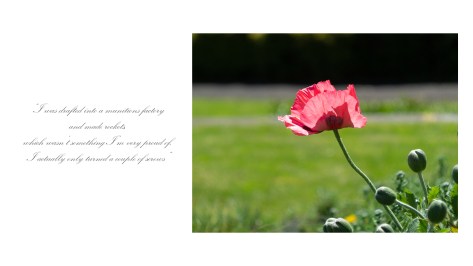
 I decided to use sentences from recordings we took of my mother describing her life not long before she died. She had never been forthcoming with information – so to get her to agree to allow us to tape her was a real achievement. We ended up with about 3 hours of story over 8 tapes. The first piece of work was to put these in order and transcribe them. I tried to use various types of software, but her voice is soft, and she has a slight accent, so this was not successful. Hand transcribing it was! Much of what she said was repetitive and didn’t follow any particular order, so I went though the transcription and found 5 sentences that came at specific points of her life – or told and important piece of her story.

I then thought about ways to add images. I didn’t want to be too didactic or illustrative but wanted to show images that had some link. I was helped by the earlier research I had done on text particularly David Favrod’s work where he uses the memories of his Japanese grandparents (see David Favrod) and also Aaron Schuman’s Slant (Schuman, 2019) where he uses elliptical pictures to illustrate the words he has collected (see Aaron Schuman – Slant). I have recently read Geoffrey Batchen’s Forget Me Not (Batchen, 2006) which talks about the use of portraits as memory/remembrance aides (seeGeoffrey Batchen – Forget Me Not). Although these are not portraits they act in a similar fashion.

I was limited in the images I could take because of the present lockdown (still ongoing in Scotland) so used images that were all taken locally, which is a long was from where she lived in America and the Germany.

I have decided to present the images in 2 ways:

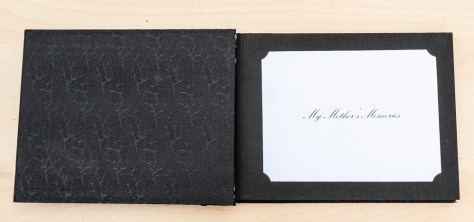
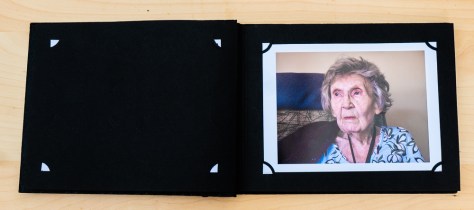
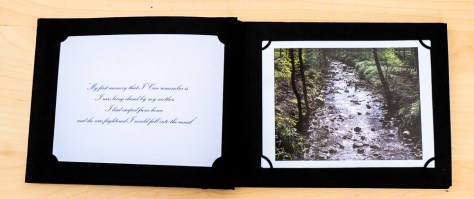
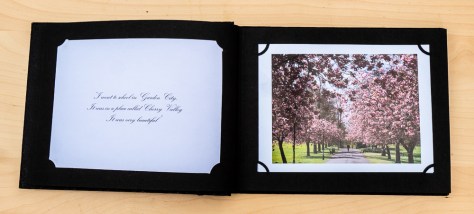
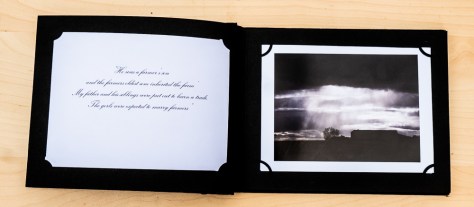
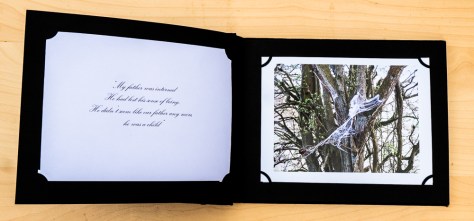
  • An old-fashioned photograph album of the type she owned, with the images paired each sentence – finishing with a poem by Ursula Le Guin – Leaves from So Far So Good (Le Guin, 2018)
  • Either a video or a PowerPoint with her words cut out from the tape and running at the same time as the images.

The photograph album was a fairly simple exercise.

  • I used an old album that I had acquired at an antique fair.
  • The words were printed in a script text that is fairly similar to the very elaborate writing my mother always used. I am slightly concerned about the legibility of it – so this is something I need to think about.
  • The images were all home printed.
  • The most difficult thing has been photographing the album for presentation. I have tried several techniques with limited success as the album does not want to stay open.
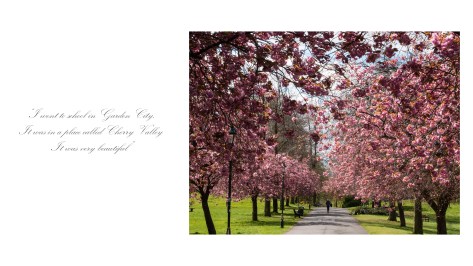
  • To show the images and words more clearly, I have also saved them as single images – as they would be seen in the album – but on one page instead of two.

Images of album:

-2006_untitled001001-2006_untitled004004-2006_untitled005005-2006_untitled008008-2006_untitled011011-2006_untitled012012-2006_untitled014014-2006_untitled016016


Back-up images (for clarity):

MotherfirstSchool daysFarminternedDraftLeavesFor the video I was helped by my son – who is far more technically minded than I am.

  • I found the specific words on the tapes and cut them out
  • They were then matched with the images
  • I thought about using a background music – a piano piece that she liked – but it made the words too unclear – although this is something that needs to be considered further.
  • The video needed an end point, so I recorded part of a different poem by Ursula Le Guin – Ancestry and added in an image of the sun though the leaves.

Both the album and the video only tell a very small portion of her life, and only use 5 of the multitude of possible audio clips (to match the 5 sentences called for in this exercise) – I think it would be worth extending, and possibly using a variety of images – some taken by me, and some from her very extensive archives. This is definitely a long-term project.

Learning points:

  • It is difficult to pick out individual sentences that make sense and tell a story from a long audio history
  • Matching images and words is a skill that needs practiced
  • Photography of an album is tricky – and I still haven’t got it quite right
  • How to use movie software
  • That movie software is widescreen – and all my images are 4:3
  • How to upload to You-tube
  • How to upload to Vimeo

 Link for videos ( You-tube and Vimeo):


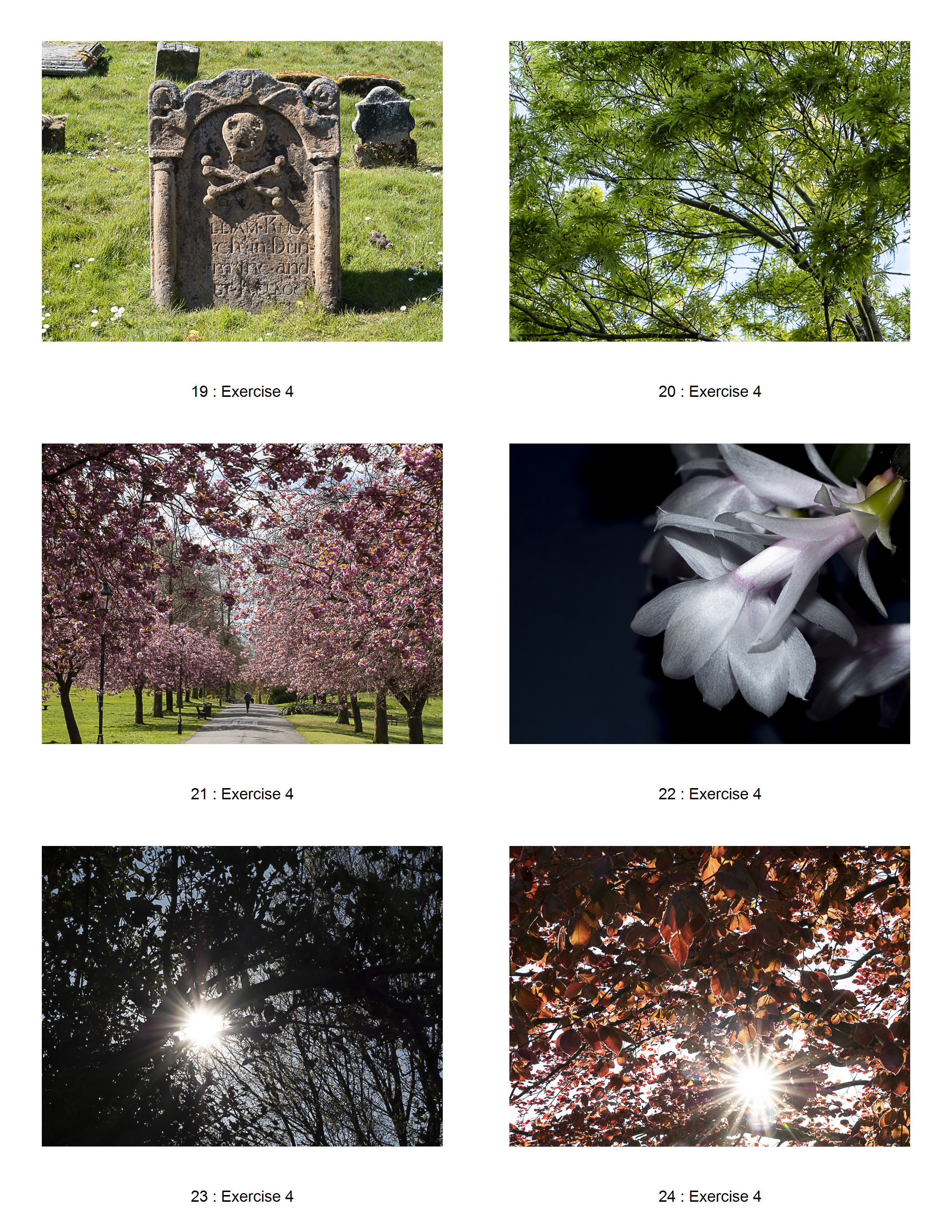
Contact sheets of possible images:


References:

Batchen, G. (2006) Forget me not: photography & remembrance. New York; London: Princeton Architectural ; Hi Marketing

Le Guin, U. K. (2018) So far so good: final poems, 2014-2018. Port Townsend, Washington: Copper Canyon Press.

Schuman, A. (2019) Slant. London: Mack.

Geoffrey Batchen – Forget Me Not

Geoffrey Batchen  in Forget Me Not: Photography and Remembrance (Batchen, 2006) discusses both why people might take portrait photography and some of its uses.  Here is a brief summary with some added thoughts.

  • Many early pictures were taken of people looking at other pictures or equally looking at photo albums again. Why was this? Was it so that you could acknowledge the memories of someone who is deceased? Or is it so that you can acknowledge ‘I am (alive)’?
    • This reminded me of the Masahisa Fukase work of portraits of his family where after the death of his father he included a photograph of him in the place he would normally sit.
  • Being pictured with a portrait of somebody who is dead or absent turns the portrait taking into an act of remembrance
  • Is a photograph actually a good way of remembering things? It is certainly nostalgic but not the same as real memory as you do not see the way they moved, the way they spoke, or the way they felt.
  • Barthes certainly did not think photographs were (as good as memory) because you lost the sensation related to memory
  • Kracauer thought that photography captured too much information (!) and was too coherent and too linear unlike malleable internal memory (see essay in the Mass Ornament) (Kracauer, 1995)
  • Early pictures could be complicated by being covered in layers of paint which again took away from the reality of the person and possibly surrounded by elaborate borders.
    • This is still done in the elaborate scrapbooks that are made today – many with images of children and pets.
  • Sometimes portraits were gathered together in patterns surrounded by elaborate borders made of paper or ribbons (or even made into a cushion) to make photographic keepsakes
  • This causes a form of collective identity – they could be family snapshots or cultural groupings
    • Think of the Adamson and Hill pictures that led to a painting of the Moderators of the Church of Scotland
  • Any photograph that has additional work done on it such as painting or embroidery also has a tactile element to it. This add to the actual feeling from a printed photograph.
  • The way photographs are made at least in the pre-digital world could be considered as a chemical fingerprint in itself.
  • Photographs were also made into wearable items such as lockets and broaches and even rings (although they would be very small in this case).
  • Many of these were family objects exchanged in marriage as well used as mourning items. Others were made into artifacts such as boxes that could contain important items – this turns what is effectively a flat object into three-dimensional object and increases the personalization of it.
  • Pictures could be further personalized by adding signatures or other writing. These pictures can be used as a remembrance object. They can also be added to albums and passed around members of the family in an album. In an album of photographs are sequenced and can in fact be moved around within the sequence.
  • The photograph might be made into a more three-dimensional object including things like fancy frames, carved items, and even bronze baby boots!
  • Hair was also used, both loose and plaited, to act as a memorial/reminder of a person. This was sometimes given us a love gift, sometimes used as a morning aid. The hair stands in for the body of the absent person (therefore the indexical nature of the image becomes doubled. It may become a fetish object or a talisman.
  • Were the complex and complicated memorial items such as photographs surrounded by wax wreath made to help you remember because you were afraid of forgetting? Making these items was often done by a member of family and would have been very painstaking – a labour of respect and possibly made to allow the grieving process to take its time. The objects can be very complex and the sheer materiality of them is important.

Back to the question of does photography enhance memory or rather replace it? The more that is added to the picture the more physical it becomes and the more the senses are involved.  A photographic image that can be multiplied with endless copies – but altering it make it become more unique. They are shown in the space between the public and the private.  They become a memory object in themselves. The photograph is a desire not to be forgotten, both the person in the picture and the owner/viewer – ourselves.

References:

Batchen, G. (2006) Forget me not: photography & remembrance. New York; London: Princeton Architectural; Hi Marketing.

Kracauer, S. (1995) The mass ornament: Weimar essays. Translated by Levin, T.Y. Cambridge, Mass: Harvard University Press.

Anna Fox

Anna Fox is a British photographer and a professor of photography at UCA, Farnham. She recently gave a talk on zoom to the OCA students. She has published several books including My Mother’s Cupboards and My Father’s Words (Fox, 1999). This is a small book that uses text to explain pictures – or pictures to illustrate text. They both have equal value. The text consists of words, aggressive, angry, violent, spoken by her father about the women in their family, more specifically her mother and the images are very quiet, simple images of the contents of the cupboards in the house. Sometime the two fit together – such as the words ‘She’s bloody rattling again’ set against a cupboard of glasses, other times less so. In a recent talk given by Fox to the OCA students she said that she collected the words surreptitiously, under the table – but simply went around the house taking the pictures. She did not attempt to illustrate the words but matched them together when they were all collected. She described the book as not simply about her mother and father but about the effect of couples living together in a patriarchal society and noted that whenever it is shown other people come out with similar stories about their families.

In another book Work Stations (Fox, 1988) Fox took a series of photographs of people in offices in London which are presented along with a line of text that she gathered from magazines and newspapers. She used the same technique in Basingstoke 1985-68 (Fox, s.d.), where the apparently banal images of Basingstoke life are matched with a series of texts culled from local papers. In both of these works sometimes the text matches the image (although with a slightly sideways match) in other the text seems to almost contradict the information in the photograph. In the same talk she said that she simply collected the texts but did not try and illustrate them – as, for her, that did not work. Fox is clear that image and texts when used in a piece of work should be seen as both parts of the work, not simply an image + a caption.  She used the work of Sophie Calle to illustrate this – where the words are crucial to the understanding and are often shown as more important (or at least more dominant) than the pictures. In another work Cockroach Diary (Fox, 2000) she made two separate books, one the diary – a copy of the diary she made which told the story of what was happening in a group of ‘dysfunctional’ people living together, and one a book of images of cockroaches – often scarcely visible (as they move so fast) and presented them together. In an exhibition of the work the pictures were shown on the walls, and the diary shown under them so you could read it all.  

In all of these works the text is important. Equal not subordinate. It needs careful thought from the very beginning of the project, it may actually precede the images and inspire them. It is not added as an afterthought, that will not work.

 In the lengthy and fascinating talk, she made several important points which I have attempted to summarise:

  • Women in photography have not often been represented enough which she and a group of other people are trying to balance in Fast Forward, which holds conferences, acts as a research project and has an online journal (Fast Forward: Women in Photography, s.d.) .
  • Women are not good at networking – possibly because focused on struggle to get seen and not enough energy left, men are better at this
  • She is inspired by fiction – fills the mind with ideas, which then become embedded and inform your work
  • Photography resembles reality – but it’s not real. Time and memory are important Are these things captured, recorded or posed in time?
  • Does it matter if the photo is ‘real’ or fictional – no but it does matter that you are honest about it if asked. Some authors embed found images in their work to make the story appear more real. Other photographers construct images from the ground up to tell a fictional story that may be more real than an actual image ever could be (Crewdson, Wells, possibly Capa).
  • All your work has a degree of fiction because you choose what to include and what to crop out – the story says as much about you as anything else.
  • She said the photographs that inspire her are the ones that surprise her.
  • You have to make yourself a good enough photographer to make the story the right way for the subjects – gives the people a voice. You need to know why you take them and use them – context is everything.

More of her work can be seen on her website: https://annafox.co.uk/

References:

Fast Forward: Women in Photography (s.d.) At: https://fastforward.photography/ (Accessed  08/06/2020).

Fox (s.d.) Basingstoke 1985 – 86 – Anna Fox. At: https://annafox.co.uk/photography/basingstoke-1985-86/ (Accessed 08/06/2020).

Fox, A. (1988) Work Stations: office life in London. London: Camerawork.

Fox, A. (1999) My Mother’s Cupboards and my Father’s Words: a short story in words and pictures. London: Shoreditch Biennale.

Fox, A. (2000) Cockroach diary 1996-1999. London: Shorditch Biennale.

IAP Group Meeting – 06 June 2020

We had an interesting discussion in the IAP group this morning. Present were me (obviously), Ben, Caroline, Mark and Julia. Unfortunately, we lost Julia halfway through – but I think most of the serious discussion was over by that point.

Caroline shared her work for A4. She was on the review post tutor input. The original work was a series of overlaid images showing 2 view of herself – what she is doing now (in England) and what she might have been doing in Dubai.  We all agreed that we liked the images, but they were quite complicated to look at and difficult to follow her theme. I wondered if both images should have been given equal visual weight – but Caroline said she had tried that, and it did not work well. She has redone the series using torn and joined together prints. We all agreed that this gave a much clearer view of what she was doing – very effective. All liked the physicality of the torn images.  Discussed about the text – whether to change the dates so it did not risk being linked to Covid as the separation was not because of that.

Zoe showed her A3 series with the new images and order as suggested by the tutor. People liked some of the pictures, especially the Star Wars in front of face. Long discussion about what order to show them in to tell a story. Ben suggested to change so that there was more of a conclusion. Agreed that the issue is whether this is a straight documentary – so did not need a more personal take – or a tale about a group that I was involved in – so personal images would be better. Impossible to reshoot – so simply maybe write up as a learning experience.

Julia shared her beautiful images for A4. This is her original take and she had already decided on some changes. She said her tutor always asked her “Why?” And what makes her like any given images – which is both an important question and one that is difficult/impossible to answer! Julia commented that she struggles with using words with images and often found them pretentious – so used quotes (very effective). We spent some time discussing fonts and how to choose them. Julia is thinking about making the images into a book. (I did not say so at the time – but think it could make a beautiful book – but would be nice rather longer).

Ben – has been working mainly on his CN assessment work but he described his A1 work on the Glasgow City Mission, deadpan images of the people there. He told us about his working practice – talking all the time, telling people exactly what he was doing. He took the people into a separate room so they wouldn’t be embarrassed – unfortunately some of the best images the subjects didn’t want shown. He commented that his tutor was encouraging him to research more.

Mark is just finishing off CN and not started IAP yet.

General points:

  • We all get asked ‘why?’ – by our tutors
  • We need to think about why things work (so we can do it again)
  • How to use text – and what font – maybe ask Caroline for advice on that!
  • Lockdown makes you think harder – work within the imposed limitations
  • Some discussion about cameras and the use of both digital and analogue – varying things can give you more opportunities.
  • Noted the Learning Outcomes are different in the course manuals (even on OCA Learn) than they are in the assessment guidelines – so be careful to check

Plans:

Susan Bright Lecture

I attended both the Susan Bright lecture and the question and answer time that followed it. Susan talked about being a curator and what it meant to her. She describes herself as a curator and a writer (and a teacher) and said that she had spent considerable time thinking about what those terms meant to her She explained that the original meaning of curator was ‘keeper’ and that most curators worked either within a museum or with a collection to work to keep it, expand on it, write about it and produce exhibitions . She is, however, an independent curator, which effectively means that she works on what she wants to, usually in collaboration with the artists involved. She chose this role to allow her to be involved with exhibitions that she was interested in.

While talking she noted several things:

  • There has been a long-term underrepresentation of women in art. This culminated in a backlash in 2019 at Arles where it was particularly noticeable
  • Women are still underrepresented, even in the present Covid situation with a lot more online talks, and after the ‘me-too’ discussions
  • Art remains mainly white – not that art is white but that the art that is shown in major exhibitions and sold does not cover the breadth or depth of art (including photography) that is available.
  • Photography appears to favour speed, youth and moving forward while she favours emotion, slowness and listening to history.
  • She considers herself to be a ‘feminist’ curator – and tries to reflect feminist values within her work
  • Collaboration is crucial, and in practice has always happened although is not always acknowledged. It can be across generations and also between various roles
  • The role of a curator is not to ‘be nice’ but also to say the hard things
  • She doesn’t censor work – but the gallery or a publisher might

Bright then talked about several of the exhibitions and artists she has been involved with.

  • Home Truths both in the exhibition and the book that followed it was born from a lack of images and discussion about ‘mothering’ in all its complexities and range. Each artists work was different and presented differently.it initially came out of her own need to make sense of her own conflicted feelings about motherhood. Talked about both abundance and loss, endurance, and emotions.
  • Deja vu in Spain (for an essay on this see : https://www.photomonitor.co.uk/dejavu_bright/
    • Elina Brotherus – she has had a long history of working with her following an initial email. She had originally been reluctant to show her work Annunciation as very personal, so SB became a virtual gatekeeper for it.
    • Clare Strand – Discrete Channel with Noise – a collaboration between her and her husband – sending information across a phone – to produce an image – working on issues of communication and electronic/virtual engagement
    • Sharon Cox – who copies paintings – but something is always a little ‘off’
    • Délio Jasse – looking at ideas of identity, obsolescence, and work across generations
    • Patrick Pound  – another curator – using algorithms to collect things and then make into others i.e. a pan pipe (related to wind) links to a fluted cooking pan. Looking at chance in how things fit together.

Bright’s background is in art history, leading on to a dissertation on curatorial practice. She feels that for her type of curation the academic background is crucial. She collaborates with the artists, but it is a very different role from that of an art critic. She pointed out that collaboration starts – but it also needs to stop – to allow both of you space. The question she always asks of the artist is “Why?”

Bright talked about the things she feels are crucial if you contact a curator (or ask someone to look at your work):

  • The work must be coherent
  • Don’t get defensive (they are there to criticise not just agree with you)
  • Grow a thick skin
  • Research the person and present work they may be interested in
  • Be clean and polite!

Making an exhibition:

  • Be careful about the details
  • Frame things well if they are to be framed.
  • If you don’t use a frame – have a reason
  • Make a maquette (software available)
  • Think about the flow though the exhibition
  • Faces are welcoming – so a good starting point if there is one
  • Be careful with text – a hook/explanation at the beginning – but do you need more?
  • Have lots of people look at it – not just photographers
  • Attend as many exhibitions as possible and take notes

Lecture available at:

https://oca.cloud.panopto.eu/Panopto/Pages/Embed.aspx?id=4eb5bd63-7530-4374-b550-abba00728e02

Conversation event available here:

https://oca.cloud.panopto.eu/Panopto/Pages/Embed.aspx?id=a0e279c7-5c46-4af6-9756-abce011d65fb&autoplay=false&offerviewer=true&showtitle=true&showbrand=false&start=0&interactivity=all

Assignment 3 – Redo

I have just received by tutor’s report on A3. Some was positive, some less so.

He was positive about the research and my coursework which is helpful as it suggests I am going along the correct lines here.

The main problem was with the photographic series I submitted for A3. He gave a long analysis of it. The bottom line, although phrased much more kindly, was that it was boring and bland!

‘Your images feel just like a document of a time and a place, I think that the audience want to feel something, know a little more about you. I think that you have been too restrained when producing the images. I think that there is room for more creativity and experimentation.’

‘The other aspect of working with a traditional narrative is the type of images we use in-order to create the story. Much like films, narratives will be built upon using a variety of types of shots such as the establishing shot, mid shot, close up and detail.’

‘The bottom line that I’d like you to take away is that although I feel that your critical input is strong, very relevant and it’s very important for the assessment criteria it’s distracting you from the actual production and process of your work. I get the impression that you are holding back. I think that you have the potential to produce stronger, more engaging (remember you have to gain the viewers interest) images. Let your guard down a little, work from intuition and be prepared to experiment with your images, think about more contemporary photographic approaches.’

Taking that on board, I have gone through the images I took and selected a different cut that hopefully is a little more interesting. I have also tried to arrange them more in a traditional narrative format, moving though the scene from distance to close up/detail for each set of images. Unfortunately, due to the present circumstances, it is not possible to go back and take any new images to make a more interesting set. It may well be several months before DWARF reopens.

I am very aware that I tend to go for the ‘safe’ images. In spite of having taken photographs for many years I have only just started taking pictures of people and do hold back from trying new things or experimenting with viewpoints. I find I like to please the subject – and in most cases my portraits do – but this is probably because they are safe and are what people expect of a photo of them. Unfortunately, this sort of image could be taken by anybody and shows nothing special – so I need to be more adventurous and experimental.

My tutor also gave me links to two photographers:

  • Donigan Cummings – who took his disturbing and graphic images of people in 1990 (published in 1991) and said “If you leave unsettled and afterwards don’t look at photographs the same way, the next time perhaps you won’t approach them with the same shallowness” (Reznik, 2014)
  • Boris Mikhailov – who took images of the poverty in Kharkov in 1887/98. Again, these are disturbing images that force you to think (Respini, 2011)

Neither of these artists could be considered safe, boring, or bland – I will look at them both in more detail for inspiration.

Powerpoint:

Dwarf Trial 2.pptx

References:

Respini, E. (2011) Boris Mikhailov: Case History | MoMA. At: https://www.moma.org/calendar/exhibitions/1125 (Accessed 03/06/2020).

Reznik, E. (2014) The Stage: Donigan Cumming’s Photography of the Absurd | Time.com. At: https://time.com/3807903/photos-of-the-absurd/ (Accessed 03/06/2020).

Aaron Schuman – Slant

Aaron Schuman’s book Slant (Schuman, 2019) came about from looking at police reports in the local newspaper in a small American town. They varied from the banal: ‘10.13p.m. – A boy peeping into a window at The Boulders fled before the police got there. The woman who lives at the apartment was given advice on how to pull down her shades so no one could look into her home’ to the odd: ‘1.47p.m. – Police were notified by a downtown resident concerned with a neighbour who allegedly is keeping a ”green monkey” as a pet’ to the downright weird: ‘9.51 p.m. – a woman called the police to respond to her North Amherst home after her son placed urine on a hot plate in the shed as part of an experiment in alchemy. The actions of her son are allegedly a violation of a court agreement’. Many of the reports focus on strangers and show phobic leanings (anti- feminism, anti-foreigners, strange accents or sounds, odd things in the sky). They are rarely of anything important and one wonders why the police were ever involved.

slantphoto11
© Aaron Schuman

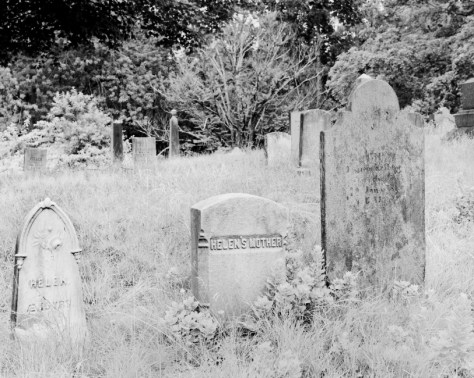
Schuman spent some time trying to think of ways to illustrate these odd statements and eventually came across the work of Emily Dickinson and her use of ‘slant rhyming’ – which is  where the rhymes do not really match, they are close and give an inharmonious sense of sound. She also wrote a poem called ‘Slant’ which starts “Tell all the Truth but tell it slant – Success in Circuit lies”.  Working from this Schuman took a series of photographs in the area that are partially paired with the words, that tell stories, that might be the truth – or might not. The images themselves, black and white and often beautiful also often have something slightly askew, a small boy burning something – but what. A notice for a Bible Study Group – that says Happy Resurrection.  Schuman says he chose black and white for these images as it echoed the “black and white” tone of the police reports.

slantphoto33
© Aaron Schuman
slantphoto19
© Aaron Schuman

In an interview in the BJP, Schuman says, ‘Slant is about telling the story gradually……it’s the idea that the truth is malleable, ever-changing and diffused in a way……I like the slow burn…..there’s something here, but you’re going to have to find out’ (Pantell, 2019) .

He was also inspired by the book Time in New England by Paul Strand and Nancy Newhall where Newhall searched for texts that reflected New England and the texts and the images were put together to make a complete story (Strand and Newhall, 1980) .

The book is fascinating and shows yet another way of integrating text and images. In this case they hold equal value, but the images do not directly link to the text and the text does not explain the images. Together they tell a story of a place in America, a rather scary place. A beautiful place – but one which clearly has some unusual people residing there.

To see more images, look on his website: https://www.aaronschuman.com/

There is a fascinating (and very long) interview on ASX that is well worth reading which explains his thought process in detail (Feuerhelm, 2019).

References:

Feuerhelm, B. (2019) Aaron Schuman: Slant Interview. At: https://americansuburbx.com/2019/05/aaron-schuman-slant-interview.html (Accessed 02/06/2020).

Pantell, C. (2019) ‘Parallel Lines’ In: British Journal of Photograohy (7885) pp.68–77.

Schuman, A. (2019) Slant. London: Mack.

Strand, P. and Newhall, N. W. (1980) Time in New England. Millerton, N.Y.: [New York]: Aperture ; distributed by Harper & Row.