I have been looking at a lot of photobooks for research for putting together a narrative for A3
Looking at lots of mags as above
Also looking online – Lenscratch, Aperture, FOAM etc
In spite of all that still not clear!
Reading Will Gompertz on 150 years of modern art
A very short book on Art Theory
Continued reading Creative Vision
Finished watching the Disability Century
Oddly enough (and perhaps because of), despite the plethora of available talks, shows, etc on the web I am having great difficulty getting organised to watch them. Either they are at an awkward time (and I then forget to go back) or I just do not get my act together
Do a diary of things to watch
Actually watch them
Brief write up
Thinking and doing:
Almost finished A3, got an idea on the story and done lots of research
Had an idea for A4 (images and text) – using words generated by thought about my recently deceased mother
Continuing with the Coursera on Modern Art
Photography:
Continuing with lockdown diary
Changed it slightly to be less rigid
Included more experimental photoshop work
addded in taking pics of people walking their dogs (a la Arnatt)
Started playing with calotypes
Started with pack of pre-done paper
Thinking about how to make my own
Collecting plant material on walks
Experimenting with microwave pressing – using cardboard
Dayanita Singh’s book Go Away Closer is described as a novel without words, a tale of opposites, connecting personal losses with collective sadness. The series was originally produced for an exhibition, with the images in museum style display cabinets that could be arranged in a multitude of ways. The secondary production in a small photobook of 40 images has, to some extent, confined them, settled the images into a specific configuration. Singh does not add any text or titles to explain the meanings. In an interview Singh has said that she actively ‘withholds’ narrative information (Rafa, 2013). The images are a selection of portraits, empty interiors, and close ups. Some, like the starting image in the book,a young girl lying on a bed, are acutely personal, other like the ending image of wet pavement, seem distanced. There is no story other than an overall feeling of change and despair, loss and mourning. But I am not Indian. Maybe the images would not read that way to someone from her culture. In an interview or the Guardian Singh says, ‘Go Away Closer is what happens between people: I can’t live with you, I can’t live without you’ and also ‘that there was a more interesting way to edit photographs – not through an obvious “theme” but through what’s going on intuitively or subconsciously’ (Malone, 2013).
Singh has moved from creating fixed exhibitions to what she calls her ‘museums’. These consist of groups of related images that are placed within wooden structures of 30 – 40 images, but these can be changed out for other images, and she may change them even within a single show. The set becomes a reflection of her feelings at the time, not a constant and unchanging one.
Her online blog (Singh, n.d.) made fascinating reading giving advice to new photographers, details of her thought processes about the development of her museums and writings about her work from others. The letter by Rilke that she quotes gives very pertinent advice to anyone engaged in a creative process, but especially to anyone lacking confidence in their own self worth as an artist. ‘So, dear Sir, I can’t give you any advice but this: to go into yourself and see how deep the place is from which your life flows; at its source you will find the answer to, the question of whether you must create. Accept that answer, just as it is given to you, without trying to interpret it. Perhaps you will discover that you are called to be an artist. Then take that destiny upon yourself, and bear it, its burden and its greatness, without ever asking what reward might come from outside. For the creator must be a world for himself and must find everything in himself and in Nature, to whom his whole life is devoted.’ (Rilke, 1934).
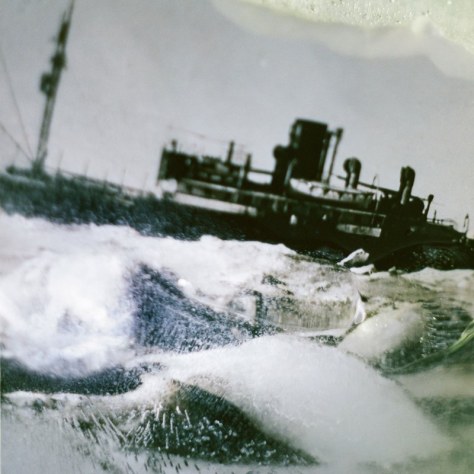
Julia Borissova in White Blonde (Borissova, 2018) is telling a story about Antarctica – she says, ‘though my series I aimed to convey a feeling of he hostile and unfamiliar environment of the South Pole, creating images where the geographic reality give way to the space of dream’. She has used a combination of archival photographs, found objects and self images to explore personal and collective history. The book is short, consisting of just over 20 images. Some are full bleed, some across 2 pages and other overlap each other. They are given consistency by their tonal range, whites, pale blues, greys, beiges and black. The only bright colour (red) is in the additional print sent with the book which shows crimson folded hearts with a portrait of a woman – I assumed it was a self-portrait however now know it is actually part of Borissova’s series Lullaby for a Bride. Most of the images are blurred or overlaid with what looks like ice. In reality Borissova did actually freeze the images to get this effect, ‘to be part of the landscape to express a sense of awareness of time’ (Arena, s.d.). Borissova calls her self-portraits ‘icebergs’. The overall feeling is of age, confusion, and exhaustion in a strange landscape. It is not clear whether or not Borissova has visited Antarctica, although I do not think so.
Her images are available in the book white blonde, on her website as single images and as a slideshow. Interestingly, the order of the images is different between the book and the slideshow, they are often cropped differently (all the images in the slideshow are square and this was the original format) and not all images occur in both. The book and the slideshow are complimentary, not equal but additive.
The book requires careful examination. On my first viewing I found if difficult to follow. Some of the images are beautiful, others are confusing, some are clear, some are abstract. On multiple views I found myself sucked into the cold and the ice. They are a meditation rather than a clear story and are worth reviewing time and again.
With thanks to Julia Borissova for additional information and pointing me towards the review on Landscape Stories.
Context and Narrative by Maria Short looks at how the planned purpose of an image can alter how you take it and how your visual language needs to vary depending on the circumstance.
The photograph:
How you show the ‘truth’ depends on the intended purpose of the image
A photo can go beyond a simple recording and take on a different personal meaning
Need to consider the context, social commentary, photojournalism, the personal experiences of the photographer
What is the ’truth’ in a constructed image? Can it be ‘deeper’?
You need to be both engaged with the subject and detached to allow for objectivity
Need to read the brief carefully and plan what you are doing if there is limited time
For a self-directed brief it may take of in unexpected directions
The context within which the photo will be seen is crucial, remember the culture may be different
Consider how the images relate to each other
There may be a need to make repeated visits to a place to learn the nuances before even starting to take pictures
Subject:
Need to be passionate about something and committed
What do you want to show? Why does it need saying? Why a photo?
Need for as full as possible understanding of your subject – leads to insight
What camera format will work best? How do you avoid being over intrusive?
Need for both humanity and vision, shows the things that are inevitably absent (smell, noise, quietness)
Look to create empathy – see Stuart Griffiths – Homeless Ex-Service
Audience:
The photographer should seek an audience which will accept his vision (Brodovitch) – How?
Think about what the image is intended to show, how you want the viewer to feel
Need for truthful communication – authenticity
Be aware of the attitude of potential viewers, and their understanding of the subject
Context and how do you tell it?
Shape, size and ordering of images inform a series
The photo is a subjective impression of what the photographer sees – not someone else’s vision
Narrative:
A beginning, a middle and an end – sometimes
Can be linear – but does not have to be
Is it a typology? A photo essay? Or what
Is the sequence crucial – or could the images work as standalone frames?
Look for coherence – visual continuity with lighting and tonal range, consider the format
Is the story sequential – or several snippets that link together?
Do you have control of the order the images are seen in?
Do all the images need to be the same size? What about pairs, or triptychs?
Need to be clear about the intention for the project
A single image can also be a narrative – it might be taken as a ‘one-off’ or actually originally have been part of a series
The more the photographer is absorbed in the moment (and the more they understand the process) the more likely an image is to tell a story – the unconscious takes over
Kim Sweet – the average subject, need to experiment and explore the idea
Signs and Symbols:
Saussure – sign is a signifier (form) and the signified (concept it represents)
Pierce – representamen (form) + interpretant (sense made of it) + an object to which the sign reference
Barthes – studium + punctum
Signs can trigger memories, can explain an image
Symbol represents something, an icon resembles it
Indexicality – a photo is a trace (therefore notions of truth)
Signs and symbols included in images need to be considered – may or may not be planned
They will influence how a viewer reads the image
What you understand from your own image is crucial – if you don’t understand it how can others
Signs and symbols can control the pace of a narrative
Text:
Might be a simple informative caption, or might be an essay, or a book! Think what is needed
Think about context of viewing
Draw on literature as part of the research either using as quotes or getting ideas
Use as a multidimensional addition to work
Does the image need the text to make sense?
What about the use of text within the images, as part of the photo?
Use of handwriting (very different from print)
Use of a diary format
Reference:
Short, M. (2018). Context and Narrative. London; New York: Bloomsbury Visual Arts.
David Hevey is a producer, photographer and storyteller. He is also the director for The National Disability Arts Collection and Archive. He has written books and made films. Among the films is a 3-part series ‘The Disabled Century’ that was made for the BBC in 2012. It can be watched in full on his website. This film concentrates on physical disability, cerebral palsy, dwarfism, hearing impairment although there is also some mention of mental health problems including bipolar disorder and PTSD. The 3 episodes can be seen here:
Shocking images on film of people with ‘shell shock’ (PTSD) from WWI – images that would rarely be taken now, associated with talk by ex ambulance driver about his memories
Images from the time on film interspersed with stills and films of people now and their memories
“That’s what happens with war -Nobody wants them”
Talks about people ‘locked away’ under 1931 Mental Defective Act – intercutting film of the past with the present day – telling what happened and how he felt
Deaf and dumb also sent away, segregation ‘considered caring’
Operations to ‘fix’ Dwarfism – to stretch people – effectively torture
Tended to have a poor prognosis given especially about life extent (often far from accurate).
Disabled workers employed in WWII – often to first work they were given
Photography – mixture of grainy film as lots of harrowing images, mainly of groups or from a distance which emphasised the differences and the oddities and new close-ups which showed the humanity, often focusing on only parts of the faces, hands or body, often overlayered with film shots of what was happening at the time. Still unsparing – but somehow more human. Is that because you are hearing the story in the people’s own voices?
Episode 2 – 1945 – 1969
Disabled veterans were heroes, society owed much, developed plastic surgery to treat burns
NHS included support for disabled people – created a system of state-run homes/hospitals
Many disabled had no choice about whether or not hey would go to an institution, spent years there, lonely and bored
Treated as though ‘we were nothing’
Thalidomide – syringomyelia – led to issues about compensation and should you be made to wear artificial limbs
Investigations for medical curiosity ‘I felt that I was property …. A bit like a lab animal’
Started to see the treatment of disability as an injustice
Pictures of the past interlaced with personal stories and reminisces. Traumatic stories of punishment and treatment. Wards cramped. Beds on top of each other. very aware of the possibility of death (both own and others). People talking are very eloquent – makes a mockery of the assumption of uselessness. Pictures still the extreme contrast of close-up now and distance images from the past. Shows a stunning image of a thalidomide lady surrounded by artificial legs, telling her story.
Episode 3 – 1970 – the present
Talking about the grim reality of mental health wards in the 70’s
Not allowed to think or make choices
But leaving could be a shock after a life in an institution, leaving home, leaving friends
Care in the community was lacking in resources
Need for self acceptance and knowledge of who you were, important to meet other people
1995 disability discrimination act – but no enforcement
“Here I am, you have to deal with me”
“We are proud of ourselves”
But, in reality, few jobs, much poverty and much to little support.
Ongoing contrast between old images and films shots, grainy, often in B/W, again distance shots versus close-up, sharp focus, colour of modern storytellers. Often overlaid, old on new, multiple sounds tracks implying the confusion of what happened to many people. Dark and light, flashing lights and images. Real life stories on fantastical (horrific) images that are hard to believe. Parts of faces, parts of bodies – implying need to look closely, to concentrate.
Conclusion:
The overall series is hard to watch, makes for a grim story of disability in the past, and, unfortunately, also in the present. The series was made nearly a decade ago – but little has changed. Most people continue to ignore the disabled, the resources are limited and there is little public understanding.
This is an overlap March/ April. Things remain strange because of Covid and self-isolation. You would think that that would make it easier to work – but in practice my concentration is poor, and I am so easily distracted. Everybody is posting things to do, things to watch, virtual tours of museums and galleries – and its far to easy to flip from one thing to another rather than any serious thinking.
Reading (and watching):
I am re-reading Context and Narrative for background for A3
Still reading about general art theory to back up my woeful lack of knowledge
Finished this issue of Aperture – on House and Home – some interesting stuff on home especially the article on the work of Ed Panar Walking through Walker Evans
Lisa Barnard – The Canary and the Hammer – really fascinating documentary type work on the extort of gold. Shows how it is possible to interweave a multitude of threads into one coherent story, includes historical images and documents alongside Barnard’s own pictures and writing
Margaret Landsink – Borders of Nothingingness – On the Mend – a fascinating and beautiful book on her relationship with her daughter
Polly Bradon’s books on ASD and LD – relevant for redo of A2
Watched the James Fox series on art – The Age of the Image, absolutely fascinating and very useful. Will watch again and take some notes. Also need to follow the links to the OU about whether or not we can trust what we see.
Watched episode 1 of David Hevey’s documentary on Disability – absolutely harrowing.
Rebooked at work of Arbus in the context of disability
Started reading Creative Vision by Jeremy Webb. An old(ish) book, but really interesting for getting ideas of different ways of working
Thinking and doing:
Have managed to redo A2 using the ASD family images and written it up and posted on the back of my report from tutor – which was a fair but damming!
Working on sorting out my multiplicity of images on DWARF for A3
Missed the bi-weekly hangout for photography – I need to be much more organised and put them in my diary, so I remember them
Started on a Cousera course on modern art for more background understanding
Photography:
Now working on a ‘Lockdown diary’ taking a daily series of images
Where I am in the house at 1200
Weather outside at 1200 (or as near as possible) taken of the sky and a tree from the same place
Screen shot of the news and the weather (also both at 1200)
A piece of still life, experimenting with different places, different methods and photoshop effects
If I manage outside – a picture that shows life in isolation, deserted park, one person in the distance etc
I am also linking this with a poem I have read and a story from 365 days
The objective of this assignment is to provide you with an opportunity to explore the themes covered in Part Two with regard to the use of both studio and location for the creation of portraits.
This assignment is about taking what has worked from the above exercises and then trying to develop this further in terms of interchanging the use of portraits taken on location (street) with portraits taken inside (studio).
You need to develop a series of five final images to present to the viewer as a themed body of work. Pay close attention to the look and feel of each image and think of how they will work together as a series. The theme is up to you to choose; you could take a series of images of a single subject or a series of subjects in a themed environment. There is no right answer, so experiment.
One of the possibilities I thought about for assignment 2 was to take images of people within their own house, using artificial lighting. My final choice of subject involves this. The room has become the studio. This contrasts with my earlier images for this section which were almost all taken outside with natural light.
Research:
I looked at several photographers portrait work for this including Martin Parr, Christophe Agou, Paul Graham, and Walker Evans and also researched work done taking images of people with disabilities such as Louis Quail in ‘Big Brother’, Siân Davey with her work on her Down Syndrome daughter in ‘Alice’, Polly Bradon’s work with the learning disabled and people with ASD in ‘Out of the Shadows ‘ and ‘Great Interactions’ and Lesley McIntyre’s photoessay on the life of her daughter ‘The Time of Her Life’. I also looked at Diane Arbus’s somewhat controversial work where she took images in a home for learning disabled people (Diane Arbus). There is a harrowing film series done by David Hevey on disability which uses the contrasting images of then and now, to tell a part of the story about disability: see David Hevey – The Disabled Century for more information.
Taking pictures of people who are aware of you is discussed further in Project 2 – The aware and Project 2 – The Aware – 2. Most of the work that I found about people with disabilities either involved people with a learning disability, severe mental health problems, or severe physical difficulties.
Background Information:
This series is about a couple who both have autistic spectrum disorder (ASD). This is a condition (I refuse to call it a disability) that I have worked with for many years and, if I have learned anything, I have learned that the people with ASD and their families are not defined by the label. Each person’s story is different, each family’s story is unique, just as for any other person and any other family. To tell the story properly takes time, a lifetime, both yours and theirs. This is just a snapshot.
Plan:
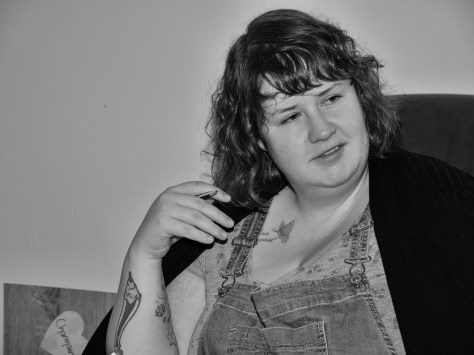
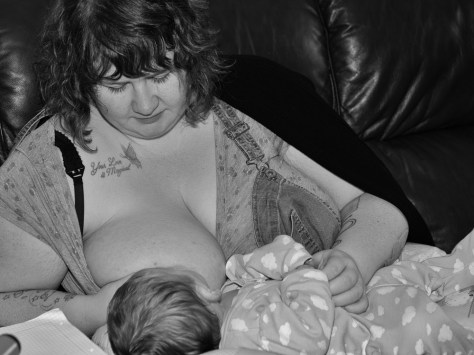
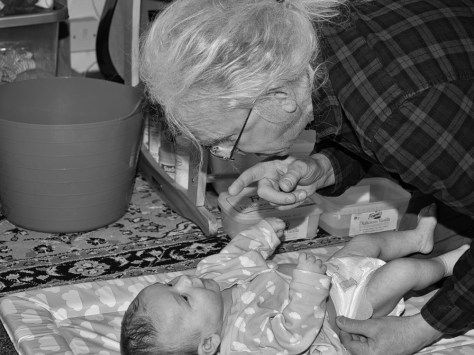
For this series I took images of a couple with autistic spectrum disorder (ASD) and their young child. Janey and Rich were kind enough to invite me into their home and give me permission to use the images. Unlike most of the work on people with disabilities looked at above neither of them has a learning disability. Janey is an author, rarely seen without a pencil and a notebook, and Rich works with computers. Their motto is ‘Anything you can do we can do too’ – although, as Janey went on to explain, that does not include working at a busy supermarket till ( but who would really want to do that from choice).
Practice:
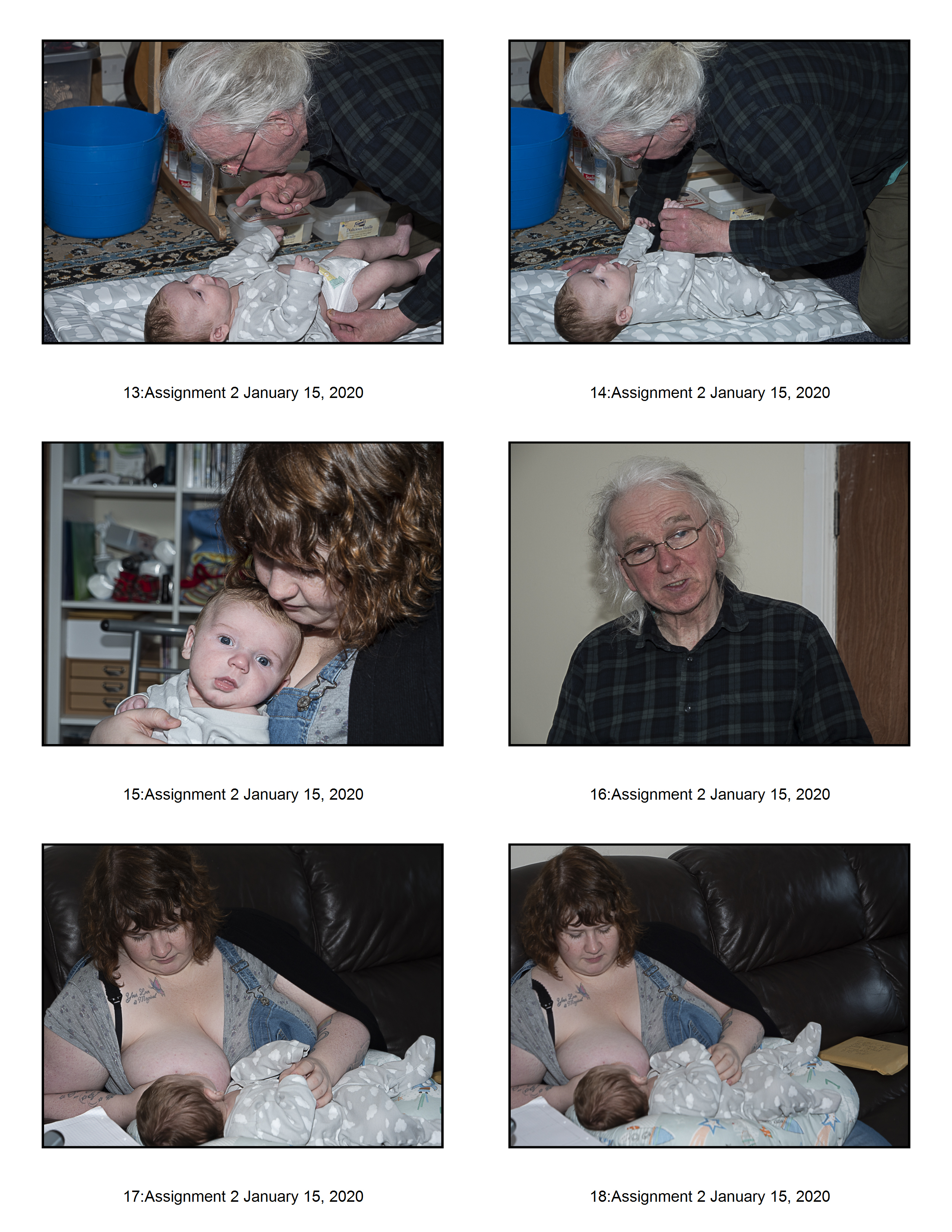
I met Janey and Rich in their home. It was the first time I had met Rich, so he was naturally somewhat guarded with me, although eventually relaxed. We spent some time talking and then I simply started taking pictures of their interactions with each other, me and their baby. One of the difficulties people with ASD have is with eye contact, especially with strangers and this is evident in all the images.
I used a combination of natural light, the artificial light in their flat and a flash unit.
I visualised these images from the start in black and white, partly because it echoed much of the earlier work I had seen and partly because it gives a softer light and timeless feel to the images.
Conclusion:
This was a fascinating piece of work to do. It fits within a much longer work I am planning about the lives of people with ASD and that of their families. I am planning to mainly concentrate on work with adults with ASD as little has been done photographically with this group.
The difficulties were:
Working inside with limited light
Allowing enough time for the family to relax without being there so long that I risked overwhelming them
The positive aspects:
Building a relationship
Exploring a new (to me) type of way of working
Images:
RichJaneyMotherSustainerFather
Learning points:
Be confident that you can do things
Relax and the subjects will also relax
Take enough images to allow for problems with the light
With sincere thanks to Janey and Rich.
Reference list:
Arbus, D. et al. (1978) Diane Arbus. London: Gordon Fraser Gallery.
Braden, P. (2016) Great interactions : life with learning disabilities and autism. Stockport: Dewi Lewis Publishing.
Bradon, P. and Williams, S. (2018) Out of the Shadows. Stockport: Dewi Lewis Publishing.
Diane Arbus (1923-1971) was an American photographer who, according to Wikipedia (!) ‘worked to normalise marginalised groups and highlight the importance of proper representation of all people’. (Wikipedia contributors, 2019). Her work has become controversial simply because of that. She called the people she photographed her ‘singular people’ and they were often different, disabled (both physically and mentally) or had other things that set them aside from high society: nudists, transvestites, Jews. Her images are often stark, usually graphic and highly revealing. I have looked at her work before in Self Evidence – Woodman, Arbus and Mapplethorpe (after seeing an exhibition) and Reading Images (in response to a research question).
Over years I have worked with people with a range of disabilities similar to those Arbus photographed and find her images both disturbing and tender. How I interpret them depends on my mood. On one day I think “How could she” and on another I think “that is perfect”. In the book ‘diane arbus’ (Arbus and Arbus, 1990) she is quoted as saying, “You see someone on the street and essentially what you notice about them is the flaw” and “there are certain evasions, certain nicenesses that I think you have to get out of” and “Freaks was a thing I photographed a lot. It was one of the first things I photographed and it had a terrific kind of excitement for me…. they made me feel a mixture of shame and awe…. they’ve already passed their test in life. They’re aristocrats” and “I work from awkwardness, by that I mean I don’t like to arrange things. If I stand in front of something instead of arranging it, I arrange myself”. On looking though the images in that book the odd thing that struck me was that the happiest, and most honest, smiles were in the images of the people with learning disabilities.
Her images are black and white (although colour film was available), square format (a Rollei) and usually low key. Often the most important part of the image is dark. Most of the portraits are taken full face on, with the subject looking straight at her – has she actually arranged them? Or is this just how people expect to be photographed?
She gave the marginalised people a voice, whether or not it was a voice that they would have chosen is an interesting question, but a least she engaged with them rather than ignoring them.
References:
Arbus, D. and Arbus, D. (1990). Diane Arbus. London: Bloomsbury.
Following my tutor’s response and suggestions for assignment 2, I am going to shift the images to my alternatives. Under more normal circumstances I could simply redo the original images, taking on board his comments, but that will have to wait for another time.
The second set of images tell a (very) small part of the story of Rich and Janey, an autistic couple I met as part of a long-term project on autistic people and their lives. They were kind enough to let me into their lives and their house. I was not originally going to use it for A2 as they are not studio (either inside or outside) images, but, as pointed out by my tutor, I could consider their living room as the studio, and I did use flash (so artificial lighting).
Janey’s life is not easy, but her principle is “(almost) anything you do I can do too”. The exceptions are things like working a till in a busy store – but who realistically wants to do that. She is an author, and rarely seen without a pencil and a notebook. Rich works with computers. Their most important role is that they are parents and are determined to give their child as much love as possible.
Practice:
The images were taken inside with a mixture of artificial light and flash.
I visualised these from the start as black and white – but (as usual) can see both colour and B/W working
B/W seems to fit with the narrative tone of the images and reflects early images of people with difficulties, but without (I hope) the negative connotations
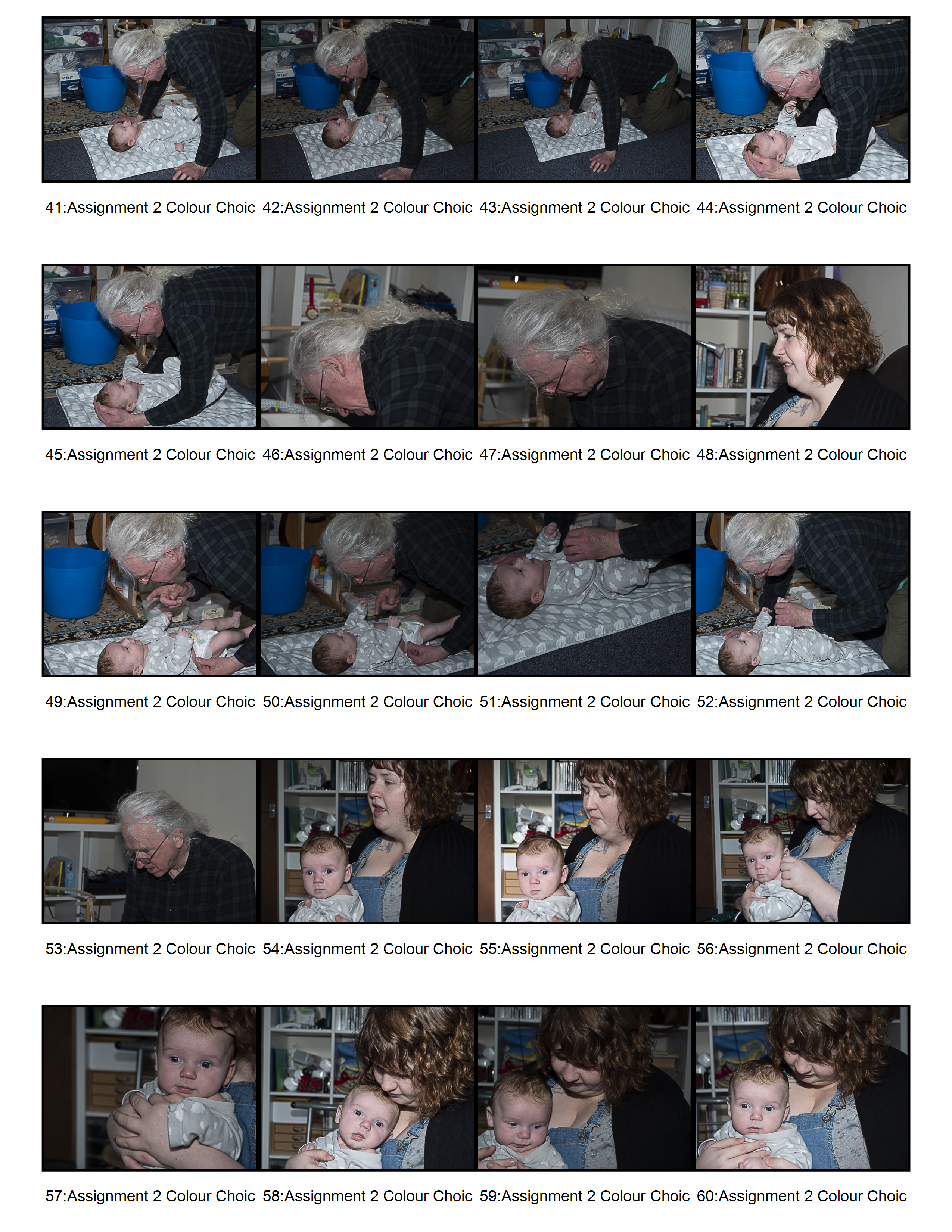
B/W avoids the concentration latching on to some of the random items in the room such as a very blue bucket
Colour is more current, and, possibly, shows more about their surroundings – but do I want that?
I took some time chatting to them both as it was the first time I had met Rich (and only the second with Janey). Then just started taking pictures of what they were doing and how they were interacting.
I have shown the images to Janey and Rich and they were pleased with them and agreed to their use.
Where I am:
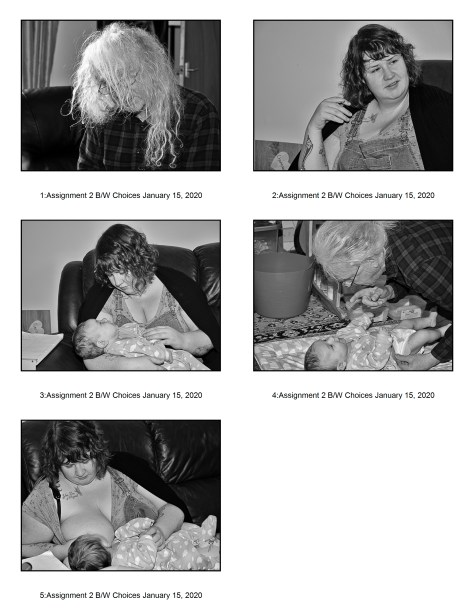
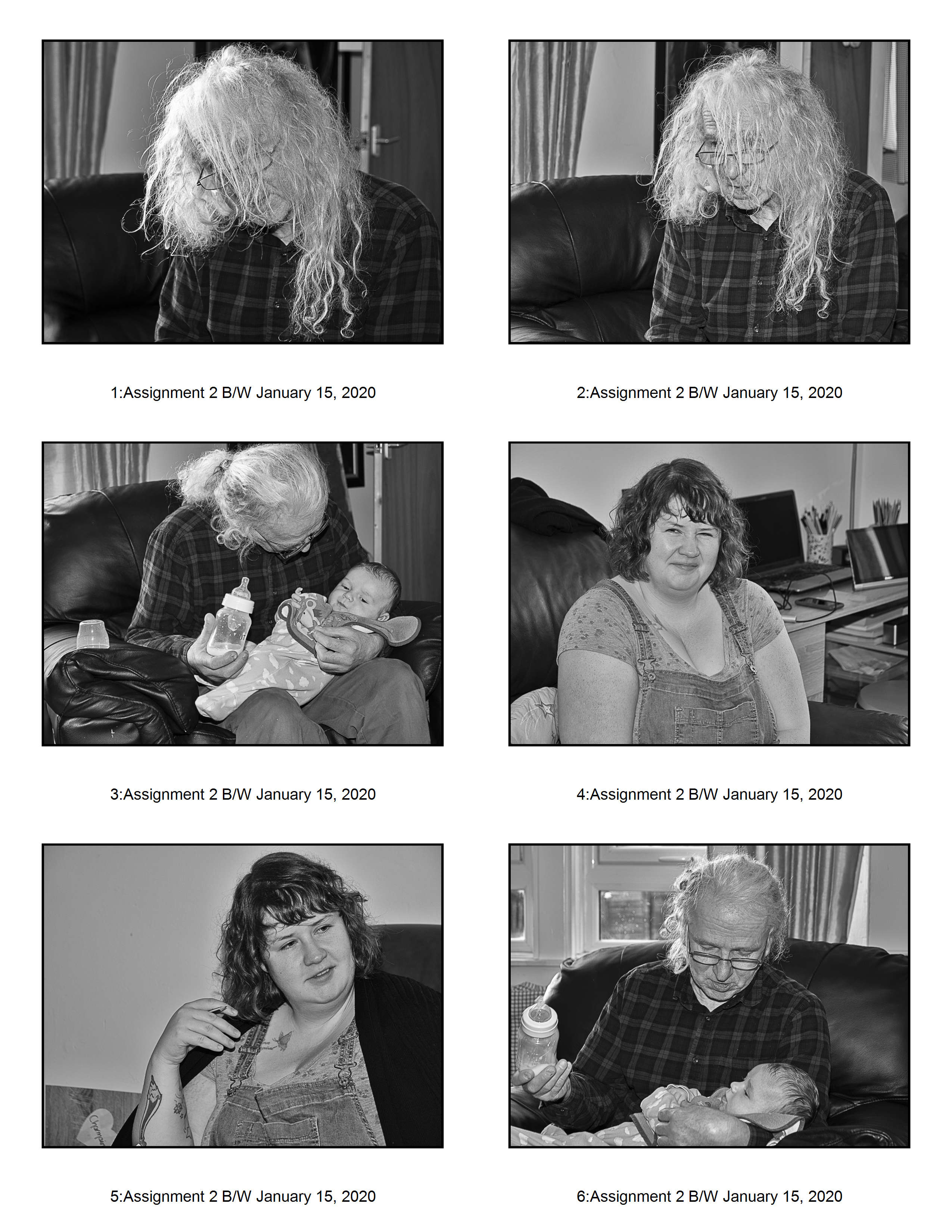
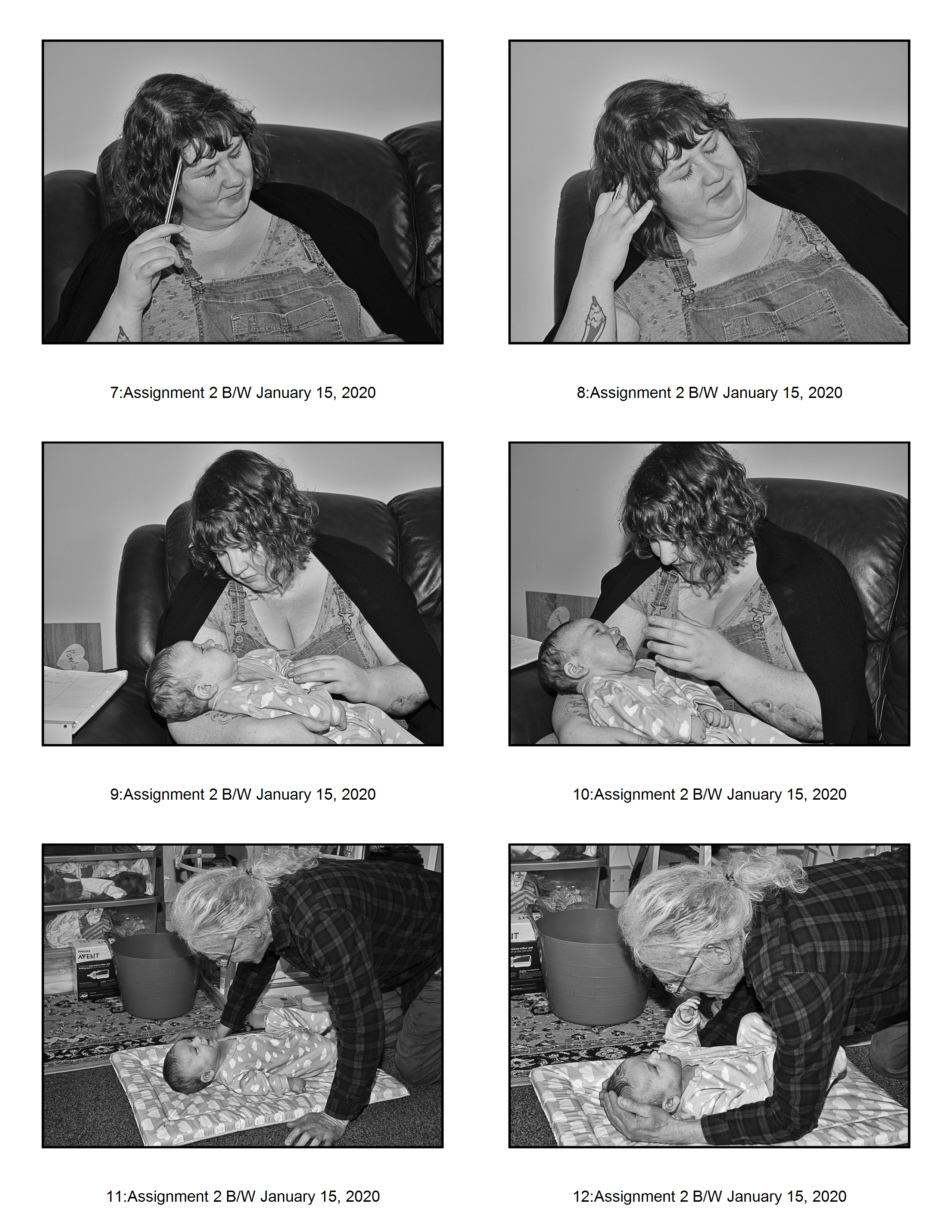
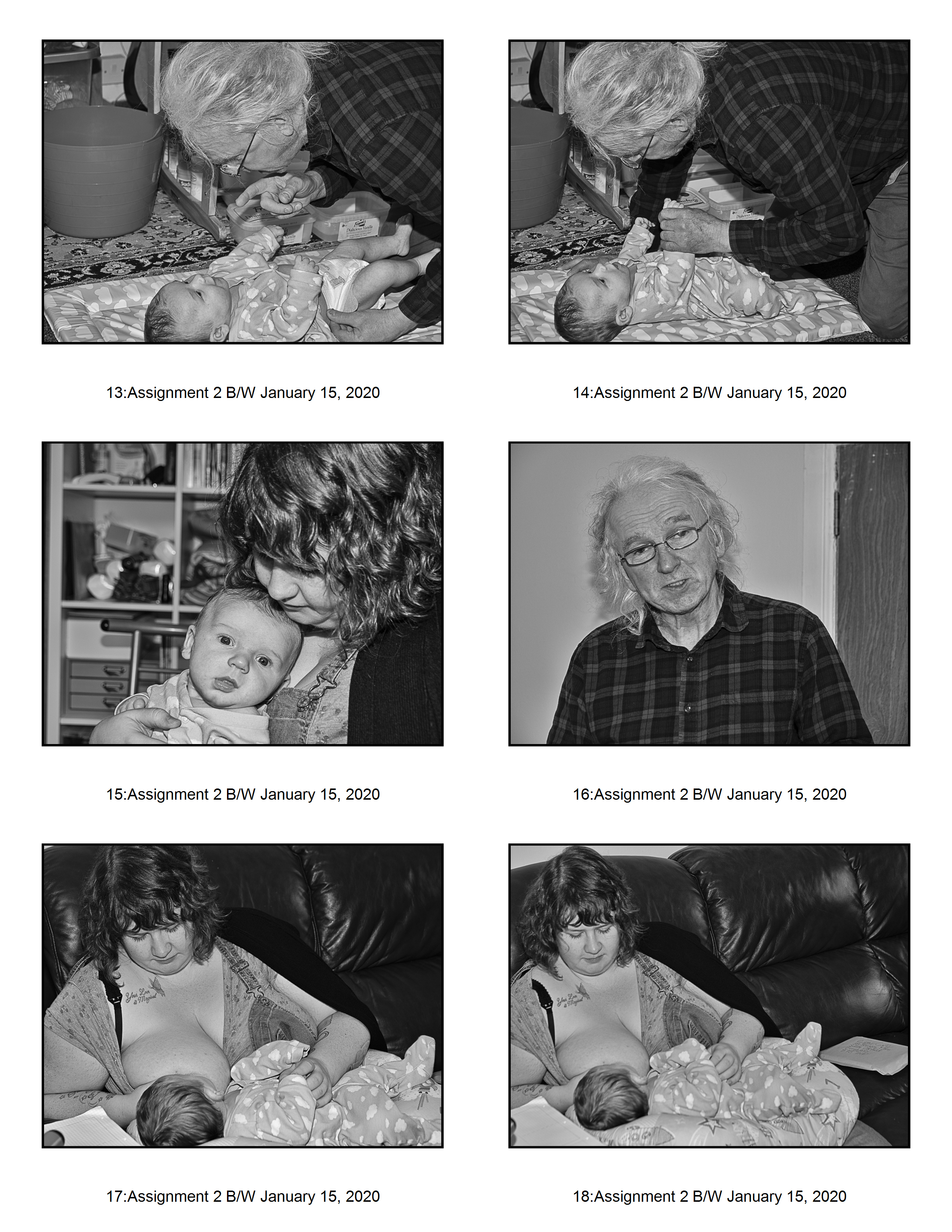
I think I have chosen my preferred 5 images, having originally cut down from 68I to 19 (19 shown in contact sheets below)
Need to decide on colour v B/W
Need to add some more research about photography of disabilities
Choices – interestingly the B/W images and the colour are not identical pictures:
I have now received a very comprehensive formal review on assignment 2 from my tutor. Usually I find a face-to-face feedback (via hangout or similar) more helpful, but that was not possible this time, however the amount of information given was extensive.
Overall, he seemed pleased, but with some caveats.
The tutor’s comments are blue, my responses black
The assignment:
However, (taking sentiment out) I do feel that better planning and a more considered use of the set-up would have resulted in a more consistent series of images.
I totally agree with this. I ended up taking the images in a rush, partly because of the endless delays on the shoot due to illness and weather, partly because Sam was clearly getting bored. I had planned on trying to redo them, but again this was delayed and then became impossible
I know it isn’t your assignment submission but I feel that the project you also worked upon with the autistic couple and baby is really interesting and shows great potential. I’m not sure how much you have shot (70?) and you decided against inclusion as assignment due to the studio brief but personally I find these images (potentially as I can only see 12) stronger and more engaging. They feel like they are born out of a more collaborative process and less intrusive, there is empathy but also distance and rawness to the images
I also felt that these images were stronger, I had a good, but not too close, relationship with the family. I didn’t use them initially in the assignment as I was trying to keep to the ‘studio’ part of the brief. I will have another look at them and work them up as a set.
Research:
A positive response here. Helpful to know that the ‘regular reflections’ make sense.
Learning log:
My only concern is that there is so much of it in different folders and the future assessment team would have difficultly viewing it all. Make sure that the more relevant folders such as research are kept up to date with the most relevant information
I struggle with this. Maybe everything that is directly related to the assignments should go in the ‘research’ folder, and everything else divided up.













 Identity and Place