Douglas Huebler (1924-1997) was a pioneer of Conceptual Art. He started as a painter, moved towards sculpture and then to making his series that he called ‘Duration Pieces’, ‘Variable pieces’ and ‘Location Pieces’ in which he documentaries places, people or everyday activities using photographs, maps and drawings. One example of this is Variable Piece # 101. In this piece he took 10 pictures of Bernd Becher who was asked to pose, in the following order, as: “a priest, a criminal, a lover, an old man, a policeman, an artist, Bernd Becher, a philosopher, a spy, and a nice guy.” Some months later, when Becher had presumably forgotten exactly what he did, he sent the images back to Becher and asked him to identify each face. Huebler then exhibited these pieces together with the list of what he had asked Becher to act out and the list of Becher titles. He was very clear “Ten photographs and this statement join together to constitute the final form of this piece.” The whole work of art was constructed from both the images and the list – but he only identified the images by number and did not say whether the list of titles belonged to his original order, Becher’s order, or indeed a completely different order. It was further confused by the fact that the work was exhibited twice, once in the Los Angeles Museum of Contemporary Art and once in Limoges and catalogues lists exist showing both of these, but the images are shown in different orders in the two places and only numbered in the Limoges catalogue. Two of the images are actually different between the two catalogues.
Hilda and Bernd Becher
Bernd Becher himself was a notable typologist, usually working with his sister Hilla Becher. They photographed industrial structures such as water towers, and factories, always in black and white. They showed the images in sets (typologies), usually layed out in a grid pattern. A quote from them on the Tate website says ‘We photographed water towers and furnaces because they are honest. They are functional, and they reflect what they do – that is what we liked. A person is always what s/he wants to be, never what s/he is. Even an animal usually plays a role in front of the camera’ (Tate, 2016).
Huebler’s work in Variable Piece 101 plays on the typology work of the Bechers, both by using Becher himself as a participant and also by laying the black and white images out in a grid. However, unlike their work where there is no ambiguity, the piece by Huebler is full of it. Which image is which? Which image did Becher identify as what? And why did he change the pictures between the two exhibitions – and which set did he show to Becher to be sorted? The title causes confusion rather than clarity. In an illuminating essay by Hughes, he points out that Becher turns the whole exercise back on the Bechers, confusion not clarity, a person rather than buildings (Hughes, 2007).
Catholic Priest 1927, printed 1990 August Sander 1876-1964 ARTIST ROOMS Tate and National Galleries of Scotland. Lent by Anthony d’Offay 2010
Huebler also comments photographically on the earlier work of August Sander and his typologies. The ‘types’ that Becher is asked to perform are some of the types that Sander divided his portfolio into; philosopher, policeman, priest, old man, criminal, and artist. However, Sander showed his images as individuals, rather than in a grid pattern. Huebler is subverting Sander’s work in that it is impossible to tell which face is supposed to be which character, and, of course, they are all images of one person. It is possible, and an interesting exercise, to cut out the faces from some of the less well-known photographs by Sander, present them to another person in a random order, and see what ‘type’ they would be identified as. Even if you gave a list of possible types I suspect that everyone would order then differently.
This piece of work emphasises how crucial it is to know the intention of the artist. The meaning of the images here are elusive. The titles are potentially misleading not clarifying. The piece needs to be seen as a whole. What is Huebler telling us? The clearest reading is not to believe the obvious. To be aware of potential for confusion. Nothing is fixed, all is variable. The meaning is what you see which may be different from what the person next to you sees.
References:
Hughes, G. (2007). Game Face: Douglas Huebler and the Voiding of Photographic Portraiture. Art Journal, 66(4), pp.52–69.
Self Evidence is an exhibition at the National Portrait Gallery of Scotland, which is being shown, appropriately, in the Robert Mapplethorpe Gallery. The three photographers shown were all interested in the idea of identity, or the self, and how to show it.
Arbus is a fascinating photographer who took a collection of images of what she called her ‘singular people’. These were often of people who were different in some way, for instance, the Jewish giant, and the images of people from nudist camps. There are ethical dilemmas in her images, especially when looked at from todays stance. Did she ask permission? Did she explain how she was using the images? Did she pay for them? The answer to all of these is probably no – but nor did any of the photographers of her time. She undoubtedly took images that would be difficult to take today – those of people with a learning difficulty and physical challenges. Nowadays we would need to find out who has the appropriate guardianship and rights of welfare attorney, get formal permission, and credit the people involved. Does that mean the images should not have been taken then, when it was a different world? Does it mean they should not be shown now? What is obvious from the images is that Arbus engaged with the people. For the images of those people in a nudist camp she took the pictures while naked to make them feel comfortable. She talked to the people with learning problems and visited them – something that was rarely done at that time, when ‘mental issues’ were hidden away. She gave them a voice, even if they did nor fully understand what was being said. Arbus addressed identity by looking at other people rather than herself.
Diane Arbus – A Young Man in Curlers At Home on West 20th Street N.Y.C. 1966
Diane Arbus- A Jewish Giant at Home with his parents in the Bronx , N.Y. 1970
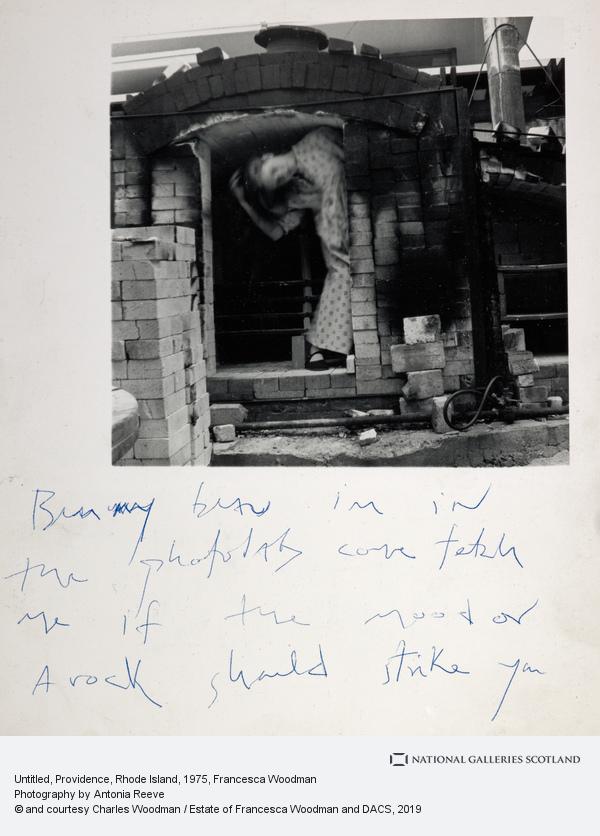
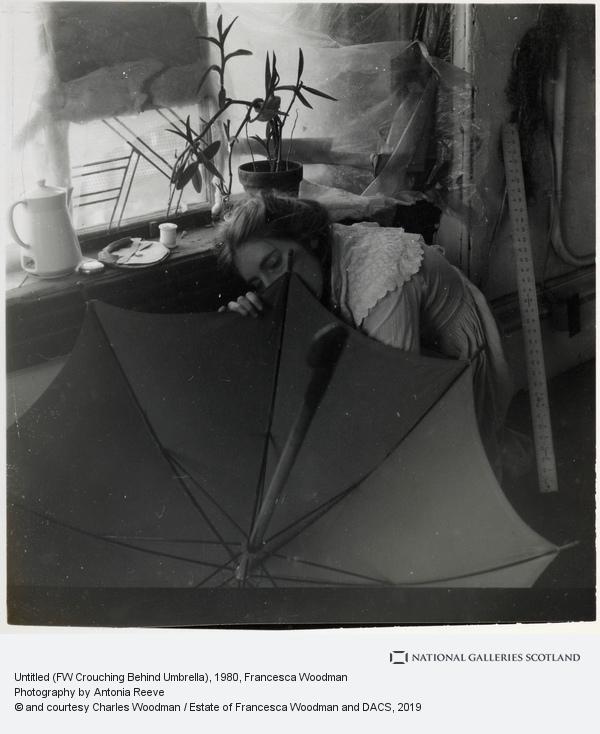
Francesca Woodman (1958-1981)
In Woodman’s short life she took a vast number of images, many which have never been on display. The ones shown in this exhibition are a variety of images mainly of herself or her boyfriend, Ben. They are small, black and white, mostly square. Some have been written across and were used as notes to send to others. Many are partially out of focus. She utilised mirrors, reflections and odd shafts of light to illuminate the important areas. Many of the images show herself partly hidden or on the edge of the frame, such as Untitled (FW crouching behind an umbrella). She becomes a ghostly partial presence. Do the images tell you about Woodman – or hide her? It is difficult to read her images nowadays without considering her suicide at a young age, and wondering what impact this had on her photography – but much of her oeuvre was taken well before that and it is almost certainly simplistic to assume that all the images were taken by someone who was depressed! Much is experimental, much echoes the type of photography and art she was exposed to.
Robert Mapplethorpe (1946-1989)
The exhibition of Mapplethorpe self-portraits shows a range of images from those of him in his early bad boy, leather and whips phase to ones with a suited and serious mien to those taken just before his death. They often show him playing a role, holding a knife or a gun, possibly copying stances from films. They become gradually less controversial, although not completely so. There is one from 1985 which shows him wearing horns. Is he playing as a satyr or as a devil? Is it another riff on his earlier images that use themes from the Catholic Church? The final one is of his face and hand holding a stick with a skull. All else is black. A true play on a ‘memento mori’ image, made more poignant because he was clearly aware of his own impending death. All of the images are beautifully crafted, balanced and set formally within the frame. Whatever you think of his lifestyle and the photographs he chose to take it is impossible to deny that he was a skilled artist, who used his own life to tell a story about a population that was mainly hidden then, and often still is.
It was fascinating to see these three photographers side by side. They all died young, two by suicide, one because of AIDS. They were all interested in portraiture. The photographs they took were very different. Arbus showed her interest in people by taking images of others. Woodman photographed herself, but in an elliptical, sideways way, hiding as much as she showed. Mapplethorpe’s images are clear, in your face and controversial – but does his apparent clarity hide as much as Woodman’s less overt images do?
Mapplethorpe was interested in identity and amongst his huge oeuvre he took multiple portraits, and many self portraits. He was gay, however he initially tried to bury this aspect of himself and conform, but eventually ended up making images that are highly charged, homoerotic in nature, that still have the power to shock, and, over the years, have often been banned from display.
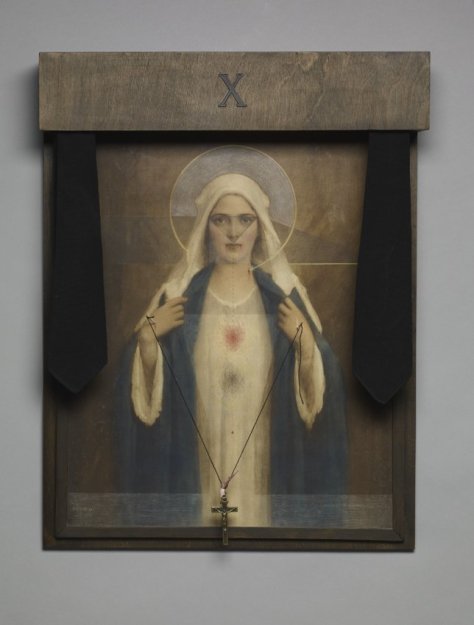
Mapplethorpe grew up in the rebellious years, when the civil rights movement in America was active, gay liberation was starting, the birth-pill became available, and gay pornographic films became mainstream (Deep Throat). He was born into a middle-class family and was said to be a socially awkward teenager. Initially at college he was part of a right wing, strongly heterosexual group, but gradually became more interested in the counterculture movement, started using drugs and became interested in the Cubists and Surrealists. He also met Patti Smith who became a huge influence and support in his life. He initially made mixed media and collage artworks, often based on religious iconography (although with erotic overtones). He had been brought up Catholic, with all the colour, pomp and rituals of that faith.
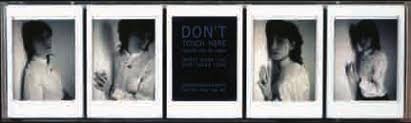
He started photography using a Polaroid camera, initially possibly to make images that he could use in his collages, but then to make images of anything he was interested in, including his lover, flowers, china and odd bits of outdoor scenery. He took many of Patti Smith, but also others of himself in a range of situations. There is one very early series of Patti Don’t Touch Here showing her leaning against the wall, looking subdued and thoughtful, possibly taken by a very possessive friend/partner/lover. Many off the Polaroid images were snapshots, taken in the moment and for the moment. Speed of production was the thing.
Mapplethorpe took self-portraits throughout his career. They were often partially veiled or broken into fragments, he would hand colour parts of the images, and take his body from unusual angles. While he was a certainly free with the types of images he took, with much play acting there was only a limited amount of true self disclosure. In an interview in 1987 he said ‘I would never take a self-portrait when I was depressed…. I don’t want to see that part of me’ (Wolf, 2019). Does all the highly explicit imagery do as much to conceal as to show?
As well as continuing to take homoerotic images mainly of the gay, male s/m community, (which he was an active and enthusiastic part of) Mapplethorpe also circulated in the art and culture high society, taking a series of portraits of the rich and famous, film stars and artists. He excelled in showing their hidden personality. Mapplethorpe was interested in art history and collected photographs by a range of people, including Julia Margaret Cameron and Minor White. He often used these interests to inform his photography, posing people to replicate statues or earlier art works, such as James Ford in his bathtub – like the Death of Marat painting by Jaqueline-Louis David. He also continued to photograph still life images, often showing them in elaborate frames. He moved to using a Hasselblad with its square format and increased clarity, while taking more images of the famous, posed against neutral backgrounds. He had moved from the immediacy of the Polaroid images to producing perfection in gelatin silver prints.
His work became famous and was regularly shown all over the world. He also produced books and limited run portfolios. Many of his exhibitions were contentious, and some were cancelled as being ‘pornographic’ (which they undoubtedly were) – although this raises the ongoing question about whether pornography and art are mutually exclusive. Can they be? And indeed, should they be? Where is the boundary and what side are many of Mapplethorpe’s images on?
Mapplethorpe kept careful control of his work, and, although he did not produce prints himself, was heavily involved in what they looked like, and how many of each edition should be offered. Many of his images were never printed for sale. He was fascinated by symmetry, form and geometry – which the square format of the Hasselblad lent itself to. However, he did not just take nudes, he also took a wide range of portraits and still life images. He always looked for perfection. Something different – he said in 1978 “I want the person to look at least as interesting as they can look… I try to catch something unique in him that no one else has” (Mapplethorpe, 1978, quoted in Robert Mapplethorpe, The Photographs, p57).
Mapplethorpe contracted AIDS and died in 1989, setting up The Robert Mapplethorpe Foundation just before he died. Prior to his death he continued to work intensively but concentrated more on still life images of flowers and sculptures. His images remain a fascinating legacy of a complex man.
References and Sources:
Hartley, K. and National Galleries Of Scotland (2006). Robert Mapplethorpe -National Galleries of Scotland to accompany the exhibition Robert Mapplethorpe held in the Scottish National Gallery of Modern Art, Edinburgh, from 29 July to 5 November 2006. Edinburgh Scottish National Gallery Of Modern Art.
Mapplethorpe, R., Martineau, P., Salvesen, B., Gefter, P., Katz, J.D., Linkof, R., Meyer, R., Squiers, C., Getty, P., County, A. and Musée Des Beaux-Arts De Montréal (2016). Robert Mapplethorpe: The Photographs. Los Angeles, Calif.: J. Paul Getty Museum.
The brief was to make a portrait of someone you know, paying attention to the background and using it to tell something about the subject.
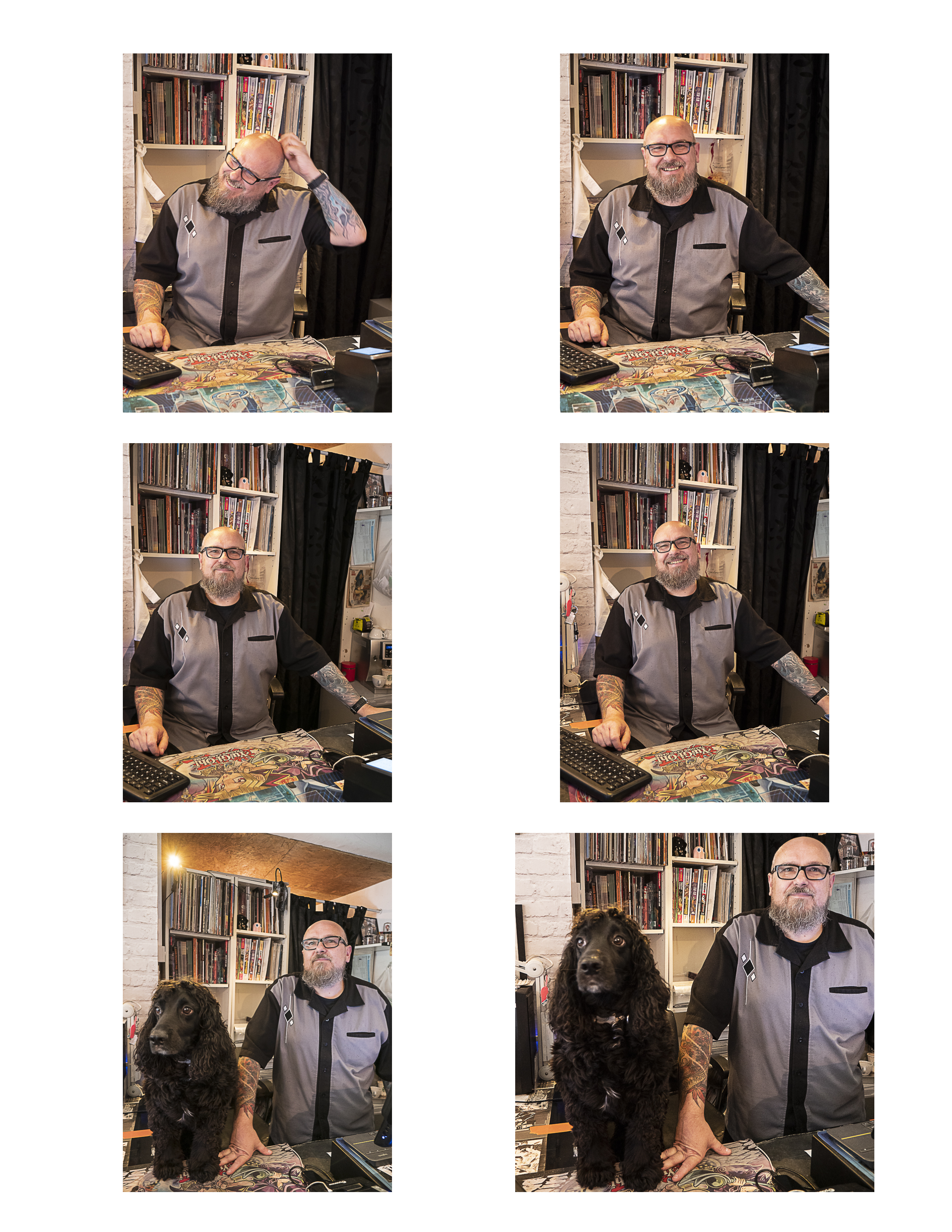
I chose to do an image of Alby. Alby is the owner of our local comic bookshop. He is also a photographer and is studying for a degree in photography at about the same stage I am at – so we have a lot of discussion about this. Alby is supported by his dog, Atticus, who is convinced the shop is there just for his personal gain, so he can get made a fuss of regularly. Atticus tried very hard to be the main subject of the mage and I have several pictures showing him in beautiful focus as he pushed Alby out of the way. We had some discussion about where to take the picture. The corner of the shop that Alby works in does not have the best lighting and is very cramped – but I decided that in spite of these drawbacks that area told the most about him and moving the shop around to get better light was not really practical. Ideally, I should have used flash – but I do not have a suitable set up, and we were also working when the shop was open, and around customers, so that did limit the flexibility of what I could do. This was, however, a useful learning experience about how to take images in limited circumstances. Alby started off trying to be very serious – which is not his usual self at all – and when teased by his family about it then tried to ‘make a smile’ which was also not very like his normal expression. Eventually I just decided to take a lot of images while talking to him, so that he relaxed enough to be natural. The whole shoot took about 45 minutes.
These were the best images
I then spent time considering a relative close up – as actually my favourite image of Alby is :
but it does not show much background or say much about him. So, I thought that in the context of the brief this was a better image:
although I was very tempted by this (where Atticus is showing that he is definitely in charge):
Both of these images say a lot about Alby, he works in a shop, he is a colourful personality (I briefly considered a monochrome image, but the effect of the fabulous tattoos was lost). He owns (or is owned by) a large dog, and he has a sense of humour.
Learning points:
Allow yourself plenty of time
Spend time talking to the subject until they relax (even if you know them)
Think about a variety of distances (close-up v 3/4 v whole body)
Consider getting a flash set-up when I can afford it
Sander’s portraits of people were mainly done as part of his study of ‘types’ – although he also produced numerous images of friends and colleagues (many of which were then included in his portfolio of type)s.
Looking at them overall (at least the ones I have access to) the majority are either full length or ¾ length. Few are just heads. Most of them are standing, but several, especially the older people, are seated. Out of the 60 images in Face of Our Time:
37 are single people
13 are couples (including 2 of a mother and child)
10 are groups (including several families)
The backgrounds are variable, while many are shown in their environments, others are shown against a simple wall or curtain, with few clues as to where the image was taken. They are simply titled, often with just a designation such as Odd-Job Man or The Young Business Man. Few are identified by name, and those tend to be the images of people that I assume he knew well, such as Bohemians (Willi Bonnard and Gottfried Brockmann), 1922-1925 although in my copy of Face of Our Time this is simply listed as Bohemia.
Analysing some of the images individually it is clear that he varied his practice depending on what effect he wanted to produce.
Odd-job Man, also called The Bricklayer. This is a very simple layout. It is a ¾ length portrait, against a black background. The man is looking directly at you, eye to eye. He carries a pallet of bricks balanced on his shoulders and is dressed in (clean) workman’s clothes with a cap partly shading his face. His expression is unsmiling, almost severe. He is identified by the tools of his trade and his clothes. The focal point is on his face and although the bricks remain sharp the rest of his body fades into the background.
August Sander – Odd-job Man
Painter (Anton Räderscheidt). This is a full-length image of a man standing, with his arms at his sides, facing you directly. Here he is carefully placed within his background, a street in Cologne, taken in the early morning. The painter is in the lower right 1/3 of the image, with his bow tie just about on the midline. The street is much lighter in colour and fades into the background. The figure almost forms a silhouette, but there is enough detail left in for it to be recognisable. His face remains the sharpest point of the image, although there is not a huge change across the foreground (there might be more in a larger copy). It is said to be in the style of Räderscheidt’s own paintings.
August Sander – Painter
The Pianist (Max van de Standt). This is a full-length image. Here the pianist is in a commanding central position. He faces you directly, but the angle of the image makes it appear as though he is looking down on you. He is not smiling and looks very stern. He wears a formal black suit, a bowler hat and a white bow tie. He carries a book (possibly a manuscript) – to suggest the idea of a musician and a walking stick. He is standing inside a grand room, with large windows and what appear to be panelled walls. His head and his right hand (holding the walking stick) are sharply in focus, the rest of his body slightly less so. The background is completely out of focus but retains enough detail to make you think of a concert hall, or a room within a mansion.
August Sander – Painter
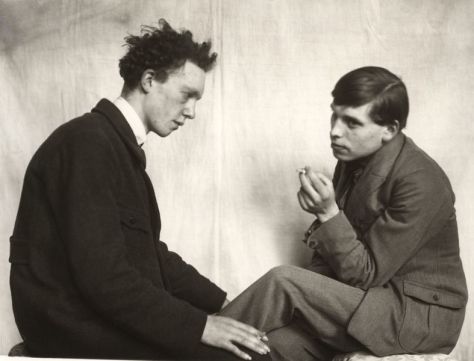
Bohemians (Willi Bonnard and Gottfried Brockman). This image is of two men, probably in their late 20’s. They were artists associated with the Cologne Dada movement and known for their unconventional lifestyle. They are seated, showing just their bodies and heads, facing each other, against a pale wall. The left-hand male has his hands resting on the others calves and is looking directly at him. His face, sideways on to the viewer, is very sharp and is the focal point of the image. The right-hand man is looking sideways, showing a ¾ face to the viewer, with a somewhat quizzical look. He is slightly less in focus. This image is easy (and tempting) to make up a story about. They are lovers. The left man is totally focused on and besotted with the other. The right man is more bohemian, less intensely involved, more aware of his surroundings. Thinking about other people. Of course, this is all a supposition, but the image encourages that. The only props are the cigarettes dangled in both men’s hands – but smoking was common in that era.
August Sander – Bohemians
Secretary, 1945. This image shows a young woman seated at a desk in front of a window, which overlooks a park. She is positioned on the left third of the image, with her neck on the midline. She is glancing up at the viewer, in a ¾ pose, with her hands still resting on the book she was reading. The room looks surprisingly sumptuous for a secretary’s office, possibly her home, or she works in the study at her employer’s house. The focus is on her face, but also on her hands. The background fades away. She looks serious, and studious. This image was taken either just at the end of the war, or just after it. It was a serious time in Germany, and this reflects that.
August Sander – Secretary
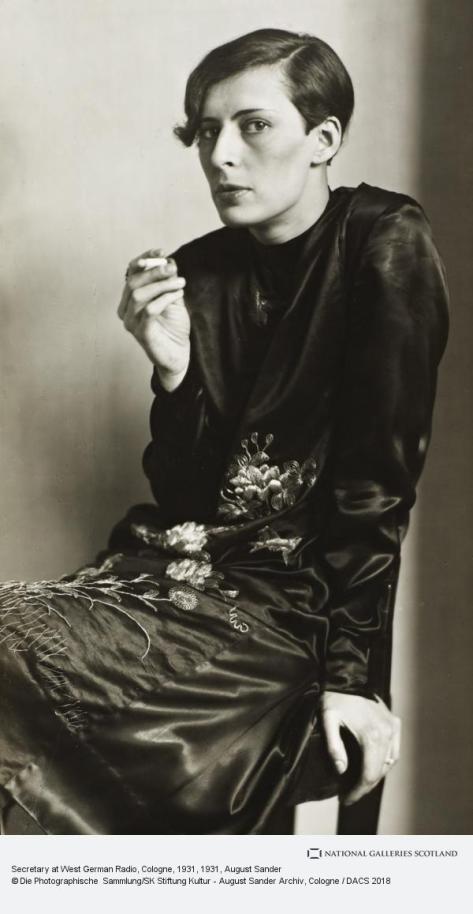
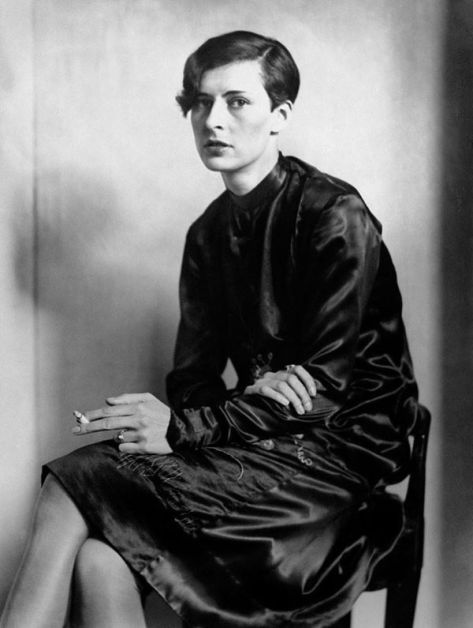
Secretary at West German Radio in Cologne, 1931. This earlier image is a complete contrast to the one above. It shows a person, that I initially thought from the hands and Adam’s apple was male, in what appears to be a floral dress. However, it is a woman, and was included as such in his portfolio. The National Gallery of Scotland website describes it as ‘Her dark silk dress decorated with floral embroidery, the secretary perches awkwardly with hunched shoulders on a wooden chair, smoking a cigarette. Her upheld right hand is drawn almost to her lips, which are slightly parted as if in exhalation. With her short hair, lipstick and carefully shaped eyebrows, this ‘Secretary at West German Radio in Cologne’ is a very fashionable woman, who may be seen as representing the ‘new’ woman of the day, much like Otto Dix’s painting ‘Portrait of the Journalist Sylvia von Harden’ (1926). The flat plane of the matt white wall behind her frames the gleaming satin folds of her garment, while Sander’s crop accentuates his subject’s tall thin frame, despite her slouched posture, in a portrait that emanates glamour and poise.’ All of the above I agree with; she is certainly very glamourous. She is shown in a commanding position. The only prop is a cigarette. The focus is on her eyes. There is an alternate image of her in a slightly different pose that looks much softer and more feminine.
August Sander – Secretary West German Radio
August Sander – Secretary West German Radio
Pastrycook. This image is clearly of a workman with his tools. He stands, face forward, dressing in his chef’s clothing, stirring a bowl. He is in his kitchen. There is a plate of small cakes on the counter behind him. The focus is on him and the background is out of focus. He is in control of his workplace and wants you to see this. He is a large man, in keeping with his trade, and a proud one. The background makes it obvious what his job is – and encouragers the idea of a type.
August Sander – Pastrycook
Vagrants, 1929. This shows two men in the countryside. They are somewhat scruffily dressed and unshaven. The images are full length and take up most of the picture. They both look directly at you. They both carry walking sticks and one a backpack. The countryside behind them is out of focus, so they stand clearly against it. Both heads are above the skyline and stand out clearly against a cloudless sky. He has caught them with tired, almost exhausted expressions.
August Sander – Vagrants
Interestingly, although all these images are recognisable as Sander’s work, he has not used a formulaic process in taking them. Some show backgrounds, some do not. On the whole the images of the more upper class and professional people are less likely to have very explicit backgrounds, but that does not always hold true – The Tycoon shows him seated, sidewards in his luxurious room, with the focus as much on the elaborate embroidered chair as on the man, while Cleaning Woman is shown against a wall, with only what appears to be a broom handle to mark her trade. Most of the faces (even of the children) are unsmiling, often stern – but that was the expected face for a portrait in that era. The exceptions here are his images of circus workers who are often smiling or looking at each other rather than at the camera. The thing that is consistent throughout is that the focus is always on the person and usually on the face. He used depth of field very effectively to lift the subject from the background so while the surrounds can give additional information, they are not the main event. That is always the person.
For an interesting extended discussion on Sander’s Types and the images produced see:
Sander, A. (2011). Face of our Time: sixty portraits of twentieth-century Germans. London: Schirmer Art Books.
Sander, A., Conrath-Scholl, G., Sk Stiftung Kultur. Photographische Sammlung and Fondation Henri Cartier-Bresson (2009). August Sander: Seeing, Observing and Thinking: photographs. Munich: Schirmer/Mosel; Cologne.
August Sander’s documentary project ‘People of the 20th Century’ was an attempt to sketch society in Germany at that time. He produced portfolios of ‘typical’ people organised by social categories (he also did the same with landscapes).
Sander (1876 – 1964) was born in Herdorf of working-class parents. He initially worked on a waste mining tip and did photography in his spare time. He moved to Linz in Austria, travelled and worked in a photographic studio. He had a very active cultural life – he was now consorting with a range of people from the professional classes and other artists. From as early as 1906, when he held an exhibition, he was already photoing people in their own domestic settings as well as in a studio. He returned to Germany 1920, initially living in Cologne and moving permanently to the countryside during the WWII air raids.
Secretary at West German Radio, Cologne – August Sander
Sander used a large format camera and planned his images very carefully, trying to reflect real life. He collected the images with a goal ‘to provide a true psychology of our time and of our people’ (Sander, 1925). His plan was to produce a massive work, containing somewhere between 500 and 600 pictures called Menschen des 20 Jahrhunderts (People of the 20th Century) that was divided into 7 sections. He was looking at taking images of human ‘types’ that were true to nature, he did not want to distort reality but was happy to ensure that an interesting image was made and was undoubtably influenced by the painters of his age including the Surrealists. He was interested in understanding the theory of photography and its use as a way of communication. The concept of ‘types’ and the underpinning use of physiognomy (the pseudo-science that suggested that you could tell much, or all, about a person by the shape of their head and face) has a complicated ethical stance, and has been linked with the eugenics policy of Weimar Germany and the Nationals Socialists. Interestingly, very few of Sander’s portraits show a typically Aryan type.
Painter [Heinrich Hoerle] 1928, by August Sander – one of the Persecuted
His life was impacted on by political situation, friends were imprisoned, some died in concentration camps, his own son, Erich, was imprisoned and died before his release. It is difficult to know what Sander’s position politically was. Before the war he was strongly engaged with the artists, (especially the group known as the Cologne Progressives who were associated with Marxist views), other intellectuals and the ‘left’ culture. His relationship with the Cologne Progressives, his multiple photographs of them and of their work is discussed in detail by Dorothy Rowe (Rowe, 2013). His son had very clear political views and was imprisoned for them. Sander himself took a series of photographs of the Jews and included them within a group called ‘The Persecuted ‘. It is undoubtedly true that what he could publish during the time of the National socialist rule was limited and may well not have reflected his inner thoughts. Certainly, later he planned to include images of both the persecuted and political prisoners in his portfolio. His political ideals and morals are discussed at length in an article by Rose-Carol Washton Long (Long, 2013) who argues that although Sander did not openly write about his political beliefs, his friendships, photographs of prisoners and the persecuted and the arrangement of images within his portfolio suggests that he had much more sympathy with the left wing than is commonly thought true. There is an interesting article on this section of his portfolio at:
Sander’s book Face of Our Time was criticised by the German National Socialist government as it did not show the ideals they ascribed to, and the printing blockers were destroyed and as many copies as could be traced also destroyed. This has now been re-issued by Schirmer Art Books with a translation of the foreword by Alfred Döblin (Sander and Döblin, 2003). Döblin remarks that Sander follows the tenants of the Realists, that is, ‘the great universals are effective and real’ and therefore he has, by means of his photographs and the way he has arranged them, formed a sociological history of his time. The types that are photographed now (1920-30’s) are, with the exception of farmers, different from those that could have been photographed 100 years ago and presumably, if the argument for ‘types’ holds true, are different from those that could be photographed now. He ends by saying ‘Entire stories could be told about many of these photographs, they are asking for it, they are raw material for writers, material that is more stimulating and more productive than many a newspaper report’ (Sander and Döblin, 2003).
The Rhine loop near Boppard – August Sander
Although he is mostly remembered for his portraits, he took pictures of places, landscapes and nature with equal precision. He was interested in showing life as a whole and how it fitted together. He took images of uncluttered nature and of the human encroachment on it. A bridge is as valid as a forest as a quarry. He didn’t just take the pretty images, the picturesque as many earlier photographers did. ‘Life as it’ is could be taken as his motto. He also was interested in the fine details of things; hands, texture of skin, parts of plants. He documented his time in its entirety, concentrating on local images of people and places to stand for the ‘types’ he felt important.
Hands – August Sander
As well as taking images he painted, drew, wrote about photography and gave lectures (some of these on the radio). His lecture Photography as a Universal Language is available in a translation by Anne Halley (Halley1978) in Seeing, Observing and Thinking (Sander et al, 2009). It is a fascinating insight into his thoughts, starting from the development of language and social reasoning. He says ‘pictorial language….is the most suggestive medium for advertising or coming to an understanding or achieving an end, because the image provides faster orientation than written language…….via photography we are capable of conveying fact, our thoughts and our ideas to all the peoples of the world: add a date to it, and we’re capable of capturing world history’. He describes it as ‘a global language’, understandable by the masses. There is a clear western, European, intellectual bias here in his thoughts as he makes a number of unfounded assumptions about the universality of understanding of images, and also that the ‘masses’ ware less likely to understand written explanations. However, these biases are understandable in the context of his time and background. He is also clearly aware that photographs can lie, ‘besides its significance as proof of truth, photography also has at it’s disposal the most dangerous potential for deception’. Sander then talks at length about the innate ability of people to understand what people are like on first impressions, from how they look, from their ‘physiognomy’ (at which he thinks females are better at than males). He thinks that the face tells you what kind of work a person does (the theory behind his dividing people into ‘types’). He includes an assumption that this also applies to a person’s political beliefs. He feels this only holds true if you do not attempt to confound the images by dressing people up or putting them in clothes from another era. He concludes ‘By means of seeing, observing and thinking, and with the aid of a camera and a date, we can capture world history and influence all of humanity by means of photography as a global language’.
While Sander’s political views are unclear, they were grounded in the complex and changing political situation of the time. His ideas about ‘types’ of people were also associated with the current thoughts in Germany and are of dubious relevance today. He did, however, take a vast number of fascinating images and his thoughts about ‘seeing, observing and thinking’ are as valid today as they were in his lifetime.
Reference list and sources:
Halley, A. (1978). Photography as a Universal Language. Massachusetts Review, Winter 1978, pp.663–679.
Sander, A. (1925). Letter from Sander to Erich Stenger.
Sander, A., Conrath-Scholl, G., Sk Stiftung Kultur. Photographische Sammlung and Fondation Henri Cartier-Bresson (2009). August Sander : Seeing, Observing and Thinking : Photographs. Munich: Schirmer/Mosel ; Cologne.
Sander, A. and Döblin, A. (2003). August Sander: Face of our time : Sixty Portraits of Twentieth-Century Germans. München: Schirmer/Mosel.
Sander, A., Sander, E. and Nunez, G.B. (2018). August Sander – Persecuted/Persecutors : people of the 20th century. Gottingen: Steidl.
Notes taken from the book John Thomson (1837-1921) – Photographer by Richard Ovenden
The quality which strikes the viewer most is his ability to get under the skin, so to speak, of whoever, or whatever, he was photographing (p.vii)
His photography on the streets of London seeking to examine the self of the great city, the soul of the British empire (p. Xii)
Wet collodion
Born in Edinburgh, working class family, initially apprenticed as an optician, attended the `school of Arts, studying natural philosophy, then maths and chemistry
Travelled initially to Singapore to work with brother acted as a photographer, travelling widely, went to Siam took pictures of the royal family, Cambodia (note typical European disregard for native cultures
1866 back to Britain, started writing and showed pictures and lecturing
Returned to Far East in 1867, Vietnam then Hong Kong china. Pictures, landscapes, the poor, the monasteries
Back home 1872
The camera should be a power in this age of instruction for the instruction of age…. Photography is alike a science of light and a light of science… (p. 29)
Started producing books and magazine articles, initially all about his `eastern travels, also lots of lectures
1876 started the project on the street life of London, produced as a monthly periodical
Next 40 years mainly spent photographing the society elite, including royal family, connections with the Royal Geographic Society allowed for more articles and also portraits of explorers
Travel and associate photography linked from very early days, often via the grand tours made by aristocratic sons Thompson however was a lone traveller, a freelancer
Romantic appeal of ruins, initially in Ankor Wat, often used a high viewpoint, impressed with technology of original builders,
Some images show a sense of loss and melancholy, picturesque
Interested in old places and architecture still being used e.g. bridges, monasteries
Photos of the street, physical aspects, social
Used types to categorise the lower orders! So, did he give realistic documentation? Started similar images in Asia, notable racial stereotyping and insensitivity but common to the era. Gradually more sophisticated and more aware of the economic conditions
Often took pictures of older women, and does talk about them as individuals, also boatmen showing a degree of sympathy to their difficulties
Took some ethnographic images, reverting again to types in Formosa
Peking multiple street images and interest in poor. Trying to show the reality of life on the street
Went on to take pictures of street scenes in London. Done in context of lots of Victorian writing about the problems there.
Smith well experienced in journalism and connected with the social reform movements (p.79). Lots of parliamentary talk, little effect.
Interested in street traders. Did put people outside of the rest of society.
Probably partly based on previous work by Mayhew London labour and the London poor illustrated by wood-engraving
Comments by S and T “ nor, as our national wealth increases, can we be too frequently reminded of the poverty that never less still exists in our midst” (p. 81) from preface to street Life
Other photographers also documented the working class e.g. Newhaven project, many people concentrated on the buildings, ~Annan’s Glasgow.
Reproduced by Woodburytype process giving rich tones and sharpness
Images inevitably staged, partly because of restrictions of equipment, use of fast lenses with short depth of field. Also crowd control and multiple distractions
Very much used types (continued right up to Sander) but the accompanying essays do talk about the specific people in great detail, does not sentimentalise them
Westminster review ‘it is to be remarked as worthy of all praise that these pictures of London life are free from the patronising characteristic spirit so repulsively pervading even popular and useful writers’ (p88)
Long history of formal portraiture from king of Siam onward, helped with access. He was aware of the customs of the country ie straight on with no shadows in China
Also took formal photos of street people
London portraits helped by royal connection!!!!
Landscape images probably influenced by other photographers as well as by contemporary painters – notion of the picturesque. He felt the photographer had to act as an artist not just a recorder. Collected Chinese scroll paintings and probably influenced by this style. Interested in pattern and texture.
Reference:
Ovenden, R., Puttnam, D. and Gray, M. (1997). John Thomson (1837-1921) photographer. Edinburgh: National Library Of Scotland, The Stationery Office.
John Thomson (1837 – 1921) was born in Edinburgh from a working-class family and ended up one of Queen Victoria’s photographers. During his remarkable life he worked as an optical glass technician , ran a photography shop in Singapore, travelled widely in the Far East, took pictures of both notable figures such as the King of Siam and Chinese mandarins and street workers, together with images of the scenery and buildings – all while carrying the cumbersome equipment need for the wet collodion process and both making and fixing the glass plates in temporary accommodation. On his return to Britain he resided in London, initially lecturing, writing articles and producing books about his travels then taking images of the London street people which were published in a series of magazines accompanied by articles by Adolphe Smith, while at the same time taking formal portraits of the great and good of London, including Queen Victoria and her family.
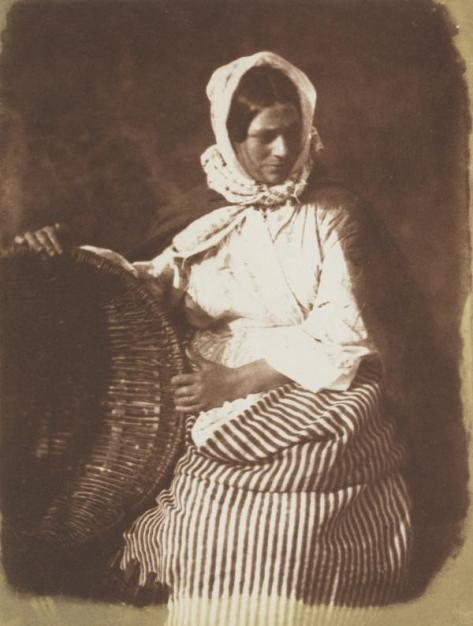
Thomson’s street images are some of the earliest examples of social documentary photography. He was preceded in Scotland by Hill and Adamson with their images of Newhaven fisherfolk, these very picturesque images are limited to a very small subsection of the population and also by both Thomas Annan, with his pictures of Glasgow slums, and Archibald Burns’s images of the Edinburgh tenements. However, both Annan and Burns concentrated on the buildings and the people are only shown fleetingly, if at all. Thomson’s images, accompanied as they were by extensive essays by Smith, tell much more about the background and lives of the people he photographed. Richard Ovenden, in his extensive work on Thomson says ‘His photography on the streets of London (is) seeking to examine the self of the great city, the soul of the British empire. John Thomson’s journeys were dominated by the quest for light…….and he found light in both the outer reaches of Asia…… and the underbelly of Victorian London’ (Ovenden, Puttnam and Gray, 1997, p.xii).
In the book Street Life in London Thomas and Smith say in the preface ‘We are aware we are not the first on the field…..we have sought to portray these harder phases of life, bringing to bear the precision of photography in illustration of our subject…….to enable us to present true types of London poor and shield us from the accusation of either underrating or exaggerating individual peculiarities of appearance’ (Thomson and Smith, 1877). In an article by the Westminster review, quoted in Ovenden, the unknown author says ‘ it is to be remarked as worthy of all praise that these pictures of London life are free from the patronising characteristic spirit so repulsively pervading even popular and useful writers’ (Ovenden, Puttnam and Gray, 1997, p88). Leach says ‘All of the photographs in Street Life in London display John Thomson’s characteristic visual acuity. He was by this time highly versed in his craft, having for many years lived the life of the consummate photographer-explorer….This odyssey seems to have brought fresh insight into the perception and understanding of his homeland, motivating him to use his camera to show the viewing public not that which they could never see, but that which they chose not to see.’ (Leach, 2016).
The most famous image from Street Life is The Crawlers , a very striking image showing an apparently elderly and destitute female holding an infant in a classic Madonna and Child pose, although, in this case, we learn from the accompanying essay that the two are not related, but that she is looking after the child for another previous denizen of the streets who has a managed to obtain some work.
However, there are several other fascinating images. One of those images, and the one that holds my attention, is that of “Tickets” the Card -Dealer. It shows an middle aged and somewhat scruffy gentleman, holding a paintbrush and working on painting a sign for a fruit seller.Tickets is not looking straight at you, as was the convention in much portraiture at that time, rather he is looking downwards at his work. His expression is melancholy, and he looks exhausted. His hair is untidy, and in spite of the image being taken indoors he is wearing a heavy coat. The only area of brightness and gaiety in the picture is a flowering plant in a bucket. Although this image was taken almost 150 years ago it could be a picture of any person down and depressed today. The gentle author in his Spitalfields Life series comments ‘When I look at these vital pictures, I am always startled by the power of the gaze of those who look straight at the lens and connect with us directly, while there is a plangent sadness to those with eyes cast down in subservience, holding an internal focus and lost in time’ (gentle author, 2011) – this perfectly describes the look on the face of Tickets. Tickets life, as discussed at length in the accompanying article, is not one of a bad man, or a lazy one , simply one who has had recurring episodes of bad luck which has led him to travel around the world from his native Paris, via America and back to Britain, intending to travel on to France, but arriving here just in time to discover that the political climate in Frances made it unwise to return there. He is left in a life he does not want, in a place that is not his own, having to cope with the despair that causes. The photograph perfectly shows this while being gentle and understanding rather than patronising or sentimentalising the situation.
The images in Street Life were printed using the Woodburytype process. This photomechanical printing process was renowned for its lasting nature as well as the sharp, saturated images in a reddish-brown colour. The sharpness is enhanced by the slight relief between areas caused by the process. For a detailed description of the process see:
This process, and the details it allows for , emphasise the skill of Thomson, taking pictures of people using a slow and heavy camera, while out in the street and needing to not only direct the people he was photographing, but also managing the inevitable crowd control caused by the curiosity produced by using a relatively new process in a poor area as at that time most photography was still either studio based or a hobby of the wealthy.
Summary:
“Tickets” – the Card-Dealer is a beautiful image, taken by a remarkable and skilled photographer who, as well as taking images of landscapes, buildings and the rich and famous, used his skills to highlight areas of social injustice. He was one of the first to do so. In Overton’s words ‘The quality which strikes the viewer most is his ability to get under the skin, so to speak, of whoever, or whatever, he was photographing’ (Ovenden, Puttnam and Gray, 1997, p.vii) and he used this to try to help people. We would do well to emulate both his skills and his ethos.
References
Anon (1877). Politics, Sociology, Voyages and Travels. The Westminster Review, 52.
Leach, G. (2016). The Crawlers: The Genesis of Social Documentary Photography. [online] Photomonitor.co.uk. Available at: https://www.photomonitor.co.uk/crawlers-new/ [Accessed 11 Jul. 2019].
Ovenden, R., Puttnam, D. and Gray, M. (1997). John Thomson (1837-1921) photographer. Edinburgh: National Library of Scotland, The Stationery Office.
The brief is to choose a portrait by a historical photographer and discuss it at some length, thinking about the context and the actual image. This opens a very wide range of options. What is historical? How far do you go back? For someone of my somewhat venerable age historical means over a hundred years ago, or a least fifty! For a younger person it might mean more than twenty years. However, the implication of the information provided is that one should be considering one of the earlier photographers.
History is a slippery concept. It is frequently said that it is written by the victors. It is certainly mainly written by, and about, men – although there has been a present press to redress that particular bias. It is also very driven by the concept of ‘class’. In photography, like painting, most early portraits were taken both by and of the relatively wealthy. They are the ones who could afford the equipment and afford to pay for a picture. A very different situation from the present where, at least in the majority of the world, most people have access to a camera of some sort, and where they do not, in areas considered deprived (if interesting enough) there are a plethora of people taking images.
I spent some time considering which photographer to choose. Amongst others I looked at:
I was recently on holiday in Wales and came across a local museum in Merthyr Tydfil, the Cyfarthfa Castle Museum, which had a collection of photographs on show by Robert Thompson Crawshay (1817-1879) who took images of the local area, his family and friends, and went as far as building a photographic studio in his house.
Self portrait – Robert Thomson Crayshaw
Another option I considered at length was the Edinburgh duo of Hill (1802 – 1870) and Adamson (1821-1848). They worked in Scotland at the very early stages of development of photography and took multiple images of the great and famous of Edinburgh and also a series of social documentary images of the fisher golf of Newhaven. I saw a recent exhibition of their images discussed here:
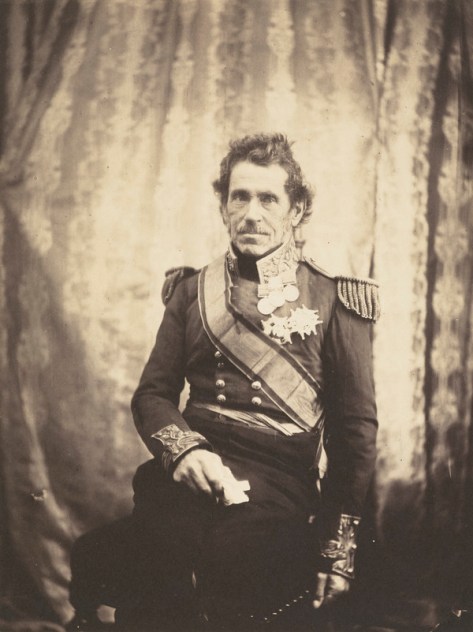
Roger Fenton (1819-1869) is also discussed in the above link. As well as his famous series of images of the Crimea he also took portraits of the London gentry and the royal family.
Sir George de Lacey Evans, – Roger Fenton
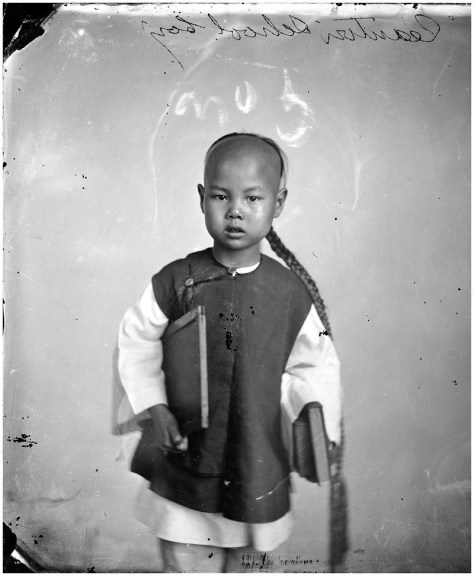
John Thomson (1837 – !921) was another Scottish photographer who was among the early pioneers of photojournalism. He spent a considerable time travelling in the East and took a series of stunning images of Chinese people of all classes (although mainly the mandarins). When looking at his work, having previously only been aware of the China images I discovered a series of images he took later in life of the street life in Victorian London. These were accompanied by essays by himself and a collaborator- Adolfe Smith.
Cantonese schoolboy – john Thomson
I eventually chose the last of these options as it was work that I had not looked at before in detail and I remember the amazing clarity of the Chinese images from an exhibition I saw in Glasgow many years ago. They were one of the reasons I became interested in the history of photography.
The next decision was what image? There are multiple possibilities. There are several beautiful images from the Chinese body of work including a picture of a young Cantonese schoolboy, whose expression could be that of a young child attending school today (although the heavy books would probably be replaced by a tablet). I eventually decided to look at one of the images from the Victorian street life series. Again, there was a choice to be made. What defines a portrait? Tagg’s comment, quoted in the course manual ‘The portrait is a sign whose purpose is both the description of an individual and the inscription of social identity’ (Tagg, 1988) is very pertinent here. One option was ‘The Crawlers’, otherwise known as ‘The Tailors Widow’, another was ‘“Tickets” The Card Dealer’. The first image is very well known, the latter less so.
References
Tagg, J. (1988). The burden of representation. Minneapolis, Minn.: University of Minnesota Press.
I did the Square Mile exercise at the very beginning of this course of study, now over 2 years ago. At the time I was pleased with it. It was the first time I had done a piece of work that was designed to ‘tell a story’ for many years. Looking back, while I still think it was interesting (I focused on the very changeable weather in a Scottish spring) in reality the images did not tell much about the local area and what it means to me. It was about the wider place – Scotland, and the time of year – spring, and the weather – variable!
If I redid this exercise now – and I might yet do so – I would concentrate on the places that I go to and see regularly, my street, the local coffee shop, the comic book store, the library and the people I meet at these places. It would be an interesting exercise to stand outside my house and take pictures of everyone who walks along the street over a few hours. I might get some very odd looks and need to do a lot of explanation, but it would tell a lot about the area especially if I got a little bit of information from everyone – who they were, what they did, and why they were there.
Simply thinking about this shows how much my attitudes to photography have changed over the 2 years and also how much my confidence has grown. At that stage I would not have thought about asking relative strangers to allow me to take pictures of them – now I am considering the implications and the need for a card to give them together with an information sheet on the project!












![Painter [Heinrich Hoerle] 1928, by August Sander](https://scottishzoeidentityandplace.blog/wp-content/uploads/2019/07/al00091_9.jpg?w=474)


 Identity and Place