Category Archives: Photographers

Harry Callahan

Harry Callahan (1912 – 1999) was an American photographer based in Chicago. He taught at the Chicago Institute of Design and then at the Rhode Island School of Design. He took many street photographs with a heavy contrast of black and white. However, he also took images of his wife and daughter, often set in the distance against the city. This contrasted with other very simple images of trees against the sky, patterns in the sand. He also combined many images to make multiple exposure prints – although it is not clear whether this was done by multiple in-camera exposures or by overlaying prints. He shot thousands of pictures but produced very few finished prints. He was an experimental photographer, trying out a range of possibilities for the subjects he was interested in. He is reported as saying ‘I guess I’ve shot about 40,000 negatives and of these I have about 800 pictures I like” (Artnet.com, 2019). He also said, “The difference between the casual impression and the intensified image is about as great as that separating the average business letter from a poem. If you choose your subject selectively — intuitively — the camera can write poetry.” (Cassidy,2006).

Eleanor
© estate of Harry Callahan – Eleanor

References:

Artnet.com. (2019). Harry Callahan. [online] Available at: http://www.artnet.com/artists/harry-callahan/ [Accessed 16 Oct. 2019].

Cassidy, V.M. (2006). Harry Callahan: The Photographer at Work – Photographs by Harry Callahan | LensCulture. [online] LensCulture. Available at: https://www.lensculture.com/articles/harry-callahan-harry-callahan-the-photographer-at-work.

Project 1 – The unaware – 2

Tom Wood (born 1951) is an Irish photographer who spent much of his life in Merseyside, and who now lives in Wales. He was photographing in New Brighton at the same time as Martin Parr and Ken Grant, but the three photographers produced very different work. Wood is an obsessive photographer, never going anywhere without his camera and constantly taking pictures. He works in series, but the series are not separated by time, rather than by how and at what time of day he takes the images. He travelled widely by bus and took pictures on the bus. He also took images at the local shipyard, and, possibly most famously, the images in the Chelsea Reach nightclub – which became the book Looking for Love (Wood, 1989).  Wood returned week after week to the nightclub (and all the other areas he was interested in) and having taken pictures of the people there one week would offer them copies of the images the next week.  He was extremely well known in the area and became their ‘Photie Man’.

Wood photographed people close-up. He said in an interview with Sean O’Hagen “I’m not trying to document anything. It’s more about deciphering and transforming. I make what you might call real-life photographs” (O’Hagen, 2015).  Wood’s work is taken over years, usually with no specific plan in mind. He said “I take pictures all the time, if did a project, had a plan, it would be self-conscious. It’s very different to go out looking for something. All that stuff can get in the way, whereas if you take pictures all the time, it’s no big deal because that’s what you do all the time. And because I was always doing pictures, going to the same places year after year, I became part of the scenery. I was just the guy who takes pictures.” (Smith, 2018). Wood does not describe himself as a documentary photographer, even though most of his series tell stories about the place they are taken in. He works long term, over years rather than weeks and makes images that are enjoyed by the local people. His pictures do explore the place, and the time (both time of day and the era) but he was more interested in taking a good photograph than in documenting a specific event. The is an interesting detailed interview In Paper Journal that was done alongside an exhibition at The Bradford Media Museum (Manandhar and Karallis, 2013).

In Photie Man (Wood, 2005) – he said, ‘I’m interested in good photographs, and if they document something, so much the better’. This statement is very different from the one by Parr ‘I am a documentary photographer, and if I take a good photograph in the process, that’s a bonus’ (quoted in OCA manual, Identity and Place, p.46). The same words (or very nearly) but in a different order and with a completely different emphasis. A good picture – or an accurate document. What takes priority? It is fascinating that two people, working in the same place, at the same time can produce such different images. Wood’s images are kinder, more caring and less satirical than Parr’s. Even the images in Looking for Love, which show people often at their worst, drunk, tired and often being groped have a sense of good humour. He was there. He was close up, and he went back time after time, so the people knew him. He did not want to exploit the people and says he made very little money from his photography at that stage. Parr’s images are harder, they are often funny, the colours are harsher, and, of course, he makes a substantial living from it. Overall, I prefer Wood’s images, although I am very aware that I was familiar with Martin Parr’s work while only came across Tom Wood when researching for this topic.

My personal preferences aside, the two photographers have a different style of work and a very different way of thinking about what they are doing and why they are doing it. At this moment, and this might change over time, I feel I am more in tune with Wood’s way of thinking. My experience is that I am looking for a ‘good’ photograph, and hopefully that will also say what I am trying to say. What is ‘good’ is, in itself, an interesting concept. Does it mean sharp, correctly exposed and so on? Does it mean truthful (itself a slippery concept)? Does it mean something that people will like and respond to (and, if so – is it the proverbial ‘man on the street’ or a population of informer viewers) ? That will depend on your planned purpose for the image or series of images, what story you are trying to tell and who it is for.


Reference list

Manandhar, N. and Karallis, P. (2013). Interview: Tom Wood – Paper Journal. [online] Paper Journal. Available at: https://paper-journal.com/tom-wood/ [Accessed 1 Oct. 2019].

O’Hagan, S. (2015). Girls (and boys) just wanna have fun: smoke, sticky carpets and snogging in the 80s. [online] the Guardian. Available at: https://www.theguardian.com/artanddesign/2015/may/08/gareth-mcconnell-tom-wood-looking-for-love-80s-photos [Accessed 1 Oct. 2019].

Photography 1 – Identity and Place. (2015). Open College of the Arts.

Smyth, D. (2018). New Brighton Revisited by Martin Parr, Tom Wood, and Ken Grant. [online] British Journal of Photography. Available at: https://www.bjp-online.com/2018/07/new-brighton-revisited/ [Accessed 1 Oct. 2019].

Wood, T. (1989). Looking for Love. Manchester: Cornerhouse Publ.

Wood, T. (2005). Photie man. Göttingen: Steidl.

 

Project 1 – The Unaware 1

Taking portraits of people who are unaware of you needs a certainly needs a degree of stealth and a place where there are plenty of people who are engaged in their own thoughts. One of the commonest places for this to be done is on public transport. If you google ‘images of the underground in London’ it becomes obvious that this is a very common place for photographers to take pictures. Many of these are of the underground architecture, others are of general crowd scenes and yet more are portraits, usually taken without the knowledge of the people being photographed, although some are obviously posing for the camera.

The genre probably started with the subway images of Walker Evans, although similar portraits were also taken by Helen Levitt, who was his apprentice, at much the same time. The two of them often went out together as Evans thought that people were less likely to see him taking photos if he was with someone else. Levitt revisited the subject much later in 1978 taking a range of images of similar scenes, this time against a background of graffiti (Silverman, 2017). They can be seen in Manhattan Transit: The Subway Photographs of Helen Levitt.

Helen Levitt
© Helen Levitt

Stefan Rousseau, a London photographer also took images on the London Underground. There is a recent photoessay available on this in which he says ‘Suddenly I became aware of a new world of phone-obsessed, sleep-deprived, makeup-wielding commuters so absorbed in their own world that I felt I had to photograph them. I’m astonished by the skill of the women who are able to apply their makeup while hurtling through tunnels and those who can watch last night’s TV standing up in the smallest of spaces’ (Rousseau, 2019). The whole essay can be accessed at:

https://www.theguardian.com/uk-news/2019/mar/29/riding-the-tube-a-photo-essay-by-stefan-rousseau

Stefan Rousseau
© Stefan Rousseau

Lukas Kuzma is another photographer who has taken pictures on the London Underground in the series Transit (Kuzma, 2015) in which he shows a mixture of images of people, some aware of him, others clearly unaware. Some of his images are amusing, some fascinating, others almost cruel.  Some of his images can be seen on Behance.

Lukas Kuzma
© Lukas Kuzma

For other photographers who work on images taken on public transport see:  Martin Parr Christophe Agou and Walker Evans

Edited 04/11/19:

I have just come across another photographer who worked extensively on the London Underground in the 1970’s. Mike Goldsmith has just produced a book London Underground 1970 – 1980 which shows images from a slightly earlier underground scene, although the people have similar world-weary expressions.  The pictures can be seen at:

https://www.bbc.co.uk/news/in-pictures-50261478

_109489911_londonunderground_northernline1975
© Mike Goldwater – Northern Line 1975

Given the number of articles and relevant photographers I have found in a fairly short exploration of this topic, I suspect that a whole PhD could be written on it.

Reference list

Candid moments on the London Underground. (2019). BBC News. [online] 4 Nov. Available at: https://www.bbc.co.uk/news/in-pictures-50261478  [Accessed 04 Nov. 2019].

Kuzma, L. (2015). Transit. [online] Behance. Available at: https://www.behance.net/gallery/23661963/Transit [Accessed 1 Oct. 2019].

Levitt, H., Campany, D., Hoshino, M. and Zander, T. (2017). Helen Levitt – Manhattan Transit. Köln Galerie Thomas Zander Köln Verlag Der Buchhandlung Walther König.

Rousseau, S. (2019). Riding the tube – a photo essay by Stefan Rousseau. [online] the Guardian. Available at: https://www.theguardian.com/uk-news/2019/mar/29/riding-the-tube-a-photo-essay-by-stefan-rousseau [Accessed 1 Oct. 2019].

Silverman, R. (2017). The Subway Portraits of Helen Levitt. [online] Lens Blog NY Times. Available at: https://lens.blogs.nytimes.com/2017/10/12/the-subway-portraits-of-helen-levitt/ [Accessed 20 Aug. 2019].


Christophe Agou

Silence01-791x550
© Christope Agou – from -in the face of silence

Christophe Agou (1969 – 2015) was a French photographer who lived in New York and, like Walker Evans, took a series of images of the New York subway – Life Below (Agou, 2004). He said ‘Trust your heart and open your eyes’ and ‘There is a certain honesty underground, a certain truth. The sense of enclosure is sometimes oppressive, but I love the feeling of the pulse beneath the city’ (Hogarth and McLaren, 2010). Agou worked in both black and white and colour, across the city of New York and in the countryside of the Forez hills in France. In the  New York subway he took mainly images of people who were unaware of him ‘an intimate rendezvous with people in a meditative state from every conceivable walk (Agou, 2011) while for the work in Forez, published as in the face of silence (Agou, 2011 a) he spent time getting the know the community of farmers over eight years. As well as a a photographer Agou was a gifted writer. His website describes his interactions with the people he photographed using lyrical prose ‘… underneath the wooded volcanoes, the furrows of poor earth, the thick fog, the scent of damp clover, the cry of the crows, the entanglement of the forest after a storm, the peace in the heart of the vines, the paths dug up into ruts, the fields lying fallow, the snow swept away by the north wind, the mysteries of the night, the silence… this reality inspires me’ Agou, 2017).

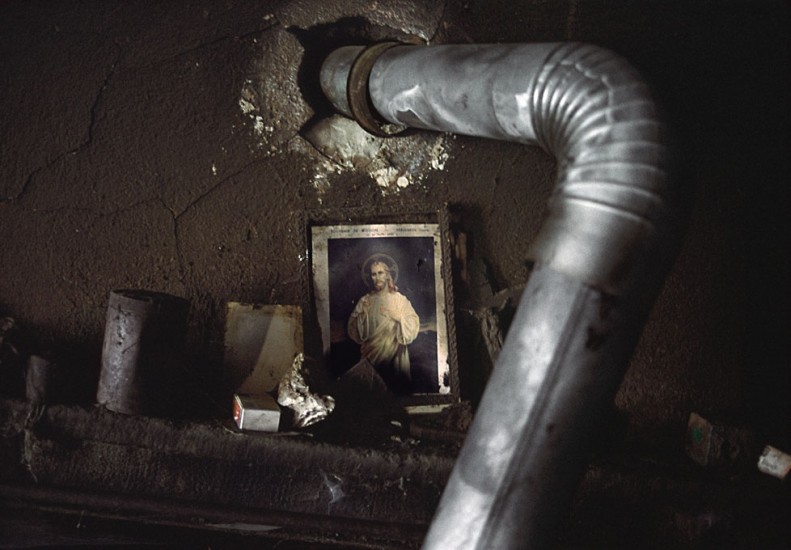
While Agou used the underground as a way of exploring people’s emotions, he was not intrusive. Although he did not always ask about taking the images, he would engage with the people involved and, unlike Evans, he did not hide his camera. However, his images in this series do act as an updated view of the subway.  I find some of his other images, from in the face of silence more revealing. The time he spent with the farmers has allowed a more intimate view, the details are both heart-warming (a cat and a cup) and heart breaking (a picture of Christ under a pipe in a wall).  He has filmed ‘their life as it is’ – with details, but no sentimentality.

Reference list

Agou, C. (2004). Life Below: the New York City subway. New York: Quantuck Lane Press.

Agou, C. (2011a). books | christophe agou. [online] Christopheagou.com. Available at: http://christopheagou.com/books/ [Accessed 1 Oct. 2019].

Agou, C. (2011b). In the face of silence. Stockport: Dewi Lewis.

Agou, C. (2017). face au silence (in the face of silence) | christophe agou. [online] Christopheagou.com. Available at: http://christopheagou.com/face-au-silence/ [Accessed 1 Oct. 2019].

Howarth, S. and Mclaren, S. (2010). Street Photography Now. London: Thames & Hudson.

Martin Parr

Grand National Ladies Day
Martin Parr: The Grand National Ladies Day © Martin Parr/Magnum Photos

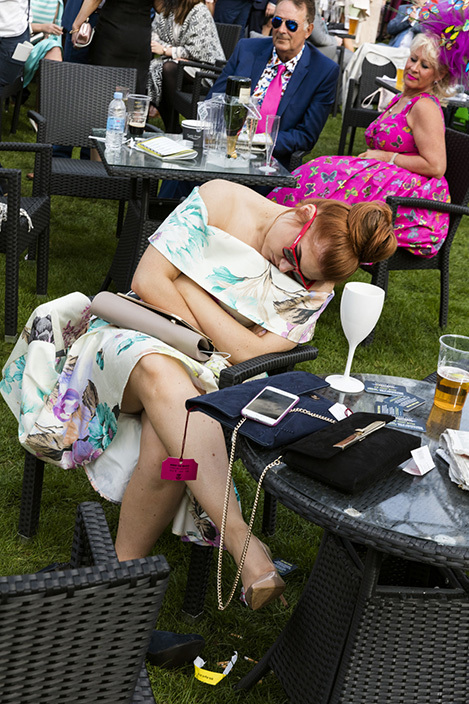
Martin Parr is a British photographer (born 1952) who is mainly known for his images of the British public, shown with loud, brash colours and often very satirical in nature. On his website they are described as ‘exaggerated or even grotesque. The motifs he chooses are strange, the colours are garish and the perspectives are unusual (Weski, 2019). He has looked at the way we live over the years, ranging from images of socialites, to people on the beach in various states of dress, via food and the Grand National racing events. Many of his images are not ‘pretty’ – he shows things as they are, rather then as we would like to think they are. He has published a plethora of books of his own images, his website lists 121 since 1982, together with many others he has edited and is a renowned collector of other people’s photo-books.

Although we tend to think of him as a British (or mainly English) photographer he has travelled and taken images (and produced books of those images) across the world, from Benidorm to Belfast, India to Italy and also Japan. Japonais Endormis (Japanese Asleep) (Parr, 1998) is a collection of images taken on the Tokyo subway of sleeping commuters.

 These salarymen (and women) often travel for long hours every day, to and from work. Parr has taken images looking down on them. They are clearly not aware that he is taking their picture and are vulnerable in the moment. The sharpest focal point of the image is usually the hair, their eyes are closed, they look exhausted.  Although his website describes his style as garish and often grotesque, in this case the images are tender, and he appears to have sympathy with their unending need to travel (and sleep while travelling. This is not echoed in the images of Japanese people shown in The Phone Book (2002) (Parr, 2002) which shows people on their mobile phones, also seemingly unaware that they are being watched, let alone photographed. Here he returns to his more usual brash colours and aggressive imagery.

4parr
© Martin Parr

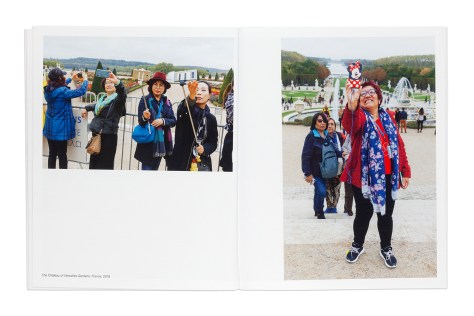
One of the themes Parr has returned to on many occasions is the multitude of people who take pictures of themselves at historic sites. He has dwelt on this theme for many years, and one of his recent projects returns to this topic. Parr was one of five artists who were commissioned by the Palace of Versailles to make work that echoed its spirit and took images of others taking images (Pegard, 2019)  Parr has  discussed this at some length in his blog (Parr, 2012) but ends up admitting that, of course, he is doing exactly the same thing. He does, however, turn is upside down by photographing the people who are taking the photos of themselves.

4
© Martin Parr

Parr’s images are often fascinating and have opened the way for other photographers to take less reverent images and also to have a sense of humour in their work. I found the Japanese Sleepers collection to be both telling and touching about a way of life I know little about. It is a very human piece of work.

 Reference list

Parr, M. (1998). Martin Parr: Japonais endormis = 眠る日本人. Paris: Published by Galerie Du Jour Agnès B.

Parr, M. (2002). The Phone Book: 1998-2002. London, Eng.: Rocket; Essen, Germany.

Parr, M. (2012). Too Much Photography | Martin Parr. [online] Martinparr.com. Available at: https://www.martinparr.com/2012/too-much-photography/ [Accessed 27 Sep. 2019].

Pégard, C. (2019). Versailles, Visible invisible: Dove Allouche, Nan Goldin, Martin Parr, Eric Poitevin, Viviane Sassen : [exposition, Versailles, Château de Versailles, Domaine du Trianon, 14 mai-20 octobre 2019]. Paris: Éditions Dilecta, Dl.

Weski, T. (2019). Introduction | Martin Parr. [online] Martinparr.com. Available at: https://www.martinparr.com/introduction/.


Joel Sternfeld

Joel Sternfeld (born 1944) is an American photographer who is known for using large format colour images. He started using colour early on, when most serious photographers were still using black and white. He is clear that he chooses what he wants to show, to tell a story. In an interview he says ‘no individual photograph explains anything. That’s what makes photography such a wonderful and problematic medium. It is the photographers job to get this medium to say what you need it to say’ (Higgins, 2004). His earlier work American Prospects came from a trip in a campervan around America and includes a wonderful (and well known) example of how what the picture apparently shows may not be the reality of the situation. InMclean, Virginia, December 1978 he shows a fireman apparently nonchalantly buying pumpkins while other firemen work on a massive blaze in the background. It was actually a training exercise for them fire service! In a recent interview he is described as ‘A native New Yorker, he has roamed though America constantly……obsessed with “the great underlying theme of my work: the utopian vision of America contrasted with the Dystopian one”’ (O’Hagan, 2017).

McLean, Virginia,December 1978 ©Joel Sternfeld

In Stranger Passing, Sternfeld again travelled around America. This time concentrating on taking portraits of people he met in their own surroundings, raising the question of what we can know about a stranger from one, singular, portrait. He made a ‘document’ of Americans at the end of the 20th century which could be considered to be an updated version of Sander’s ‘Face of Our Time’.

A Homeless Man With His Bedding, New York, New York, July 1993
A Homeless Man With His Bedding, New York, New York, July 1993 © Joel Sternfeld

The people are mainly taken outdoors and the choice of the background is significant and related to the person or people in the image. There is a wide range of race, age and economic status.  The images are titled by their occupation, what they are doing and when they were taken. A Homeless Man with his Bedding, New York, July 1993. Summer Interns Having Lunch, Wall Street, New York, August 1986. The people are central in the image, full length and looking at Sternfeld. The details are important. The woman carrying a rabbit, the tramps red shoes, the woman at home exercising with several half-eaten plates of food on the table. They invite you to invent a story about the people and become more personally engaging than the Sander images.

Reference list

Higgins, C. (2004). False witness. [online] the Guardian. Available at: https://www.theguardian.com/artanddesign/2004/mar/10/photography [Accessed 20 Sep. 2019].

O’Hagan, S. (2017). The drifter: Joel Sternfeld on his sly glimpses of wild America – seen from the endless highway. [online] the Guardian. Available at: https://www.theguardian.com/artanddesign/2017/jan/11/joel-sternfeld-photographer-america-interview-colour-photographs-1977-88 [Accessed 20 Sep. 2019].

Bettina von Zwehl

Bettina Von Zwehl is a German photographer who lives and works in London. She concentrates on portrait photography and has held several artists residencies in museums both in Britain and abroad. Her early work included photographing people in very precise conditions, such as holding their breath or standing in the rain, soaking wet. Later work has moved more towards miniatures, with a clear aim to simplify the portrait while maintaining the central concept of the series.   The later miniatures are jewel-like in their intensity.

Made Up Love Song (2011):

http://www.bettinavonzwehl.com/made-up-love-song.html

This series done was made as part of an artist’s residency in the Victoria and Albert Museum in London. Inspired by the portraits in the gallery, but especially by the painted miniatures, Von Zwehl took a series of images of staff in the gallery, but the core of the work revolved around a series of portraits of Sophie taken 3 times a week over 6 months. The photographer and the subject started out as complete strangers and they gradually developed a relationship. The portraits are all posed in the same way (in profile) and in the same place, taken by a window in natural light.

Only the hair style changes. The expression on the face gradually softens. The images were shown as miniatures and eventually published in book format (Chandler and Von Zwehl, 2014).

2940372
Image from Made Up Love Song © Bettina Von Zwehl

Invitation to Frequent the Shadows (2014 -16):

http://www.bettinavonzwehl.com/the-sessions.html

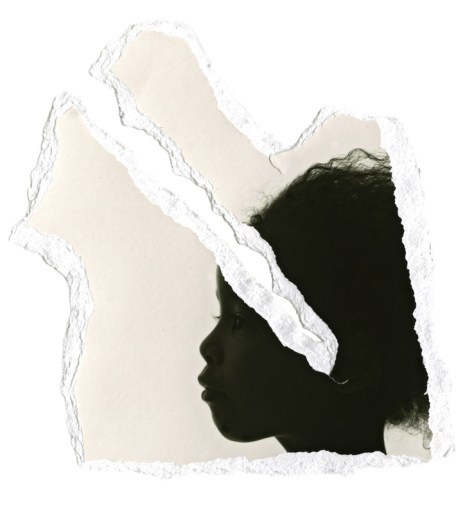
This is a series of related works done in response to a residency in the Freud Museum. She uses the idea of psychoanalysis to spark ideas related to grief, loss and personal exploration.  One of these works The Sessions consists of 50 fragmented silhouettes which she describes as ‘A voyage to the core of my practice …. It reflects the love/hate relationship with my medium. It’s a glimpse into that dark, magical void’ (Von Zwehl and Cohen, 2013). The pieces show partial images of the silhouette of a young girl that appear to have been torn up. Destroyed, but not quite. It would appear possible to recreate the initial image – but do the individual fragments tell you more – or less?

10-fragment013-cutout-jpeg10_orig
Image from The Sessions © Bettina Von Zwehl

Meditations in an Emergency (2018):

http://www.bettinavonzwehl.com/meditations-in-an-emergency.html

This series was taken during an artist’s residency at the New York Historical Society. These are 17 portraits based on the mass shooting in a Parkland, Florida High school in 2017. The teenagers in the images stand in for those killed, and also reflect on the protest ‘die-ins’ performed by teenagers in front of the White House. The portraits are done in black and white, showing prone teenagers who had responded to her call for volunteers to the schools in New York. She reports in an interview with Alyssa Coppelman that ‘it was all quite casual to make the teens feel comfortable ……. Some of the teens expressed their anxiety about going to school knowing that another school shooting could happen on any given day …… I worked with the effects of gravity and highlighted the weight of strands of hair or small necklaces’ (Coppelman, 2019). The also said that she had been working with subjects in profile for 18 years, having been influenced by the Renaissance paintings. She also is working to reduce the information – hence the use of silhouettes. This particular set was inspired by a series of very simple black and white profile portraits by Tappen from the 1790’s which she found within the museum’s collection.

BVZ_Meditations-in-an-Emergency_2018-16
Image from Meditations in an Emergency © Bettina Von Zwehl

Summary:

Von Zwehl’s work is fascinating. She uses series of portraits to show ideas rather than individual people. She has gradually moved away from overt personal representation to representation of the concept.  What is friendship? What is fear? Her work echoes that of the much earlier Renaissance painters, with their silhouettes and miniatures but used in a modern context. She concentrates on the person, not the background, which is rarely visible – so the images become timeless and of any place.  The profile view is one rarely used in vernacular imagery at present, especially within the vast ‘selfie’ culture and acts to formalise the image. A quick look though my own images shows how rarely I use it. A fascinating and different take of portraiture.

Reference list:

Chandler, D. and Von Zwehl, B. (2014). Made up love song. London: V & A Publishing.

Coppelman, A. (2019). Bettina von Zwehl’s Haunting Tribute to the Parkland School Shooting Victims | Hatje Cantz | fotoblog. [online] Hatjecantz.de. Available at: https://www.hatjecantz.de/fotoblog/?p=11167 [Accessed 14 2019].

Von Zwehl, B. and Cohen, J. (2013). Invitation to Frequent the Shadows – Interview with Bettina Von Zwehl | LensCulture. [online] LensCulture. Available at: https://www.lensculture.com/articles/bettina-von-zwehl-invitation-to-frequent-the-shadows [Accessed 19 Sep. 2019].

Walker Evans

Walker Evans (1903-75) was an American photographer who had previously worked for the USA Farm Security Administration taking, among other images, photographs of the people with their complete awareness, to show the lives of the farmers in the Depression.  He went on to produce the book Let Us Now praise Famous Men together with the writer James Agee, which described, in detail, the lives of farmers in Alabama. He then had a major exhibition in The Museum of Modern Art American Photographs accompanied by a book of the same name which showed what had been described as a portrait of America of that time showing the ‘the tangible expressions of American desires, despairs, and traditions’ (Metmuseum.org, 2004).

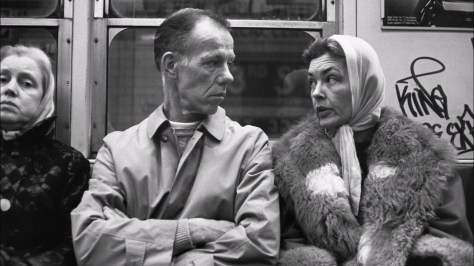
Between 1938 and 1941 Walker Evans took a series of portraits of people on the New York City subway.  Unlike his previous images these were taken covertly. Evans used a set-up where he blacked out his camera, strapped it under his coat and allowed the lens to show out between the buttons. He then threaded a release cable down his sleeve into his hand. Using this method, he took a series of images of people at close range, he was often sitting opposite them and able to observe them in their private and unguarded moments. Evans said “The guard is down, and the mask is off, even more than when in lone bedrooms (where there are mirrors). People’s faces are in naked repose down in the subway” (Metmusuem.org, 2004). These images were eventually published in a book Many are Called in 1966. The book was reissued in 2004 associated with an exhibition and is discussed in an interview with Jeff Rosenheim which is available at:

https://www.npr.org/templates/story/story.php?storyId=4156233?storyId=4156233&t=1565772143009

Rosenheim says, ‘The pictures work intimately because you feel Evans sitting there…the other passengers could probably tell this guy was up to something…. some of them are looking at him…. Evans had always been interested in the social facts of his time…. he was trying to understand his time … these pictures, both then and now, was another way of looking at the great struggle by individuals to survive… a true documentary product’ (Ludden, 2004).

3428-018-web
Walker Evans
cri_000000188601
Walker Evans
2180
Walker Evans

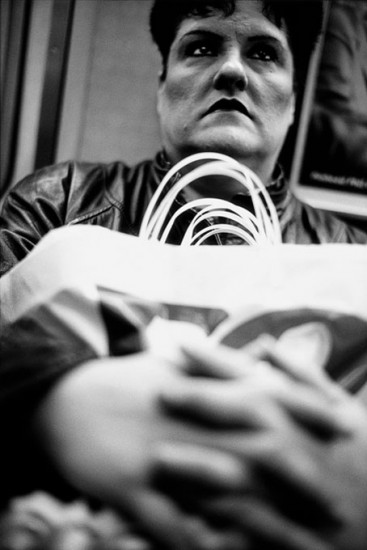
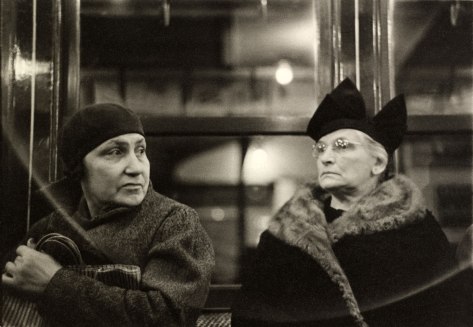
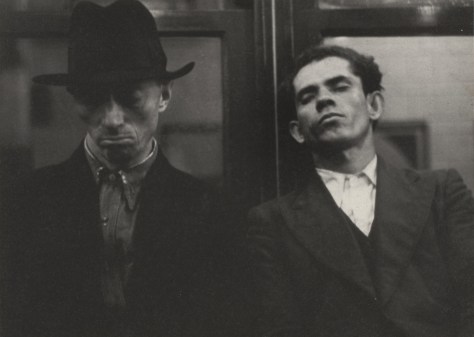
The pictures are fascinating. They show true snapshots of life. A person leaning back asleep next to a person leaning forward also apparently asleep. Two women, both looking severe, one clutching a bag, the other with a fur coat, they look as though they are from very different parts of the social spectrum – but both are on the subway. A pair of nuns. A mother holding a bored child. People reading newspapers. Women in fancy hats. With the exception of the number of hats being worn, most of these images could be taken nowadays. People were doing the same thing then while traveling as would happen today, talking, sleeping, reading, controlling the children, clutching the shopping or a handbag. Their expressions are, in Evans’ words ‘naked’. If you take a ride on a crowded train today – would they be as off guard – possibly not on the subway, because of fear of pickpockets, but on a long train journey probably yes.

Nowadays we have long discussions about the ethics of taking pictures covertly. Legally it is allowable, at least in the United Kingdom, although not so in all countries. Everywhere we go pictures are taken, by people, by security cameras, by Google. In Evans’ era this discussion was not open. People in general were aware of the profusion of cameras – but would almost certainly not have consciously thought they would be the subject of an image that would be published, not unless they were already famous. The book and exhibition showing these images was not published until many years later. Was Evans deliberately giving people their privacy as has been suggested, or was that simply that that was the time he wanted to show the image?

References and Sources:

Evans, W. and Agee, J. (2004). Walker Evans – Many are called. New Haven, Conn.: Yale University Press.

Evans, W. and Kirstein, L. (2016). American photographs. New York: The Museum of Modern Art.

Ludden, J. (2004). Many are Called – Walker Evans Subway Photographs. [online] Npr.org. Available at: https://www.npr.org/templates/story/story.php?storyId=4156233?storyId=4156233&t=1565772143009&t=1566290520744 [Accessed 20 Aug. 2019].

Metmuseum.org. (2004). Walker Evans (1903-1975). [online] Available at: https://www.metmuseum.org/toah/hd/evan/hd_evan.htm [Accessed 20 Aug. 2019].


Huebler- Variable Piece #101

huebler
Douglas Huebler – Variable Piece #101 ©unknown

Douglas Huebler (1924-1997) was a pioneer of Conceptual Art. He started as a painter, moved towards sculpture and then to making his series that he called ‘Duration Pieces’, ‘Variable pieces’ and ‘Location Pieces’ in which he documentaries places, people or everyday activities using photographs, maps and drawings. One example of this is Variable Piece # 101. In this piece he took 10 pictures of Bernd Becher who was asked to pose, in the following order, as: “a priest, a criminal, a lover, an old man, a policeman, an artist, Bernd Becher, a philosopher, a spy, and a nice guy.”  Some months later, when Becher had presumably forgotten exactly what he did, he sent the images back to Becher and asked him to identify each face. Huebler then exhibited these pieces together with the list of what he had asked Becher to act out and the list of Becher titles. He was very clear “Ten photographs and this statement join together to constitute the final form of this piece.” The whole work of art was constructed from both the images and the list – but he only identified the images by number and did not say whether the list of titles belonged to his original order, Becher’s order, or indeed a completely different order. It was further confused by the fact that the work was exhibited twice, once in the Los Angeles Museum  of Contemporary Art and once in Limoges and catalogues lists exist showing both of these, but the images are shown in different orders in the two places and only numbered in the Limoges catalogue. Two of the images are actually different between the two catalogues.

Pitheads 1974 by Bernd Becher and Hilla Becher 1931-2007, 1934-2015
Hilda and Bernd Becher

Bernd Becher himself was a notable typologist, usually working with his sister Hilla Becher. They photographed industrial structures such as water towers, and factories, always in black and white. They showed the images in sets (typologies), usually layed out in a grid pattern. A quote from them on the Tate website says ‘We photographed water towers and furnaces because they are honest. They are functional, and they reflect what they do – that is what we liked. A person is always what s/he wants to be, never what s/he is. Even an animal usually plays a role in front of the camera’ (Tate, 2016).

Huebler’s work in Variable Piece 101 plays on the typology work of the Bechers, both by using Becher himself as a participant and also by laying the black and white images out in a grid. However, unlike their work where there is no ambiguity, the piece by Huebler is full of it. Which image is which? Which image did Becher identify as what? And why did he change the pictures between the two exhibitions – and which set did he show to Becher to be sorted? The title causes confusion rather than clarity. In an illuminating essay by Hughes, he points out that Becher turns the whole exercise back on the Bechers, confusion not clarity, a person rather than buildings (Hughes, 2007).

Catholic Priest 1927, printed 1990 August Sander 1876-1964 ARTIST ROOMS Tate and National Galleries of Scotland. Lent by Anthony d’Offay 2010

Huebler also comments photographically on the earlier work of August Sander and his typologies. The ‘types’ that Becher is asked to perform are some of the types that Sander divided his portfolio into; philosopher, policeman, priest, old man, criminal, and artist. However, Sander showed his images as individuals, rather than in a grid pattern. Huebler is subverting Sander’s work in that it is impossible to tell which face is supposed to be which character, and, of course, they are all images of one person. It is possible, and an interesting exercise, to cut out the faces from some of the less well-known photographs by Sander, present them to another person in a random order, and see what ‘type’ they would be identified as. Even if you gave a list of possible types I suspect that everyone would order then differently.

This piece of work emphasises how crucial it is to know the intention of the artist. The meaning of the images here are elusive. The titles are potentially misleading not clarifying. The piece needs to be seen as a whole.   What is Huebler telling us? The clearest reading is not to believe the obvious. To be aware of potential for confusion. Nothing is fixed, all is variable. The meaning is what you see which may be different from what the person next to you sees.

References:

Hughes, G. (2007). Game Face: Douglas Huebler and the Voiding of Photographic Portraiture. Art Journal, 66(4), pp.52–69.

Tate (2016). Who are Hilla and Bernd Becher? | Tate. [online] Tate. Available at: https://www.tate.org.uk/art/artists/bernd-becher-and-hilla-becher-718/who-are-bechers.


Self Evidence – Woodman, Arbus and Mapplethorpe

Self Evidence is an exhibition at the National Portrait Gallery of Scotland, which is being shown, appropriately, in the Robert Mapplethorpe Gallery.  The three photographers shown were all interested in the idea of identity, or the self, and how to show it.

https://www.nationalgalleries.org/exhibition/artist-rooms-self-evidence-photographs-woodman-arbus-and-mapplethorpe

Diane Arbus (1923-1971)

Arbus is a fascinating photographer who took a collection of images of what she called her ‘singular people’. These were often of people who were different in some way, for instance, the Jewish giant, and the images of people from nudist camps. There are ethical dilemmas in her images, especially when looked at from todays stance. Did she ask permission? Did she explain how she was using the images? Did she pay for them? The answer to all of these is probably no – but nor did any of the photographers of her time. She undoubtedly took images that would be difficult to take today – those of people with a learning difficulty and physical challenges. Nowadays we would need to find out who has the appropriate guardianship and rights of welfare attorney, get formal permission, and credit the people involved. Does that mean the images should not have been taken then, when it was a different world? Does it mean they should not be shown now? What is obvious from the images is that Arbus engaged with the people. For the images of those people in a nudist camp she took the pictures while naked to make them feel comfortable. She talked to the people with learning problems and visited them – something that was rarely done at that time, when ‘mental issues’ were hidden away. She gave them a voice, even if they did nor fully understand what was being said.  Arbus addressed identity by looking at other people rather than herself.

Francesca Woodman (1958-1981)

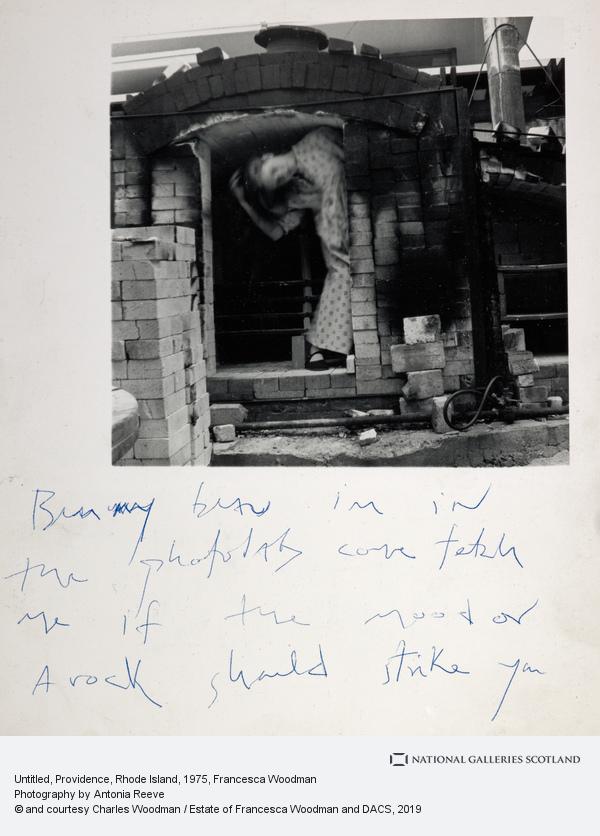
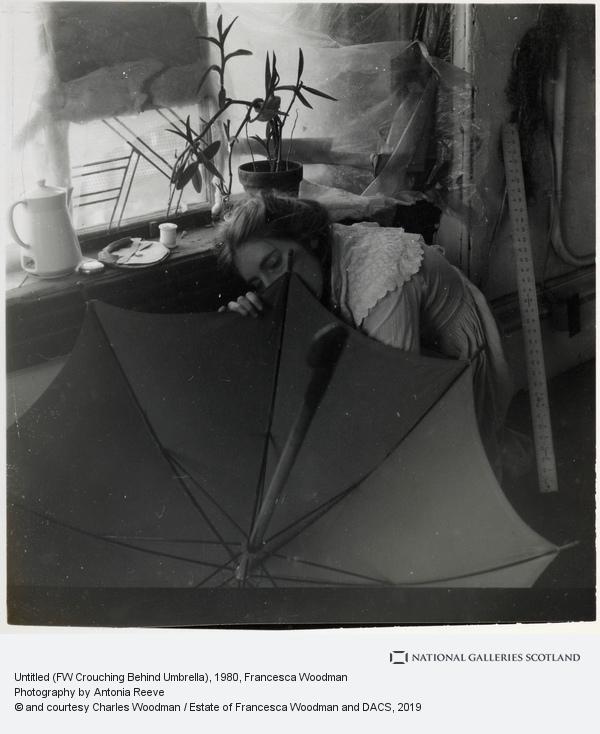
In Woodman’s short life she took a vast number of images, many which have never been on display. The ones shown in this exhibition are a variety of images mainly of herself or her boyfriend, Ben. They are small, black and white, mostly square. Some have been written across and were used as notes to send to others. Many are partially out of focus. She utilised mirrors, reflections and odd shafts of light to illuminate the important areas. Many of the images show herself partly hidden or on the edge of the frame, such as Untitled (FW crouching behind an umbrella). She becomes a ghostly partial presence. Do the images tell you about Woodman – or hide her? It is difficult to read her images nowadays without considering her suicide at a young age, and wondering what impact this had on her photography – but much of her oeuvre was  taken well before that and it is almost certainly simplistic to assume that all the images were taken by someone who was depressed! Much is experimental, much echoes the type of photography and art she was exposed to.

Robert Mapplethorpe (1946-1989)

The exhibition of Mapplethorpe self-portraits shows a range of images from those of him in his early bad boy, leather and whips phase to ones with a suited and serious mien to those taken just before his death. They often show him playing a role, holding a knife or a gun, possibly copying stances from films. They become gradually less controversial, although not completely so. There is one from 1985 which shows him wearing horns. Is he playing as a satyr or as a devil? Is it another riff on his earlier images that use themes from the Catholic Church? The final one is of his face and hand holding a stick with a skull. All else is black. A true play on a ‘memento mori’ image, made more poignant because he was clearly aware of his own impending death.  All of the images are beautifully crafted, balanced and set formally within the frame. Whatever you think of his lifestyle and the photographs he chose to take it is impossible to deny that he was a skilled artist, who used his own life to tell a story about a population that was mainly hidden then, and often still is.

Summary

It was fascinating to see these three photographers side by side. They all died young, two by suicide, one because of AIDS. They were all interested in portraiture. The photographs they took were very different. Arbus showed her interest in people by taking images of others. Woodman photographed herself, but in an elliptical, sideways way, hiding as much as she showed. Mapplethorpe’s images are clear, in your face and controversial – but does his apparent clarity hide as much as Woodman’s less overt images do?