Category Archives: Photographers

Research point 1 – Elina Brotherus

I previously looked at the work of Elina Brotherus when doing CAN while looking at autobiographical portraits (Autobiographical self-portraiture). I have now looked at her work in slightly more detail.

I watched the video of her talk to the OCA students (The Open College of the Arts, 2015) and took notes – the quotes are not exact but give the idea of what she said. It was a fascinating talk and I would recommend it to anyone looking at self-portraiture.

  • Brotherus is a Finnish artist, who works between Finland and France. She initially went to France on a residency but didn’t speak any French. She used a post-it sticker method, starting with basic words. Starting with very concrete words and took photos of them in situ. Gradually moved to less concrete words. Did a series of these images. ‘Starting point of my work’. They took me seriously. Then (2011) invited back to work within the schools. Went back to same place as the initial series to look at the beginning of her art – how would it feel? Eventually became a body of work – ‘a position statement’, a turning point, looking back, again using post-its, but talking in more detail. 12 years ago – then a series of statements about how she felt then and where she is now (when taking the images). The images show a picture with long texts, talking about her life – but more about her feelings ‘I can’t take the company of people my own age’. Made into an exhibition and into a book. Includes ‘all the themes that are important to me’, landscapes, fog, reflections, the human figure in a landscape. A return to autobiographical working. Previously was interested in work related to the history of art.
  • ‘I don’t do things in a hurry, if you have the luxury of time use it’, leave things aside then come back to them.
  • When the work is personal it’s hard to have anyone else there – but when it’s a study of the human figure it can be anybody, it’s easier to position someone else – but when yourself you end up running back and forward. I like to be alone because there are less distractions and I am not worried about the other person.
  • I don’t want to hide the camera release – it shows that the person is also the artist – ‘it’s an invitation to a shared contemplation – that’s also why I like the back image’. It’s a different feel when she (the artist) is looking at us or looking away – ‘a frontal figure is a confrontation’. It’s easier as a spectator to enter in (when it’s the back of the artist) as we are together, but we are not disturbing each other.
  • The Annonciation– it’s a responsibility as an artist to lift the lid on things that are taboo – pictures can allow you a route into things, making something into a picture may allow you to distance yourself, to see myself as a human being and others have similar issues.
  • Work in a sincere way as its all your work, eventually it will all come together, you have your own way of discovering, work more rather than stay at home and think.’ I shoot a lot, then I leave it aside’. Think afterwards, edit and reflect. There is no one right answer, multiple solutions out of a body of work.

    05_Le+deuil+du+jeune+moi+qui+a+ete
    © Elina Brotherus – Le deuil du jeune moi qui a été

I have also looked at more of her work online (Brotherus, 2014). The series discussed above – 12 Ans Après (1999/ 2011 – 2013) shows a combination of her earliest work and the later images taken at the same place. As noted, there are a combination of landscapes and portraits. Interestingly she has mixed portrait and landscape formats for both types of images. All are colour. Most are melancholy. In several the emotions are overflowing. Some, but not all, of the images include the post-it notes, scattered all over the pictures. Unfortunately, I cannot read French – as I think they add another dimension to the work. One of my favourite images from the series is a very simple view of water and sky – La Saône 3.

23_La+Saone+3
© Elina Brotherus – La Saône 3

The series Carpe Fucking Diem is a recent series in which she attempts to move beyond her perceived failure (not having children) looking at ‘the surprising and surreal undertones of the everyday life, not totally deprived of humour, because even an unhappy end is not The End’ (Brotherus, 2014b). While this series is not so overtly autobiographical as some of her other work it still is clearly based on her life and her feelings. Some of it was actually shot at the same time as the work for The Annonciation and the two series can /should be looked at in parallel.

25+My+Dog+Is+Cuter+Than+Your+Ugly+Baby
© Elina Brotherus – My Dog Is Cuter Than Your Ugly Baby

Summary:

I find Brotherus’s work fascinating. When I looked at it previously, I actually found it somewhat disturbing and hard to view. My feelings have changed over the last year and I now find it both sad and surprisingly beautiful. The combination of clear autobiography, both sad and funny, (at times uproariously so) with images of small details, a bowl of potatoes, a worm on the street, give an insight into the life of someone I wish I could meet.

References:

Brotherus, E. (2014a). 12 Ans Après [online] Elina Brotherus. Available at: http://www.elinabrotherus.com/photography#/12-ans-apres/ [Accessed 10 Dec. 2019].

Brotherus, E. (2014b). Carpe Fucking Diem. [online] Elina Brotherus. Available at: http://www.elinabrotherus.com/photography#/carpe-fucking-diem/ [Accessed 10 Dec. 2019].

The Open College of the Arts. (2015). Elina Brotherus student talk | The Open College of the Arts. [online] Available at: https://www.oca.ac.uk/weareoca/photography/elina-brotherus-student-talk/ [Accessed 10 Dec. 2019].

Calum Colvin – Andrew Carnegie

Dunfermline has strong links with Andrew Carnegie as it is where he was born, and it hosts his Birthplace Museum. At present the artist/photographer, Calum Colvin, is in the process of making a work of art that will become a photograph of Andrew Carnegie.

Burns_Country
© Calum Colvin Burns Country

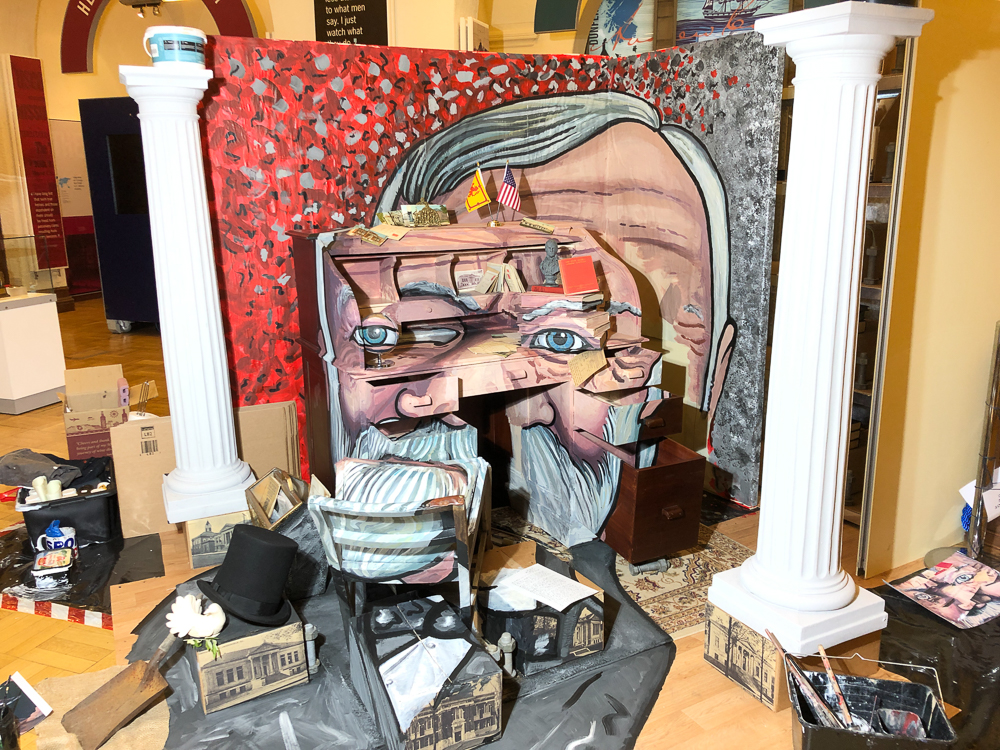
Calum Colvin is a Scottish artist (although when I asked him, he said he wasn’t sure if he was an artist or a photographer) who specialises in making three dimensional constructed pieces of work that when photographed become an image of the person. He has mainly (although not exclusively) worked with figures that have a relationship to Scotland or Celtic mythology. Recent work has included Burnsiana, which was an exhibition of work exhibited alongside poetry by Rab Wilson that was written in response to the artworks. He describes it as ‘‘Burnsiana’ is an exhibition and book born from an appreciation of the poetry, life and times of Scotland’s favourite son, Robert Burns. The works are a mixture of the mundane and the surreal, assemblages of everyday objects, which become a three-dimensional canvas for various painted scenarios’ (Colvin, 2019). The images can be seen on his website:

http://calumcolvin.com/Burnsiana.html

Other work also included a series looking at Scottish history and the symbolism of the Jacobite Risings and therefore the legacy this has had on Scottish identity. He collages items together to make the image. ‘His complex artistic manoeuvres and erudite references can be read as a metaphor for the construction, the ‘collaging’, of history itself, thereby asking us to be vigilant as to which version of history is presented to us, by whom and to whose gain.’ (Edinburgh Printmakers, 2009). The work is full of illusions, both visual and metaphorical and need more than a brief look to interpret.

http://calumcolvin.com/Jacobites_by_Name.html

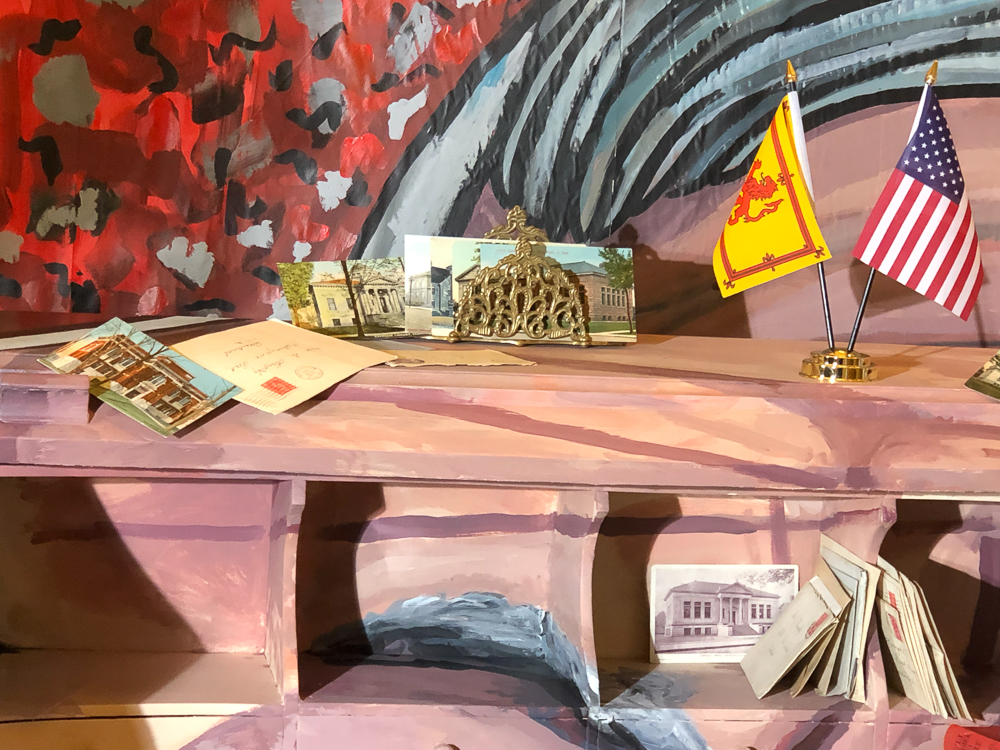
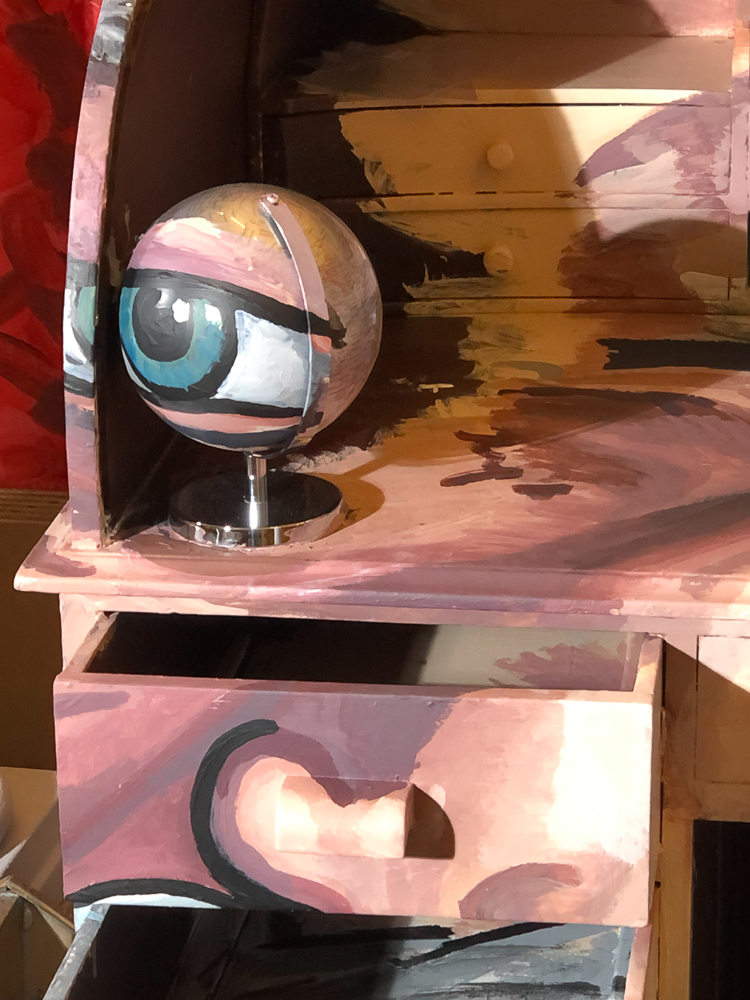
Colvin is in the process of working on another piece, a head of Andrew Carnegie and I was lucky enough see this work in its final stages and catch a very brief conversation with him. The process is that he builds a large construction that, in this case, included books, postcards, Carnegie memorabilia, a desk which he has overpainted  and some purely constructed pieces (the eyes) and then places them in such a way that when photographed from directly in front they merge to produce a single image that shows the man. Looked at from any other angle they become a 3-D jigsaw puzzle. In this case the work is being made in the Carnegie Birthplace Museum and has been watched by the visitors and Colvin’s research has been influenced by the easy availability of relevant information.  When I saw it he was just putting the final touches to the model, altering some lines in the painting to make it more realistic. Colvin takes regular images of the model to guide his work. The final model will then be photographed, printed large scale and displayed within the museum and the model itself will be destroyed, although I was told that some pieces of it will be retained and shown alongside the photograph.

Colvin kindly allowed me to take some pictures of both the model and him working with it.

Side Views:

Details:

Working on it:

Almost completed:

untitled (1 of 1)-11

References:

Colvin, C. (2019). Calum Colvin – Burnsiana. [online] Calumcolvin.com. Available at: http://www.calumcolvin.com/Burnsiana.html [Accessed 5 Dec. 2019].
Edinburgh Printmakers. (2009). Lochaber No More. [online] Available at: https://www.edinburghprintmakers.co.uk/calum_colvin [Accessed 5 Dec. 2019].
Project 2 – The Aware – 2

When thinking about portraits as well as considering who you are going to photograph (Project 2 – The aware) you also need to consider where. Just as dividing up who you are going to photograph you can also divide up the place into types:

  1. Inside – examples of these are the June Street images by Parr and Daniel Meadows, Daniel Meadows 2 and the Mother series by Paul Graham
  2. Outside – many of the images of Eleanor taken by Harry Callahan

Both of the places can be further subdivided into:

  1. A natural environment – the images by Sian Davey in Martha and Looking for Alice.
  2. A studio, which can be further divided into:
    1. Formal – an example of this is the work Gone Astray by Clare Strand where people are photographed against a backdrop of a Victorian type frame
    2. Informal – the work of Irving Penn in Worlds in a Small Room could be considered as a relatively informal studio, in that it was portable, although it became more fixed as time went on. A more informal studio was shown in Daniel Meadows Omnibus Project where he travelled around with a converted bus.

Interestingly there is a recent series of work by Sandro Miller shown on Lenscratch  I am Papua New Guinea available at:

http://lenscratch.com/2019/10/sandro-miller-i-am-papua-new-guinea/

In this Miller went to Papua New Guinea on three occasions, set up a studio and offered the chance for people to come and have the photographs taken in all their finery. The images, although mainly in colour, are strongly redolent of Penn’s images of a similar area of the world. Like Penn, he noted that many of these people have had little or no previous awareness of a camera. However, Miller’s images do give more of a feeling of the person rather than just the exotica and he identifies the people both by name and tribe, rather than showing a group of images that are exciting but impersonal.

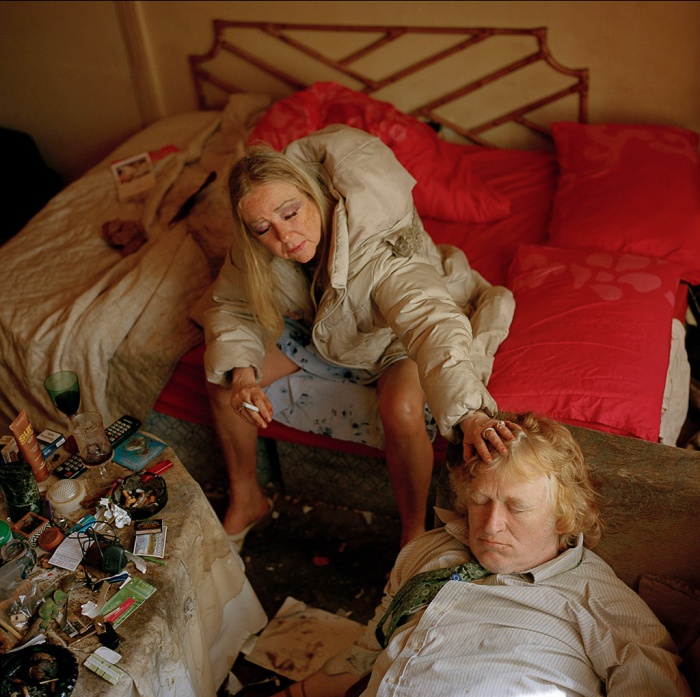
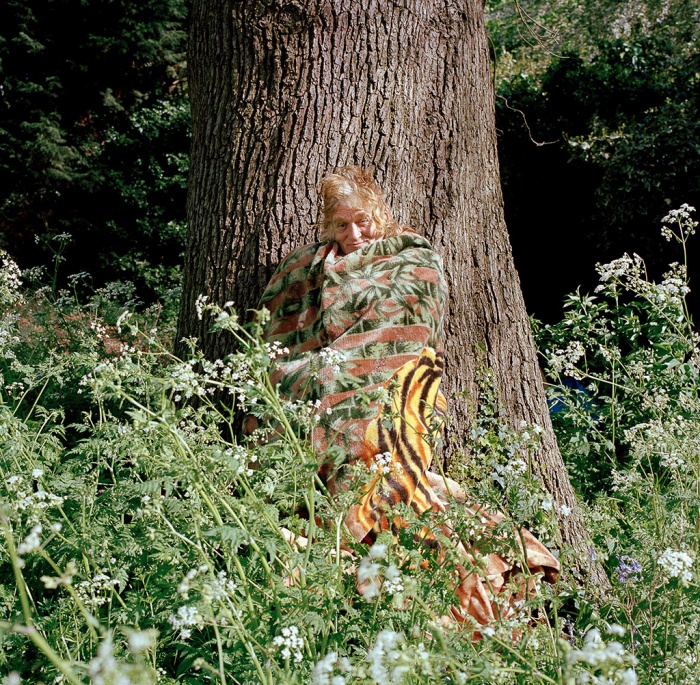
An example of photographs of people taken mainly outside, in a ‘natural’ environment, is the work of Andrea Modica – Treadwell.  Treadwell is ‘a place in the imagination…. a fiction about a little girl growing up’ (Modica and Proulx, 1996).  In the initial essay by E.Annie Proulx,  Modica describes how she  ‘entered into an intimacy with the situation of place’ and took a series of pictures, not all in the ‘real’ Treadwell that tell the life of a girl growing up in a series of decayed farmhouses and crowded places. The places are allegorical, essential to the meaning, often ghostly or reminiscent of death. Without the landscape the story would not be present. Without the children there would be nothing but depression and misery. Both together give a possibility of hope.

References:

Drew, R., Chandler, D., Eskildsen, U., Jeffrey, I., Mullen, C. and Strand, C. (2009). Clare Strand : a Photoworks Monograph. Brighton: Photoworks ; Göttingen, Germany.

Graham, P. (2019). Mother. S.L.: Mack.

http://lenscratch.com/author/aline-smithson (2019). Sandro Miller: I am Papua New Guinea. [online] LENSCRATCH. Available at: http://lenscratch.com/2019/10/sandro-miller-i-am-papua-new-guinea/ [Accessed 11 Nov. 2019].

Modica, A. and Proulx, A. (1996). Treadwell. San Francisco: Chronicle Books.

Penn, I. (1974). Worlds in a Small Room. London: Secker & Warburg.

Siân Davey (2015). Looking for Alice. Great Britain: Trolley Ltd.

Siân Davey (2019). Martha. Hertfordshire: Trolleybooks.

Daniel Meadows 2

© Daniel Meadows

I have just listened to a fascinating podcast with Daniel Meadows in which he talks at length about his career and his thoughts on photography – A Small Voice episode 116. All the quotes here are from that podcast.

Meadows talks about his upbringing, how he was brought up in a very typecast structure, class related, boarding school, had a housekeeper. This led to interest in other people. He struggled with authority and argued in school which led to him spending much of his final year in the art department where he saw Bill Brandt exhibition – when he realised that Brandt moved across the class structure and showed it was possible to do so in photography.

Meadows met Martin Parr at Manchester Polytechnic, they would meet up regularly and immerse themselves in contemporary photography via magazines and films. This led on to Graeme Street project. ‘How do I respond to them tearing down the middle of the city?’. He invited people into a rented shop and ask them to tell their stories and take images. He then heard about and was influenced by the Irving Penn work that went on to become Worlds in a Small Room. Meadows said that in those days ‘Kids came first, and then they would bring their parents’.

My work has been about a way of generating chance encounters with strangers…. what came through the door was so inspiring…..a brilliant portrait of Britain’. To make money he spent the summer as a photographer in Butlins, taking images both at random in the camp and at formal events ‘The walkie photographers….. there I started using colour, Ektachrome slides.’  At that point he hadn’t seen much colour work, as most of the inspiring work was still black and white.

June Street with Martin Parr came about following a visit to the Coronation Street sets. The streets were being torn down so they looked for the last remaining street and photographed everybody in there. They were done as a typology, looking towards the sofa, with every living creature in the photo.

Then came the Omnibus Project, which had multiple problems, the bus was always breaking down, it was difficult to find places to stop. He talked about working on my own. ‘You are lonely….you are scared….I slept in places where people tried to break in in the night….but generally people would open up ….. you listened to people…… I was beginning to think about what is documentary all about….I was a beginning to say “I will put you in the history books”’. Many years later these images were put on as an exhibition, he then reconnected with as many of the people as possible via local newspapers and re-photographed the people and put the new with the original images. Meadows is very definite that the story is about the individual people and not a typology.

Nowadays he says, you need to learn how to listen, that there is a story to be had on every street. Then a camera was novel, this is now not the case. How do you work now? ‘You are different from the people you are working with…. so, what can you add? Can you get other people to tell their own story?’ Now many people do on Facebook etc. But this can be very ‘dismissive of other people’ and often very ‘shouty’. ‘Can you write things without swearing and make people cry?’

 “I spent a lot of my life wishing that I’d taken pictures like Cartier-Bresson or Diane Arbus or Bill Brandt. And it took me a long while to learn that I’d actually taken pictures like Daniel Meadows.”  He says he has a loathing of advertising photography. Meadows then talks about the perceived differences between art and documentary and that galleries want ‘art’ not documentary – why is documentary a ‘second-class thing’?  His work has now gone to the Bodleian Library at Oxford where they have taken everything – all the pieces of writing, all the journals, all the recordings, all the history.

Meadows ends by saying ‘Everybody has to invent their own way…You have to sit down and say to yourself why do I want to take pictures… who am I doing it for…what is my subject matter… I you don’t know your subject matter you are never going to make good pictures, important ones’.

 References:

https://podcasts.apple.com/gb/podcast/a-small-voice-conversations-with-photographers/id1039540784?i=1000455468852

https://www.photobus.co.uk/picture-stories/the-shop-on-greame-st


Clare Strand

Clare Strand (born1973) is a British photographer. In her website she describes her practice as “rolling in the grass and seeing what you pick up on your jumper”. And says she ‘brings together intensive research, deadpan humour and insights into culture’ (Strand, 2015). Sean O’Hagan says, when talking about her exhibition The Happenstance Generator ‘There is always something odd – in a good way – about Strand’s work. That oddity rests in the tension between her often personal, always playful take on conceptualism and her wilfully old-fashioned methods – the archive images, black-and-white tones and kinetic machines here are a case in point’ (O’Hagan, 2015). In her latest work The Discrete Channel with Noise she looks at how the act of communication can lead to misinterpretation, starting with the issue that as information is transmitted digitally it is split into multiple minute pieces and these can be altered into process of reformation to a whole. This piece of work has just been shortlisted for the 2010 Deutsche Börse Photography prize. In an interview with Chris Mullen, Strand says, ‘all my work is about the nature of the medium of photography, its uses and its limitations’ and ‘the question is always ‘how much to give away to the viewer?’ it is possible to explain the image away and allow the viewers no space for their own interpretation…..there are issues throughout my work I want to leave unsolved ’ (Drew et.al., 2009).

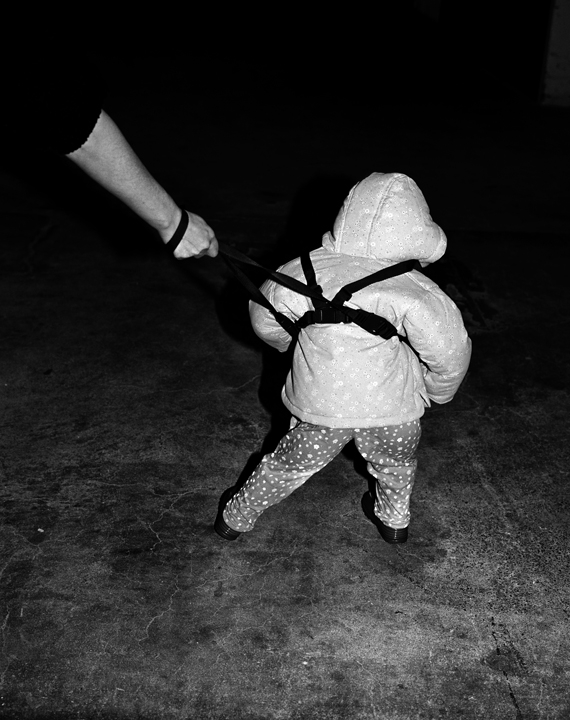
In one of her much earlier pieces of work Gone Astray Portraits she uses a 19th century convention of using painted backdrops to photograph someone against. She took a series of portraits of people, all of whom show a degree of distress or damage. The title comes from a story by Charles dickens which tells of a child lost in London and the anxiety that provokes. The background shows an apparently idyllic scene while the people are AK troubled. They look away from you, either sideways on, on with a failure of eye contact. They seem disinterested, both in the photographer and in their own problems. Chandler says ‘the ambiguities and cul-de-sacs in Strand’s work, qualities that leave the viewer on a continually slippery surface. Her art is in many ways an intensely private world, her projects are a way of resolving obsessions, of processing thoughts that simmer and won’t go away, many of them arising from the most ordinary of encounters and the most routine situations. Like the best photographers, Strand is a great and meticulous observer of details, and yet her work is rarely about that: the details are simply the things that lead her on, to enquire and to investigate, the work itself is then positioned at a point where her, often conflicting, evidence collides (Chandler, 2015). In this work there is the collision of the old with the new, the Acadian with the downtrodden, the photographer’s gaze with the lack of gaze of the subjects. There is said (in the OCA manual) to be a constructed backstory to go with each of these images, but I could not find them. In reality I wonder whether it is better to apply one’s own imagination to each of the somewhat surreal images and invent one’s own story.  Gone Astray Portraits was accompanied by Gone Astray Details in which she shows a series of images of details of happenings in the city, a child pulling on its reins, the legs of a woman, someone holding a dog’s tail. Looking at the two sets of images together which tells more about the city? Which is less staged – the people against the backdrop or the apparently real snapshots? Gone Astray Details is accompanied by a series of ‘short stories’. Small snippets, just a few lines long. An example is ‘1. On the corner of Bowling Green Lane, a Middle Ages woman suddenly fell to her knees on the pavement. There was no apparent cause. In the previous six months over twenty women have fallen at this spot.’ In my book Clare Strand (Drew et. al., 2009) the words run along under the full-page images or along the bottom of occasional blank page. The is no obvious connection between the words and the images shown. There is, in fact, an image of someone crawling on their knees but it is not placed above this particular story. Are they linked? Are they too beread as entirely separate meanings? The reader/viewer is thrown into confusion. She has, as she wants to, left an open question, an unsolved mystery.

References:

Chandler, D. (2015). Vanity Fair r. [online] Clare Strand. Available at: https://clarestrand.tumblr.com/post/142841300931/vanity-fair-text-by-david-chandler [Accessed 31 Oct. 2019].

Drew, R., Chandler, D., Eskildsen, U., Jeffrey, I., Mullen, C. and Strand, C. (2009). Clare Strand : a Photoworks Monograph. Brighton: Photoworks ; Göttingen, Germany.

O’Hagan, S. (2015). Things fall apart: the photographer who destroys her work for fun. [online] the Guardian. Available at: https://www.theguardian.com/artanddesign/2015/apr/30/clare-strand-photographer-getting-better-and-worse-at-the-same-time [Accessed 31 Oct. 2019].

Strand, C. (2015). Clare Strand ~ Photographer ~ about. [online] Clarestrand.co.uk. Available at: https://www.clarestrand.co.uk/about/ [Accessed 31 Oct. 2019].


Irving Penn

© Estate of Irving Penn – from Worlds in a Small Room

Irving Penn (1917-2009) is an American photographer who is probably best known for his fashion images, often taken for Vogue magazine together with portraits of the rich and famous of that world. However, he also took the opportunity to photograph other people while travelling. Penn set up a simple outdoor studio, using a grey or whole cloth and only natural light. He then invited people to pose against it, using no props. He describes it as “The [portable tent] studio became for us both a sort of neutral area. It was not their home, since I had brought this alien enclosure into their lives. It was not my home since I had obviously come from elsewhere far away. But in this limbo was in us both the possibility of contact that was a revelation to me and often I could tell a moving experience for the subjects themselves.” (McLaughlin, 2013).  Initially Penn worked by locating studios and hiring them and asking people to come and have their photos taken. He then moved on to developing his own portable studio which could be set up outside. The images he took have a timeless quality as he used a very simple background cloth. When talking about the series of images taken of the Cusco people,  Kozloff describes it as ‘It is as if his subjects had stepped, not onto the stage to which theory were accustomed, but onto one of his imagining, a bare environment intended to set off their picturesque shabbiness to graphic effect’ (Kozloff, 2007). The images are studied, there is no apparent feeling for the individuals involved, just the costumes and masks the people wear. He went on to take other series of images such as those of the people from New Guinea and even groups of Hell’s Angels. His pictures of the celebrities, while more individual, show use of similar techniques of use of a simple backdrop and harsh light and shadow such as that of Woman with a Handkerchief (Jean Patchett) a Vogue cover from 1950. His images of the various native populations have often been described as exploitative as he used them as ‘fashion pictures’ rather than serious studies of the ethnography of the regions. However, he said about them ‘the people I photographed were not primitive. The primitive people are in New York’ (Goldberg, 1991).

© Estate of Irving Penn – Woman with a Handkerchief (Jean Patchett) New York

Penn was an eclectic photographer. As well as his portrait work, both personal and for fashion magazines,  he took pictures of flowers where he said he was ‘drawn to flowers considerably after they’ve passed their point of perfection’ (Smart and Jones, 2019) , cigarette butts and things found underfoot (a series of marks on the pavements). Penn was also famous for his printing, often utilising platinum/palladium techniques to give a soft but intensely detailed finish.

Whatever you think of the ethics of his photography there is no doubt that he produced an astounding and varied body of work. Penn’s vision for his project that is shown in Worlds in a Small Room was ‘These remarkable strangers would come to me and place themselves in front of my camera, and in this clear north sky light I would make records of their physical presence. The pictures would survive us both and at least to that extent something of their already dissolving cultures would be preserved forever.’ (McLaughlin, 2013). This has come to pass and is a remarkable epitaph to a man who worked at his passion almost until he died.

References:

Goldberg, V. (1991). ART; Irving Penn Is Difficult. “Can’t You Tell?” The New York Times. [online] 24 Nov. Available at: https://www.nytimes.com/1991/11/24/arts/art-irving-penn-is-difficult-can-t-you-tell.html [Accessed 30 Oct. 2019].

Kozloff, M. (2007). The Theatre of the face : Portrait Photography Since 1900. London: Phaidon.

McLaughlin, T. (2013). Worlds in a Small Room. [online] Image on Paper. Available at: https://imageonpaper.com/2013/07/21/review-worlds-in-a-small-room/ [Accessed 29 Oct. 2019].

Smart, A. and Jones, R. (2019). How Irving Penn ‘changed the way people saw the world.’ [online] Christies.com. Available at: https://www.christies.com/features/Guide-to-Irving-Penn-9751-1.aspx [Accessed 30 Oct. 2019].


Daniel Meadows

Daniel Meadows is a British photographer, a contemporary and friend of Martin Parr, who taught and worked in collaboration with him. He describes himself on his website as ‘I am a Documentarist, I have spent a lifetime recording British society, challenging the status quo by working in a collaborative way to capture extraordinary aspects of ordinary life, principally through photography but also with audio recordings and short movies’ (Meadows, 2019) and says his story is about the England he comes from. An archive of all his work to March 2018 is held in the Boddleian Library in Oxford and has been used to study how UK photographers can make their work and studies publicly available.

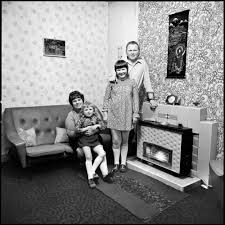
The June Street series was made in collaboration with Martin Parr in 1973, as series of pictures of the residents of houses in June Street, Salford, that were awaiting demolition. They took photographs of families in their sitting rooms, all looking at him, seated in similar positions. The project was taken up by the BBC and the verbal stories and comments of the people were added. A short Vimeo talk, Daniel Meadows – June Street by Meadows explains how he went back to see some of the residents of June Street in 1996 and how the photographs brought back memories of the past. He also talks about the comments of some bloggers on an exhibition in 2011 talking about how his photographs of June Street brought back personal memories of their own childhoods and says ‘ ..that something so rooted in a specific past can speak so powerfully in an ever-changing present and with such a range of meaning is, I think, magical’ (Meadows, 2014).

In the introduction to his recent book, Now and Then, England 1970-2015 Meadows says ‘My rule of thumb when doing documentary work is to try and treat people as individuals, not types’ (Meadows 2019). This is completely opposite to the rule of typology that Sander used and leads to a very different kind of image. He quotes Karl Ove Knausgaard who says ‘; Should our culture not …. establish difference, which is the stuff of all worth in which value resides and from which it is released’ (Knausgaard, 2018). The book starts from his very early work as a student when he set up a free photo-studio in a disused room in Graeme Street. Even these early images show the individual nature of the people he took, the cheekiness of the children and the serious adults. He moved on to travelling with a bus, still taking free pictures of anyone who wanted their picture taken, single people, pairs and groups – building up an early version of a portrait of England. He made contact with some of the people photographed in both these projects many years later and took their stories and re-photographed them – hence Now and Then. It makes fascinating reading. Among other things, in 1975 he was photographer-in -residence for the Borough of Pendle, where he took images of what was then the industrial heartland of England, the people, the machines and the scenery. All in black and white – colour was generally too expensive then. The photographs in Now and Then are accompanied by the stories of the people, not (definitely not) politically correct – but extremely funny. He has always made audio recordings to go with the images – to extend the story.

References:

Knausgaard, K.O. (2018). My Struggle. London: Harvill Secker, p.p.626.

Meadows, D. (2014). Photobus ~ Daniel Meadows. [online] Photobus.co.uk. Available at: http://www.photobus.co.uk/daniel-meadows [Accessed 17 Oct. 2019].

Meadows, D. (2019a). June Street, Salford by Daniel Meadows. My photography stories #4. [online] Vimeo. Available at: https://vimeo.com/110983025 [Accessed 17 Oct. 2019].

Meadows, D. (2019b). Now and Then: England 1970-2015. Oxford: Bodleian Library.


Paul Graham

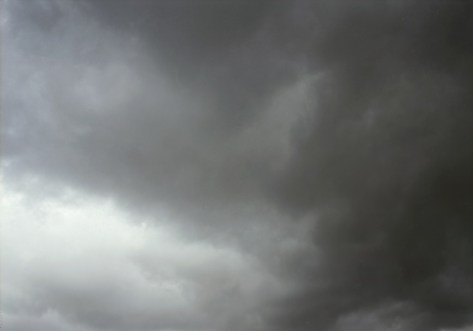
Paul Graham (born 1956) is a British photographer (although he has lived long term in America) who uses documentary photography to explore, not just what is happening, but why it happened and the associated emotions. One of his recent books a shimmer of possibility shows images taken on his travels around America. The book shows 12 visual stories of the small pieces of life that make up the America of the ordinary people that live there. In an interview he says  “it has steadily become less important to me that the photographs are about something in the most obvious way. I am interested in more elusive and nebulous subject matter. The photography I most respect pulls something out of the ether of nothingness… you can’t sum up the results in a single line. In a way, ‘a shimmer of possibility’ is really about these nothing moments in life.” (O’Hagan, 2011).  In another book, Cease Fire he shows images of the sky over Northern Ireland’s troubled areas such as the Shankill Road. What is he saying? And how do you interpret them?

Paul Graham 1
© Paul Graham – from Cease Fire

His most recent book Mother (Graham, 2019) is more personal. It shows a series of apparently simple images of his mother in her care home. The images are dark, the light only glancing of the edges of her cheekbones or her hair. Often her face is not in focus, rather the focus is on the edge of her blouse or the sinews in her neck. There is only one image where she is looking at him and that look (to me at least) reads ‘What are you up to now?” Many of the images show her sleeping. The images are large, shown in groups and interspersed with pink textured pages, which echo the pink that his mother frequently wears. The book is described as showing ‘mortality and the slow unravelling of late old age……the watched-over becomes the watcher’. It is a series of images that I wish I had taken of my mother; they are his tribute – but will stand in for mine.

Mother_Paul_Graham-61_aeb7f40c-0c73-444e-81ad-d434800398d8_1024x1024
© Paul Graham – Mother

References

Graham, P. (2019). Mother. S.L.: Mack.

O’Hagan, S. (2011). Paul Graham: “The photography I most respect pulls something out of the ether.” [online] the Guardian. Available at: https://www.theguardian.com/artanddesign/2011/apr/11/paul-graham-interview-whitechapel-ohagan [Accessed 18 Oct. 2019].

Louis Quail

Louis Quail is described as a documentary photographer, but that tends to imply a photographer who looks at something from the outside with an analytical voice. Some of his earlier projects such as Desk Job in which he explores office life across the continents, showing the similarities of how the workers in a large office exist and how there is a common culture of the office worker versus the big bosses can be described in this fashion.

However, his latest project Big Brother is deeply personal. It tells the story of his brother’s struggle with schizophrenia and the ongoing difficulties this causes. It shows the difficult side of having a severe mental illness, and how negotiating the pitfalls of state, welfare and hospital treatment is fraught with anxiety both for the person and his relatives – but it also tells an ongoing love story about Justin and his long time girlfriend Jackie. The book is both fascinating and terrifying. I was constantly torn between laughing and weeping while reading and seeing Justins story.  The book contains photographs taken over 7 years interspersed with text telling the story and drawings and pieces of writing by Justin. It includes a small booklet of paintings and poems by Justin which make it clear that however damaged Justin is by his schizophrenia he is also a very creative person. One of these poems begins:

Boxed in clever on a psychiatric ward

It’s no wonder I am bored.

The fatigue sets in

The eternal light won’t go off

Before its off.  (Quail and Quail, 2018).

© Justin Quail

Quail says on his website ‘This book did not set out to be a political polemic; rather, my intention was to fight stigma and share Justin’s story so we can understand, empathize and celebrate Justin’s individuality. However, inevitably by studying the problems affecting my brother, the work speaks of and draws attention to the crisis in mental health care, raising important questions about how we look after our most vulnerable citizens’ (Quail, 2019).

The book is worth a long look – for the story, the images and the increased understanding of a person’s difficult world. For this story the long-term engagement was essential to avoid a superficial glance and to give the meaning to the story. It would have been simple to just show the ‘bad bits’ but Quail succeeds in showing both these and the joy that even a difficult life can encompass.

References:

Quail, L. (2019). Big Brother – Introduction – Louis Quail Photography. [online] Louis Quail Photography. Available at: http://louisquail.com/big-brother-introduction/ [Accessed 17 Oct. 2019].

Quail, L. and Quail, J. (2018). Big brother. Stockport: Dewi Lewis Publishing.

Julian Germain

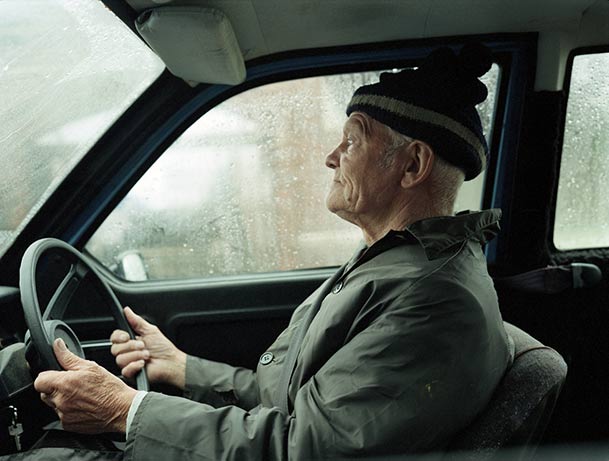
Julian Germain (born 1962) is a British photographer who often combines his own images with archival images to look at the effects of change in society. He works in Britain and abroad, especially Brazil, where he gave cameras to the street children and collected their images – showing the lives of marginalised people. In For every minute you are angry you lose sixty seconds of happiness, which was originally shown at the Baltic gallery, accompanied by a book (Germain and Snelling, 2005), he made a series of photographs taken over 8 years of an elderly gentleman called Charles Snelling which he then published along with pages from Snelling’s own photo album. Germain says ‘He showed me that the most important things in life cost nothing at all. He was my antidote to modern living’ (Germain, 2005). The images are a straightforward story telling that combines photographs of Snelling in his house, on the beach and out walking with images of items that he owns, such as an old kettle steaming on the hob. The work acts as an ‘extended portrait’ – a story of the later part of someone’s life where the photographer has engaged over considerable time – thus giving a richer view than a flying visit could give. This is an excellent example of the additional information time spent on a project gives you, and I find it fascinating.

Germain mostly works by producing books. He says ‘A book is such an excellent way to really look at a body of work over a long period of time. Of all the visual arts the book is suited to photography. Of course, much of my work is not about the single image, my pictures work on each other, placed as they are in sequences and a book is the perfect framework for that. A photo book is a work of art in its own right…’ (Skerrett and Germain, 2010).

References:

Germain, J. (2005). Julian Germain “For every minute you are angry you lose sixty seconds of happiness” project. [online] Juliangermain.com. Available at: http://www.juliangermain.com/projects/foreveryminute.php [Accessed 16 Oct. 2019].

Germain, J. and Snelling, C. (2005). For every minute you are angry you lose sixty seconds of happiness: portrait of an elderly gentleman. London: Mack.

Skerrett, P. and Germain, J. (2010). INTERVIEW: “In Conversation with Julian Germain” (2005) – AMERICAN SUBURB X. [online] Americansuburbx.com. Available at: https://americansuburbx.com/2010/09/interview-in-conversation-with-julian.html [Accessed 16 Oct. 2019].