Category Archives: Coursework

Notes on Ovenden -John Thomson (1837-1921) – Photographer

Notes  taken from the book John Thomson (1837-1921) – Photographer by Richard Ovenden

  • The quality which strikes the viewer most is his ability to get under the skin, so to speak, of whoever, or whatever, he was photographing (p.vii)
  • His photography on the streets of London seeking to examine the self of the great city, the soul of the British empire (p. Xii)
  • Wet collodion
  • Born in Edinburgh, working class family, initially apprenticed as an optician, attended the `school of Arts, studying natural philosophy, then maths and chemistry
  • Travelled initially to Singapore to work with brother acted as a photographer, travelling widely, went to Siam took pictures of the royal family, Cambodia (note typical European disregard for native cultures
  • 1866 back to Britain, started writing and showed pictures and lecturing
  • Returned to Far East in 1867, Vietnam then Hong Kong china. Pictures, landscapes, the poor, the monasteries
  • Back home 1872
  • The camera should be a power in this age of instruction for the instruction of age…. Photography is alike a science of light and a light of science… (p. 29)
  • Started producing books and magazine articles, initially all about his `eastern travels, also lots of lectures
  • 1876 started the project on the street life of London, produced as a monthly periodical
  • Next 40 years mainly spent photographing the society elite, including royal family, connections with the Royal Geographic Society allowed for more articles and also portraits of explorers
  • Travel and associate photography linked from very early days, often via the grand tours made by aristocratic sons Thompson however was a lone traveller, a freelancer
  • Romantic appeal of ruins, initially in Ankor Wat, often used a high viewpoint, impressed with technology of original builders,
  • Some images show a sense of loss and melancholy, picturesque
  • Interested in old places and architecture still being used e.g. bridges, monasteries
  • Photos of the street, physical aspects, social
  • Used types to categorise the lower orders! So, did he give realistic documentation? Started similar images in Asia, notable racial stereotyping and insensitivity but common to the era. Gradually more sophisticated and more aware of the economic conditions
  • Often took pictures of older women, and does talk about them as individuals, also boatmen showing a degree of sympathy to their difficulties
  • Took some ethnographic images, reverting again to types in Formosa
  • Peking multiple street images and interest in poor. Trying to show the reality of life on the street
  • Went on to take pictures of street scenes in London. Done in context of lots of Victorian writing about the problems there.
  • Smith well experienced in journalism and connected with the social reform movements (p.79). Lots of parliamentary talk, little effect.
  • Interested in street traders. Did put people outside of the rest of society.
  • Probably partly based on previous work by Mayhew London labour and the London poor illustrated by wood-engraving
  • Comments by S and T “ nor, as our national wealth increases, can we be too frequently reminded of the poverty that never less still exists in our midst” (p. 81) from preface to street Life
  • Other photographers also documented the working class e.g. Newhaven project, many people concentrated on the buildings, ~Annan’s Glasgow.
  • Reproduced by Woodburytype process giving rich tones and sharpness
  • Images inevitably staged, partly because of restrictions of equipment, use of fast lenses with short depth of field. Also crowd control and multiple distractions
  • Very much used types (continued right up to Sander) but the accompanying essays do talk about the specific people in great detail, does not sentimentalise them
  • Westminster review ‘it is to be remarked as worthy of all praise that these pictures of London life are free from the patronising characteristic spirit so repulsively pervading even popular and useful writers’ (p88)
  • Long history of formal portraiture from king of Siam onward, helped with access. He was aware of the customs of the country ie straight on with no shadows in China
  • Also took formal photos of street people
  • London portraits helped by royal connection!!!!
  • Landscape images probably influenced by other photographers as well as by contemporary painters – notion of the picturesque. He felt the photographer had to act as an artist not just a recorder. Collected Chinese scroll paintings and probably influenced by this style. Interested in pattern and texture.

Reference:

Ovenden, R., Puttnam, D. and Gray, M. (1997). John Thomson (1837-1921) photographer. Edinburgh: National Library Of Scotland, The Stationery Office.


John Thomson – Street Life in London

Tickets - the Card Dealer
“Tickets” the Card Dealer John Thomson

John Thomson (1837 – 1921) was born in Edinburgh from a working-class family and ended up one of Queen Victoria’s photographers. During his remarkable life he worked as an optical glass technician ,  ran a photography shop in Singapore, travelled widely in the Far East, took pictures of both notable figures such as the King of Siam and Chinese mandarins and street workers, together with images of the scenery and buildings – all while carrying the cumbersome equipment need for the wet collodion process and both making and fixing the glass plates in temporary accommodation. On his return to Britain he resided in London, initially lecturing, writing articles and producing books about his travels then taking  images of the London street people which were published in a series of magazines accompanied by articles by Adolphe Smith, while at the same time taking formal portraits of the great and good of London, including Queen Victoria and her family.

Thomson’s street images are some of the earliest examples of social documentary photography. He was preceded in Scotland by Hill and Adamson with their images of Newhaven fisherfolk, these very picturesque images are limited to a very small subsection of the population and also by both Thomas Annan, with his pictures of Glasgow slums, and Archibald Burns’s images of the Edinburgh tenements. However, both Annan and Burns concentrated on the buildings and the people are only shown fleetingly, if at all. Thomson’s images, accompanied as they were by extensive essays by Smith, tell much more about the background and lives of the people he photographed. Richard Ovenden, in his extensive work on Thomson says ‘His photography on the streets of London (is) seeking to examine the self of the great city, the soul of the British empire. John Thomson’s journeys were dominated by the quest for light…….and he found light in both the outer reaches of Asia…… and the underbelly of Victorian London’ (Ovenden, Puttnam and Gray, 1997, p.xii).

In the book Street Life in London  Thomas and Smith say in the preface ‘We are aware we are not the first on the field…..we have sought to portray these harder phases of life, bringing to bear the precision of photography in illustration of our subject…….to enable us to present true types of London poor and shield us from the accusation of either underrating or exaggerating individual peculiarities of appearance’ (Thomson and Smith, 1877).  In an article by the Westminster review, quoted in Ovenden, the unknown  author says ‘ it is to be remarked as worthy of all praise that these pictures of London life are free from the patronising characteristic spirit so repulsively pervading even popular and useful writers’  (Ovenden, Puttnam and Gray, 1997, p88).  Leach says ‘All of the photographs in Street Life in London display John Thomson’s characteristic visual acuity. He was by this time highly versed in his craft, having for many years lived the life of the consummate photographer-explorer….This odyssey seems to have brought fresh insight into the perception and understanding of his homeland, motivating him to use his camera to show the viewing public not that which they could never see, but that which they chose not to see.’ (Leach, 2016).

The  most famous image from Street Life  is The Crawlers , a very striking image showing an apparently elderly and destitute female holding an infant in a classic Madonna and Child pose, although, in this case,  we learn from the accompanying essay that the two are not related, but that she is looking after the child for another previous denizen of the streets who has a managed to obtain some work.

However, there are several other fascinating images. One of those images, and the one that holds my attention, is that of “Tickets” the Card -Dealer. It shows an middle aged and somewhat scruffy gentleman, holding a paintbrush and working on painting a sign for a fruit seller.  Tickets is not looking straight at you, as was the convention in much portraiture at that time, rather he is looking downwards at his work. His expression is melancholy, and he looks exhausted. His hair is untidy, and in spite of the image being taken indoors he is wearing a heavy coat. The only area of brightness and gaiety in the picture is a flowering plant in a bucket. Although this image was taken almost 150 years ago it could be a picture of any person down and depressed today. The gentle author in his Spitalfields Life series comments ‘When I look at these vital pictures, I am always startled by the power of the gaze of those who look straight at the lens and connect with us directly, while there is a plangent sadness to those with eyes cast down in subservience, holding an internal focus and lost in time’ (gentle author, 2011) – this perfectly describes the look on the face of Tickets. Tickets life, as discussed at length in the accompanying article, is not  one of a bad man, or a lazy one , simply one who has had recurring episodes of bad luck which has led him to travel around the world from his native Paris, via America and back to Britain, intending to travel on to France, but arriving here just in time to discover that the political climate in Frances made it unwise to return there. He is left in a life he does not want, in a place that is not his own, having to cope with the despair that causes. The photograph perfectly shows this while being gentle and understanding rather than patronising or sentimentalising the situation.

The images in Street Life were printed using the Woodburytype process. This photomechanical printing process was renowned for its lasting nature as well as the sharp, saturated images in a reddish-brown colour. The sharpness is enhanced by the slight relief between areas caused by the process.  For a detailed description of the process see:

https://www.getty.edu/conservation/publications_resources/pdf_publications/pdf/atlas_woodburytype.pdf

This process, and the details it allows for , emphasise the skill of Thomson, taking pictures of people using a slow and heavy camera, while out in the street and needing to not only direct the people he was photographing, but also managing the inevitable crowd control caused by the curiosity produced by using a relatively new process in a poor area as at that time most photography was still either studio based or a hobby of the wealthy.

Summary:

“Tickets” – the Card-Dealer is a beautiful image, taken by a remarkable and skilled photographer who, as well as taking images of landscapes, buildings and the rich and famous, used his skills to highlight areas of social injustice. He was one of the first to do so. In Overton’s words ‘The quality which strikes the viewer most is his ability to get under the skin, so to speak, of whoever, or whatever, he was photographing’ (Ovenden, Puttnam and Gray, 1997,  p.vii) and he used this to try to help people. We would do well to emulate both his skills and his ethos.

References

Anon (1877). Politics, Sociology, Voyages and Travels. The Westminster Review, 52.

gentle author (2011). John Thomson’s Street Life in London | Spitalfields Life. [online] Spitalfieldslife.com. Available at: http://spitalfieldslife.com/2011/03/28/john-thomsons-street-life-in-london/ [Accessed 11 Jul. 2019].

Leach, G. (2016). The Crawlers: The Genesis of Social Documentary Photography. [online] Photomonitor.co.uk. Available at: https://www.photomonitor.co.uk/crawlers-new/ [Accessed 11 Jul. 2019].

Ovenden, R., Puttnam, D. and Gray, M. (1997). John Thomson (1837-1921) photographer. Edinburgh: National Library of Scotland, The Stationery Office.

Stulik, D. and Kaplan, A. (2013). WOODBURYTYPE. [online] Available at: https://www.getty.edu/conservation/publications_resources/pdf_publications/pdf/atlas_woodburytype.pdf.

Thomson, J. and Smith, A. (1877). Street life in London. London: Low, Marston, Searle and Rivington.


Historic Portrait – Initial Thoughts

The brief is to choose a portrait by a historical photographer and discuss it at some length, thinking about the context and the actual image. This opens a very wide range of options. What is historical? How far do you go back? For someone of my somewhat venerable age historical means over a hundred years ago, or a least fifty! For a younger person it might mean more than twenty years.  However, the implication of the information provided is that one should be considering one of the earlier photographers.

History is a slippery concept. It is frequently said that it is written by the victors. It is certainly mainly written by, and about, men – although there has been a present press to redress that particular bias. It is also very driven by the concept of ‘class’. In photography, like painting, most early portraits were taken both by and of the relatively wealthy. They are the ones who could afford the equipment and afford to pay for a picture. A very different situation from the present where, at least in the majority of the world, most people have access to a camera of some sort, and where they do not, in areas considered deprived (if interesting enough) there are a plethora of people taking images.

I spent some time considering which photographer to choose. Amongst others I looked at:

  1. I was recently on holiday in Wales and came across a local museum in Merthyr Tydfil, the Cyfarthfa Castle Museum, which had a collection of photographs on show by Robert Thompson Crawshay (1817-1879) who took images of the local area, his family and friends, and went as far as building a photographic studio in his house.

    GTJ01560_2
    Self portrait – Robert Thomson Crayshaw
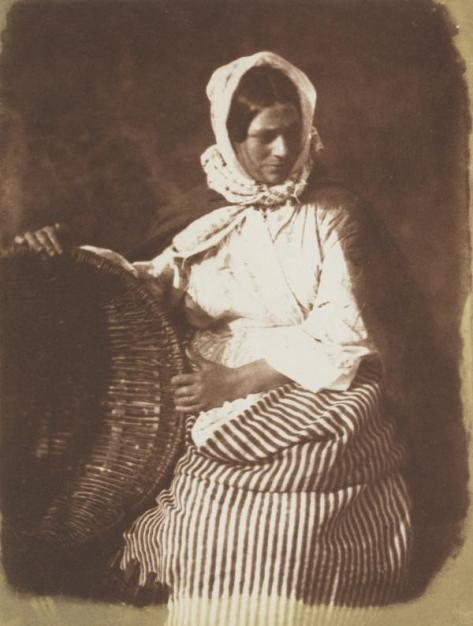
  2. Another option I considered at length was the Edinburgh duo of Hill (1802 – 1870) and Adamson (1821-1848). They worked in Scotland at the very early stages of development of photography and took multiple images of the great and famous of Edinburgh and also a series of social documentary images of the fisher golf of Newhaven. I saw a recent exhibition of their images discussed here:

https://scottishzoe.blog/2017/10/09/edinburgh-exhibitions/

119681
NewHaven Fisherwoman – Hill and Adamson

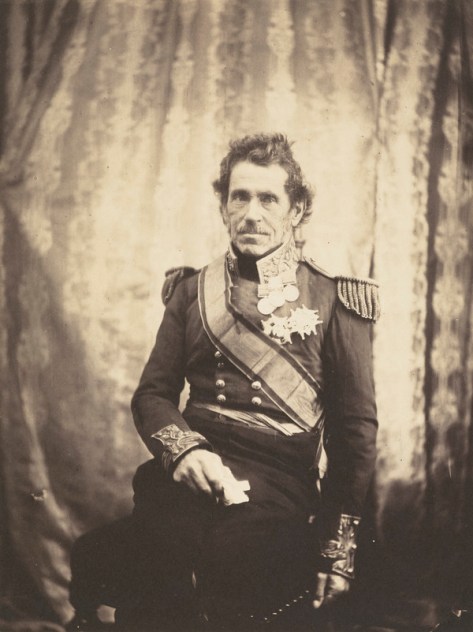
  1. Roger Fenton (1819-1869) is also discussed in the above link. As well as his famous series of images of the Crimea he also took portraits of the London gentry and the royal family.

    PGP 237.13
    Sir George de Lacey Evans, – Roger Fenton
  2. John Thomson (1837 – !921) was another Scottish photographer who was among the early pioneers of photojournalism. He spent a considerable time travelling in the East and took a series of stunning images of Chinese people of all classes (although mainly the mandarins). When looking at his work, having previously only been aware of the China images I discovered a series of images he took later in life of the street life in Victorian London. These were accompanied by essays by himself and a collaborator- Adolfe Smith.

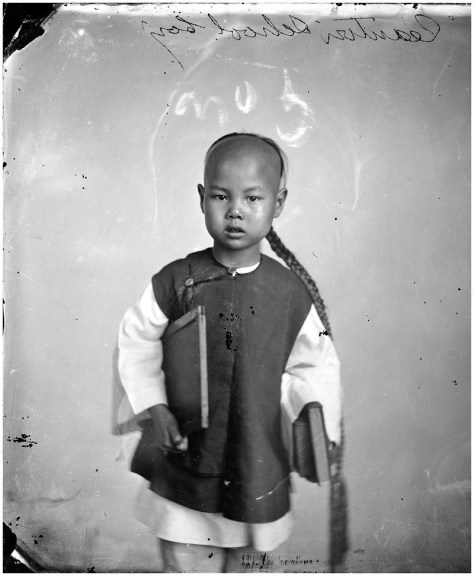
    Cantonese-school-boy
    Cantonese schoolboy – john Thomson

I eventually chose the last of these options as it was work that I had not looked at before in detail and I remember the amazing clarity of the Chinese images from an exhibition I saw in Glasgow many years ago. They were one of the reasons I became interested in the history of photography.

The next decision was what image? There are multiple possibilities. There are several beautiful images from the Chinese body of work including a picture of a young Cantonese schoolboy, whose expression could be that of a young child attending school today (although the heavy books would probably be replaced by a tablet). I eventually decided to look at one of the images from the Victorian street life series. Again, there was a choice to be made. What defines a portrait?  Tagg’s comment, quoted in the course manual ‘The portrait is a sign whose purpose is both the description of an individual and the inscription of social identity’ (Tagg, 1988) is very pertinent here. One option was ‘The Crawlers’, otherwise known as ‘The Tailors Widow’, another was ‘“Tickets” The Card Dealer’. The first image is very well known, the latter less so.

References

Tagg, J. (1988). The burden of representation. Minneapolis, Minn.: University of Minnesota Press.

A Square Mile -update

A Square Mile – A Walk in the Park

I did the Square Mile exercise at the very beginning of this course of study, now over 2 years ago. At the time I was pleased with it. It was the first time I had done a piece of work that was designed to ‘tell a story’ for many years. Looking back, while I still think it was interesting (I focused on the very changeable weather in a Scottish spring) in reality the images did not tell much about the local area and what it means to me. It was about the wider place – Scotland, and the time of year – spring, and the weather – variable!

If I redid this exercise now – and I might yet do so – I would concentrate on the places that I go to and see regularly, my street, the local coffee shop, the comic book store, the library and the people I meet at these places. It would be an interesting exercise to stand outside my house and take pictures of everyone who walks along the street over a few hours. I might get some very odd looks and need to do a lot of explanation, but it would tell a lot about the area especially if I got a little bit of information from everyone – who they were, what they did, and why they were there.

Simply thinking about this shows how much my attitudes to photography have changed over the 2 years and also how much my confidence has grown. At that stage I would not have thought about asking relative strangers to allow me to take pictures of them – now I am considering the implications and the need for a card to give them together with an information sheet on the project!

Theories of Identity

Theoretical Underpinning of identity:

A person’s identity is made up of a series of layers that come from a combination of genes, early nurture and experience as an adult.

Humans are a species that has more capability for conscious thought (as far as we are aware) than any other species on outer planet.  Susan Black says, ‘Humans belong to the group of conscious beings that are carbon-based, solar system dependent, limited in knowledge, prone to error and mortal’ (Black, 2018). As part of our make-up we have an identity, which is part physical, part psychological and part social. Erickson, a behavioural psychologist working in the 1050’s  (quoted in Black, 2018) defined identity as ‘either (a) a social category, defined by membership rules and (alleged) characteristic attributes or expected behaviors, or (b) socially distinguishing features that a person takes a special pride in or views as unchangeable but socially consequential (or (a) and (b) at once).’  That is, he is saying that identity is a social construct dependent on the groups you belong to and the things you are interested in. Black, however, argues that the physical identity of a person is equally important and asks, ‘How much alteration can a biological entity sustain while remaining recognisable as the same individual and maintaining its traceable identity?’ (Black, 2019).

Maintaining your identity is important and is emphasised in the multiple stories from around the world of lost, stolen or fake identities both couched as history and as fiction, often in folklore. This means names (as a crucial part of our identity) are central and finding out that our name is ‘fake’ may be very traumatic. Our name and heritage are our base, our bedrock and it should not be made of sand! The importance of our perceived heritage can make a profound impact on who we are.

Genetic:

Our initial identity comes from our genes. Our genetic code is very similar to that of  chimpanzees and the other great apes who are tribal species where the strongest aim to be the leader of the tribe and may be very aggressive in obtaining that goal but when they get there they will often protect the weaker members, while still remaining aggressive to outsiders.

Environmental:

Behaviour is believed to be caused by environment. As humans we absorb the stories that flow around our culture to make sense of who we are and what we want to be. In Europe this follows on from the Ancient Greek tradition of individuality featuring a strong person who aims to be a moral leader. This probably developed from the need to be an entrepreneur, because of the limited pastures and need for each small group of people to be self sufficient. Aristotle shows that individuality was key. There was also frequent engagement with foreigners and different beliefs systems and values that allowed further for the development of individuality (provided you were rich and strong enough). This is thought of as the ‘independent construal – the inherent separateness of distinct persons. (Markus and Kitayama, 1991)

This was very different from ancient China with its wide pastoral areas and need for large projects and grand schemes. Group harmony was paramount rather than individuality. Harmony came from people who knew their place in life and stuck to it. Confucius was a major exponent of this. Identity is part of a group! This concept continues to hold in much of the  Eastern world even today and may lead a very different views of  of who you are and how you should interact with others with a need to consider multiple perspectives and seeing things in a wider context rather than as single objects and a simple right or wrong in the Western world. This as described as the ‘interdependent construal – the fundamental connectedness of human beings to each other’ (Markus and Kitayama, 1991).

There are similar variances in other cultures even on a relatively small scale. Southern USA males are often said to be more belligerent than northern ones, northern Chinese people who live in small communities are said to be more individualistic than southern ones who rely on large communities to work the large paddy fields.

These theories of the development of identity are very broad based and obviously do not explain individual variation but may well underpin some of it.

Sociological:

A person’s identity consists of an internal interpreter which makes up stories to explain why things happen and the underlying emotions and drives. In the modern world, especially in the west, there is an assumption that you can (and should) be a hero. A star of your own story. Be perfect. There is a (wrong) assumption that everybody thinks like you do. This has led to a massive ‘wellness’ industry. It is true that meaningful core projects (work, hobbies, religion – it varies from person to person) do act to improve our well being and are essential to our sense of self identity. However, the self (your identity) is formed from series of overlapping layers that often seeks validation from others. Your ‘self’ changes depending on where you are, your role and on how other people are treating you.

The onset of personal computers and the internet was a game changer. You are visible and have to be the best at everything, perfect or others see that you are not! The problem is that we end up judging others very harshly. No time or space for the underdog. We lose sight of the fact that we a a social species and depend on others and also that what we do impacts on a lot of people. Individual responsibility is a myth. This has led to the development of a new pattern of identity especially in the younger generations. The selfie people, where the ambition is to be known!  Social media plays on that, and also on a the (very basic) need for tribal approval.

Summary:

How much of our personality is due to genetics? How much nurture? Behaviour is a combination of situation and genes.  People are not all the same. Identity is a core part of your person and is undoubtedly partly secondary to your background. Showing a person’s identity therefore becomes complex. A simple snapshot can only show a fragment, but will a million images tell anything more?

References

Black, S. (2018). All That Remains. [Place of publication not identified]: BLACK SWAN.

Markus, H. and Kitayama, S. (1991). Culture and the self: Implications for cognition, emotion, and motivation. Psychological Review, 98(2), pp.224-253.

Storr, W. (2017). Selfie. London: Picador.


Grayson Perry – Picturing Identities

Grayson Perry (born 1960) is an English multimedia artist who, among his large oeuvre, specialises in making portraits. His portraits are not, however, simple representations of a face or a body.  He spends considerable time with the person, or group of people that he intends to portray, getting to know them, talking to their friends and colleagues, joining in with their activities and, probably most importantly, thinking before making an image, which might be a piece of pottery, a tapestry or a painting.

Perry is known for his eclectic persona. He is a transvestite (and proud of it) and a television personality. He comments on the contemporary arts scene, and on what he sees as British prejudices. He has made several television programs about making art and portraiture, two of which All Man and Who We are as particularly fascinating. Unfortunately, episode 1 do Who We Are does not seem to be available for download on any source available in the UK, but episodes 2 and 3 are well worth watching.

Who We Are 2 looks at how you can show families in portraits.  He looks at 3 families

  • A religious group who act as an extended family and live together. Here he notes that ritual makes up an important part of their lives, together with the need to be accepting of others and also give things up to act as a single unit. He comments that ‘other people act as a mirror, a reflecting surface’ and that allows you to understand yourself and him to understand the group
    • He made a reliquary casket showing the caring aspect of the family, based on the older form of religious icons

      grayson-perry-who-are-you-the-jesus-army-money-box
      © Grayson Perry
  • A complex family unit of 2 white gay men raising a mixed-race child. This brought up issues about how you define yourself, both about race and the LGBTQ+ axis, together with the fact that society tends to put people ‘in pockets’ and to tell their story you need to tale the back out again. Identity is formed of multiple layers, a feeling rather than a conscious knowledge, and these need to be explored to make an image
    • He made a pottery jar showing the surrounding and caring aspect of a family

      15cb617eb016836b55f9641ebe86ae40
      © Grayson Perry
  • A couple of older people one of whom has Alzheimer’s disease. Here he looked at how the loss of memory affected identity. Taking away the layers, especially when you loose professional accomplishments. Identity then starts to rely on the memories of others – but the carer can also then loose (or change) their own identity, becoming a shadow. Your identity can also be part of being a couple – so if this is lost it changes – Alzheimer’s is described as “ a random bombing raid on the whole of the mind”.
    • He made a funeral urn for memories, composed of multiple photo shattered and cut apart, then recomposed.

https://youtu.be/PJ835U-wr7c

Who We Are 3 looks at tribes, groups of people whose identity is bound up in their culture.

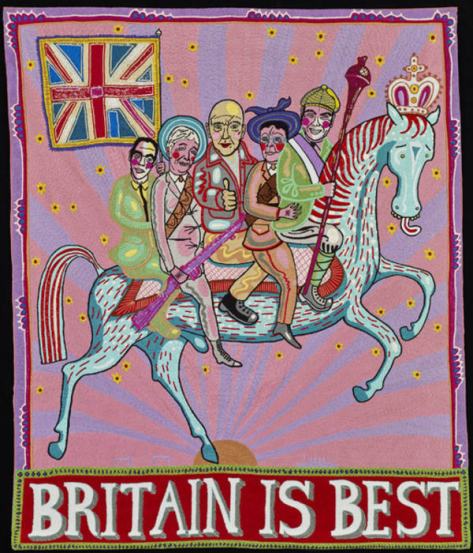
  • Belfast people – where portraits that reflect the past violence are still everywhere. Symbols tell a story, might be tattoos, might be clothes. Possibly an ‘old-fashioned view of what Britishness is, and very different from the view in other parts of Britain. Thinking about how identical I’d affected by where you live, especially by where you were born.
    • He made a flag that was in many ways a caricature, wondering if humour could help the situation, but a risk of it being offensive

      1413377476.5842_117_o
      © Grayson Perry
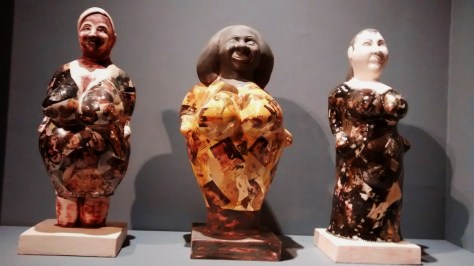
  • Obese women – looking at how your identity is fashioned by what other people think of you. How your body can make you an outsider, a negative impact similar to the effect the one that other minority groups get from the world. Being in a group allows acceptance and may improve confidence with a positive effect on mental health.
    • He made a series of statues, playing on the theme of the Willendorf Venus. Objects of beauty.

      p.txt
      © Grayson Perry
  • Deaf people who have their own culture based on a visual not spoken language and which can be very different. Not hearing is often seen as a disability but should be considered a difference. There can be a conflict between cultures especially if you are born into one but live within another. How does that impact on your identity? It becomes an internal (and external) negotiation.
    • He made a very visual and colourful silk screen printing based on a set of hearing aid covers

https://youtu.be/i6WWeneq6Z0

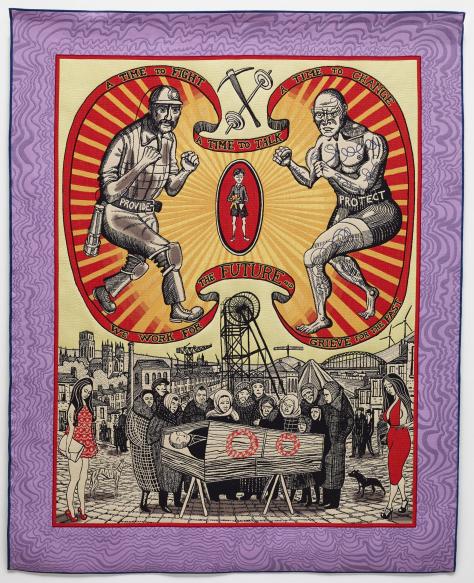
All Man 1 looked at the identity men give themselves.  He looked closely at the culture of extreme ‘macho’ men including cage fighters. The surface personality may be very brutal but underneath the person may be very gentle. The fighter described “being broken inside” and “its all we have left’ coming from a run-down, working class area with little opportunities for work remaining.  The risk of suicide is high. Men are not encouraged to recognise their feelings. He made a banner that echoed the banners that are still paraded in the villages and towns and also a very ‘frilly’, gentle pot, a very feminine object to commemorate the life (and death) of a man who couldn’t cope and who had killed himself. A masculine banner and a feminine pot. Cloth and pottery. Hard and soft. Both working together to tell the story.

PerryG-DoaWH
© Grayson Perry

https://youtu.be/qvrC0i4pXak

Summary:

Both series showed the depth of investigation required to produce a meaningful piece of artwork that told a story of the person or group of people and their lives. Emotion is needed, both from the person and the artist. A connection of some sort needs to be formed. To make a good portrait you need to be part detective, part psychologist.  You need to look at what the person shows to the world, and also what is underneath it, consider their lives and the lives of other around them and the culture they live in now together with the one they were born into. Not a simple task.

What is Identity?

What is identity? This is far from a simple question as different people will understand both the word and the question in different ways.

Identity is a key part of your persona. It does not just include your name or your description but explains who you are and how you feel about yourself. Identity is fluid. It changes over time. It changes depending on where you are. It changes depending on who you are with. You need to be aware of your identity and understand it or you can disappear. That all sounds very abstract and overstated. Most people probably never think of the concept of identity beyond ‘I am John Smith’, ‘I am 6’ tall and have brown hair and blue eyes’ – a description that would satisfy a police report, but, in reality, this does not tell anyone who you are.

I am:

  • A daughter, a wife, a partner and a mother
  • A good friend and a bad enemy
  • A doctor, a housewife, a cleaner and a cook
  • A photographer, a knitter, a reader and a gardener
  • White, British, female and heterosexual

I am:

  • Overweight and under-exercised, often tired
  • Obsessive, fussy and meticulous
  • Retired but still working
  • Very poor at relaxing and rarely stay still
  • Easily frustrated with my own limitations and impatient with them

This list could go on and on. None of the items on it stand alone. Some days one is more prominent, some days others. None would help anyone pick me out when walking down the street or in an identity parade. I take on different personas depending on where I am. At work I am efficient, confident and outgoing. At home, much less confident, shy and tend to avoid people. This can cause interesting situations at times when people who know me in one setting suddenly meet me in another. When discussing authenticity Lucy Soutter says, ‘We all encounter a degree of contradiction between our experience of ourselves and the way we present ourselves to the world’ (Soutter, 2018). The same applies to identity. For further discussion on authenticity it is worth listening to:

https://www.bbc.co.uk/sounds/play/m00035z4

Failure of your sense of identity can be catastrophic leading to breakdown of your feelings of self worth and even to suicide. How we present ourselves to the world may be very different from our internal thoughts, so it is not surprising that we find it so difficult to describe a person’s identity and even more difficult to show it in a portrait. When a portrait is a good one and has validity, it doesn’t just show the outward aspect of a person, but something of their inner being that some would call their soul.

So, what makes a good portrait? Knowledge has to be the key, applied with patience and understanding. A passport photograph tells you very little other than the key indicators for facial recognition, a snapshot may show more, and it is a contentious question about how much one of the ubiquitous selfies show! To show a person’s internal identity, their ‘real self’ much more is needed. It becomes important to study the person. To think about the setting, to consider what is important, to use the clues in the environment. All that is much easier to say than to do and takes time and the willingness to be open to the other person.

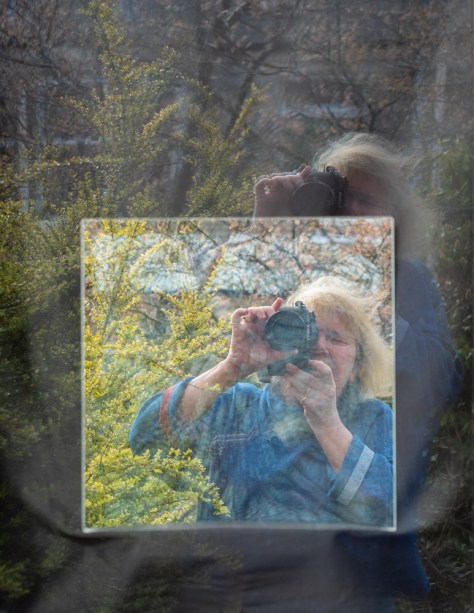
On my social media sites, I tend not to use a portrait. The images rotate around those of my pets or flowers. They give very little away. All it says about me is that I love cats (and have a bearded dragon) and am obsessive about photographing flowers in close detail. Some of this is self-protection. I work and live in the same area and am very conscious of my need to keep my home self private. This, in itself, says something about me. Recently, as my final image for Context and Narrative I produced a self-portrait reflected in both a window and a mirror. Multi-layered and fractured. This describes my feeling about myself and is a good leaping off point for this new course when I am looking for ways to show the identity of other people.

Diary (1 of 1)

https://scottishzoecontextandnarrative.wordpress.com/2019/05/03/assignment-5-reflected-image/

References:

Bragg, M. (2019) In Our Time, Authenticity, BBC Radio

Soutter, L. (2018). Why Art Photography?. Oxon: Routledge.