Much, if not all photography is a way of looking at memory. Your memory, your family’s memory, the collective memory. A memory of a person or the memory of a place. Photos taken today will become memories for the future. Photographs are one way of engaging with the past. Marianne Hirsh uses the phrase ‘points of memory’ (Hirsh, 2012) to describe this. This memory can be personal – but does not have to be. Remembering the past, before you were even born, is a way of paying homage to it. Hirsh calls that ‘postmemory’ and discusses it in her book Family Frames together with other forms of describing memory and how images can be read in the context of the family. See Marianne Hirsch – Family Frames for an extended review of the book.
Annette Kuhn in Family Secrets talks about the way photographs trigger memory, both personally – in a photograph of herself as a child and collectively – in the photograph of a burning London with St. Pauls set against the smoke. See Annette Kuhn – Family secrets for an extended review of her book.
Keith Roberts’s work on the Hardman Portraiture Collection of images of mainly servicemen discusses how memory can be personal or collective (postmemory) and can also be direct (something you remember) or a family memory. This memory can be invoked by photographs, which Roberts’s notes can be both an act of recall and an act of mourning. It also references Boym’s work on nostalgia (Boym, 2016) which again can either be reflective (looking at personal and historical past – how the images impact on the families of the servicemen) or restorative (looking a national past – in this instance how the images evoke WWII and its effect on the national thought and memory).
A recent book Project Cleansweep by Dara McGrath (McGrath, 2010) also talks about memory, in this case how the land holds memories and how images can reveal them. War Sand by Donald Weber (Weber and Frolicking, 2018) talks at length about the memories held by the beaches of the Normandy invasion in WWII. He uses a combination of present images, stories and microanalysis of sand samples to tell the story of the invasion and the lives lost.
Memories can also be highly personal. Lesley McIntyre, whose daughter was born with a muscular abnormality that impacted both on what she could do and how long her life was likely to be, started documenting her life in photographs from when she was born and continued until her untimely death age 14. The book – The Time of her Life is a poignant memorial to a life lived fully (McIntyre, 2004).
A quick look at my shelves warns me that this list of books about memories could become extremely extensive – enough that it reminded me of where I started thinking about memory – much, if not all photography is a way of looking at memory. Making worthwhile memories is critical, hard and important both for myself and my family.
Reference list:
Boym, S. (2016) The future of nostalgia. New York: Basic Books, A Member Of The Perseus Books Group, Dr.
Hirsch, M. and Harvard University Press (2016) Family frames : photography narrative and postmemory. Cambridge, Mass. ; London: Harvard University Press, Dr.
Kuhn, A. (2002) Family secrets : acts of memory and imagination. London ; New York: Verso.
Mcgrath, D. (2020). Dara McGrath Project Cleansweep. Beyond the Post Military Landscape of the United Kingdom. Heidelberg, Neckar Kehrer Heidelberg.
Mcintyre, L. (2004) The time of her life. London: Jonathan Cape.
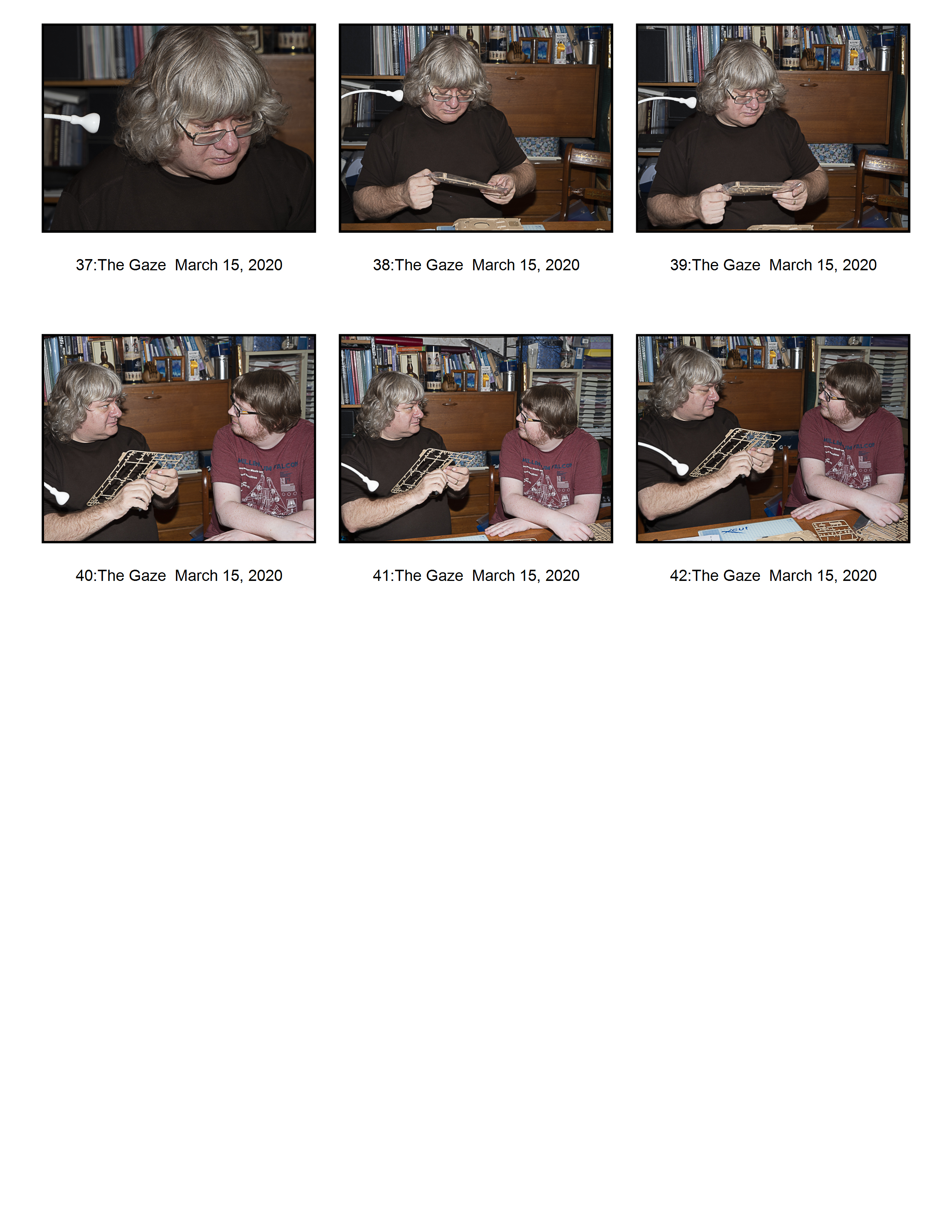
The exercise is to produce a series of 5 portraits that show various types of ‘the gaze’ to tell a narrative.
I have discussed the theory behind ‘the gaze’ in The Gaze
I had two possible thoughts around this:
To use some of images that I have been developing for assignment 3, which are pictures of people at a gaming club.
To talk a completely separate set of images to illustrate the gaze.
I decided to do the latter, as not only would this avoid the risk of duplicating images in an exercise and an assignments, which although possible is not ideal, but this would also allow me to act as ‘the director’ and ask people to do exactly what I wanted.
I asked my husband and son to help with this and took a series of images of my husband modelling (his hobby) with my son helping out and watching the process. The activity needed to be done inside and therefore necessitated the use of flash. They were moderately cooperative – but got involved in what they were doing so didn’t always listed to my directions.
The main protagonist was the modeller, with the watcher playing a secondary role.
Final story:
This was a fascinating exercise, initially reading all about the gaze and how that term is used in a wide variety of ways and then trying to actually catch people doing the specific thing I wanted. It would have been simpler to use a series of already taken images and pick out examples of types of gaze, but I wanted to have the extra control and practice of acting as the director in a shoot. I felt this was moderately successful – but something I want to try again with different people and specifically with people I did not know so well.
“To gaze implies more than to look at – it signifies a psychological relationship of power, in which the gazer is superior to the object of the gaze.” Schroeder. J, in Barbara B Stern, Representing Consumers: Voices, Views and Visions (1998) London: Routledge. Pg 208.
The gaze is an important in the theory of photography. There are multiple ways of looking at what that actually means. A simple list that summarises it is:
The photographer’s gaze
What they are actually looking at and how they are looking, which might be though the lens of the camera – but could also be by looking at the image that they are planning (an example of this would be in the work of Gregory Crewdson).
The viewer’s (spectator’s) gaze
The male gaze is discussed in Berger’s Ways of Seeing (Berger, 1973) – ‘Men look at women. Women watch themselves being looked at’ – and usually implies power, ‘I own the image/object that is shown’. It was initially suggested in relation to film by Laura Mulvey in her essay Visual Pleasure and Narrative Cinema’ (Mulvey, 1975).
The female gaze – initially discussed by feminists in response to Mulvey’s work and now widely used but not clearly defined. Is it about all work by females? Or only about that work with a feminist slant? There is an interesting recent article by Murray Brown that says, ‘if anything, the female gaze is simply an awareness that women do not hold half the power’ (Murray Brown, 2019).
The LGBTQ+ gaze also needs to be considered and has more recently been explored, for instance in the context of the work of Mapplethorpe and Goldin.
The ‘colonial gaze’ – about attitudes to ‘others’ (not white, European or American).
The academics gaze – analysing the context, sources and details
The gaze of the person/people within the image
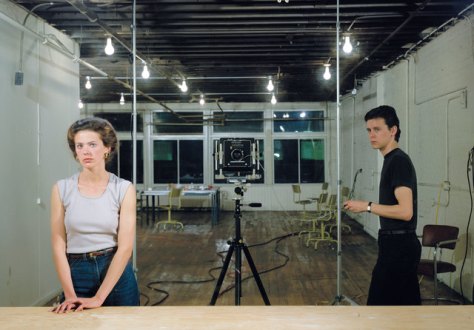
Where they are looking and who they are looking at- an example of multiple gazes within an image is Jeff Wall’s photograph Picture for Women (1979).
People looking at people looking! Good examples of these are in Martin Parr’s recent work on Versaille where he has photographed people taking images of themselves (Pégard, 2019).
For a more complicated consideration of the gaze there is an essay by Lutz and Collins in ‘The photography reader’ (Wells, 2010, pp. 354-374) which starts by saying ‘the photograph……is not simply a captured view of the other, but rather a dynamic site at which many gazes or viewpoints intersect’. The essay is written in the context of research on National Geographic images. They discuss seven different types of gaze which I shall summarise here:
The photographer’s gaze which controls the subject matter, the structure, view and content, and which may be emotionally distant (alienated) from the subject
The magazines gaze (they were talking in the context of the National Geographic), but there would be similar issues from any commissioned image – where a specific image is chosen, and the layout will give a desired ‘reading’ to the image
The magazine reader’s gazes where ‘the reader….is invited to dream in the ideological space of the photograph’ (Tagg, 1988), anything that jars may put the reader off interpreting the image as the magazine would want. It is reliant on cultural models, gender and diversity of experience together with the context of reading (a quick skim or detailed look, alone or with other people)
The non-Western subject’s gaze (or more generally the gaze of the subject in the image) divided further into:
Confronting the camera, acknowledging the photographer and the reader ‘I see you looking at me, so you cannot steal that look’ (p.359), what it means is dependant on the expression (smiling, glaring etc.), a collaboration and an attempt at creating intimacy. They note that those who the West defines as weak are more likely to look directly at the camera than those defined as strong – is that editorial choice/political reasons?
Looking at something else within the frame – gives information about the subject of the image
Looking into the distance – may suggest things about the personality of the subject (dreamy, forward thinking)
No gaze visible, too small, covered with a mask – ‘a boundary erected’
A direct Western gaze – in the context of the National Geographic included Westerners in the image may allow the viewer/reader more identification with the image. The meaning will then partially depend on how the various people within the image interact – ‘the mutuality or non-mutuality of the gaze of the two parties’ (p.362). Is the gaze colonial? Is it patronising? These types of images are less frequent now – is that because of a changing view of Americans within the world – the other becoming more threatening and therefore safer behind the camera?
The refracted gaze of the Other: to see themselves as others see them – ‘mirror and camera are tools of self reflection and surveillance’ (p.365), creating a double, looking for self-knowledge. The photo may actually increase alienation, see Sontag’s suggestion ‘the photographer is a supertourist, an extension of the anthropologist……the photographer is always trying to colonise new experiences……to fight against boredom’ (Sontag, 1978).
The academic spectator’s gaze as a subtype of the reader’s gaze which here looks at a critique of the images and why they were made
They summarise by saying that ‘the multiplicity of looks is at the root of a photo’s ambiguity, each gaze potentially suggesting a different way of viewing the scene’ (p.171).
In the OCA handbook for IAP it states:
A key feature of the gaze is that its subject remains unaware of the present viewer. Academics and theorists have identified a number of different gazes:
the spectator’s gaze – the look of the viewer at a person in the image.
the internal gaze – the gaze of one depicted person at another within the same image.
the direct address – the gaze of a person depicted in the image looking out directly, as if at the viewer (through the camera lens).
the look of the camera – the way the camera itself appears to look at people depicted in the image (the gaze of the photographer).
the bystander’s gaze – the viewer being observed in the act of viewing.
the averted gaze – the subject in the image deliberately looking away from the lens.
the audience gaze – an image depicting the audience watching the subject within the image.
the editorial gaze – the whole ‘institutional’ process by which a proportion of the photographer’s gaze is chosen and emphasised.
There is a comprehensive overview of the gaze and accompanying issues available at: http://visual-memory.co.uk/daniel/Documents/gaze/gaze12.html?LMCL=zhc8U6 . In this Daniel Chandler adds in discussion about the direction and angle of the gaze, proximity and how this is varied by race and custom (as is length of time someone will look at you and how direct the gaze will be). He also discusses the eye of the camera, although mostly related to film and TV and notes ‘Looking at someone using a camera (or looking at images thus produced) is clearly different from looking at the same person directly. Indeed, the camera frequently enables us to look at people whom we would never otherwise see at all. In a very literal sense, the camera turns the depicted person into an object, distancing viewer and viewed’ (Chandler, 1988).
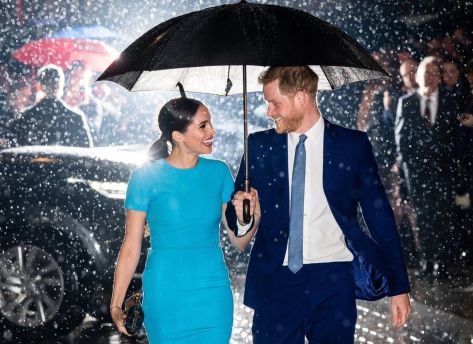
This short discussion of different ways of considering the use of the word ‘gaze’ shows many alternative ways of interpreting it and its use within photography. While I was considering this, in the work-up for exercise 3.4 I came across a photo-essay on the BBC news site. https://www.bbc.co.uk/news/in-pictures-51767925
I do not usually follow the British royal family – but I thought that many of these images demonstrated the types of gazes listed above. In order:
Pégard, C. (2019). Versailles, Visible invisible: Dove Allouche, Nan Goldin, Martin Parr, Eric Poitevin, Viviane Sassen : [exposition, Versailles, Château de Versailles, Domaine du Trianon, 14 mai-20 octobre 2019]. Paris: Éditions Dilecta, Dl.
Sontag, S. (1978). Susan Sontag on photography. London, Great Britain: Allen Lane.
Tagg, J. (1988). The Burden of Representation : Essays on Photographies and Histories. Basingstoke: Palgrave Macmillan.
Wells, L. (2010). The photography reader. Abingdon, Oxon ; New York, Ny: Routledge, pp.354–374.
The exercise is to consider how marginalised or under-represented groups could be badly or unhelpful portrayed and how being an insider could help combat this.
People who are marginalised include people with mental health difficulties, people with learning difficulties, people of races that are not the prevalent one in the area/country/context that the information is read in, drug users, the poor, the whole LGBTQ+ population, the Jews in Nazi Germany, the Palestinians in Israel and the Mexicans in the USA – and this list could continue. It is well recognised that information about these groups could help decrease marginalisation and there have been many attempts in popular culture to say that these groups should be included. There is a song by Dory Previn (Previn, 1971) which contains the words:
Give me your poor
Your tired your pimps
You carhops your cowboys
Your midgets your chimps
Give me your freaks
Your whores your harlots
Your flunkies your junkies
Give me your starlets
……..
Give me your poor
Your maladjusted
Your sick and your beat
And your sad and your busted
Give me your has-beens
Give me your twisted
Your loners your losers
Give me your black-listed
And, of course, there is the sonnet by Emma Lazarus – “The New Colossus” (Lazarus, 1883) that is inscribed on the Statue of Liberty which contains the words:
‘With silent lips. “Give me your tired, your poor,
Your huddled masses yearning to breathe free,
The wretched refuse of your teeming shore.’
Much of the time these groups of people are negatively shown simply by the poor choice of words that are used about them and therefore leading to assumptions being made by the majority of people that have no insight into the reality of the people involved or the life they live. A topic I know a reasonable amount about is autism. A quick internet search netted me an article about the myths of ASD such as autistic people can’t make friends, autistic people can’t show empathy, only boys are autistic and autistic children are naughty. Luckily this was an article saying that all these are wrong – but equally I have heard all of them expounded to me at length as incontrovertible truths usually along with the statement ‘but everybody knows that’.
Reasons for unhelpful portrayal include (in no particular order):
Oversimplification of the issues
Lack of understanding and research by the writer, speaker or photographer
Real bigotry, racism, homophobia and similar problems
Overuse of stereotypes in TV, film and novels – such as the psychotic person who kills someone or lies in storylines – this is particularly common in crime novels, which are widely read. This also occurs in sitcoms “She’s painted as ‘the other’ or ‘mad, bad and dangerous’” – although to a large extent this is being minimised by the involvement of organisations such as Mind (see https://www.mind.org.uk/information-support/your-stories/improving-representations-of-mental-health-on-tv/ – for more information on the work they do).
Over-glamourising of mental health problems such as a a focus on suicide or anorexia
Compassion fatigue – and overuse of violence -as described by Susan Sontag in ‘On Photography’ (Sontag, 1978) although she later changed her mind about how much this is true.
Showing negative aspects makes for more exciting (and often simpler) reading about a topic and is not always (or often) balanced by the positive (bad news sells)
Much information is written (photographed) by an outsider, a ‘normal’ ‘average’ person (often a white male) and is read by people of the same group.
People often write information to ‘raise awareness’ for a cause and therefore may well use the extremes (worst and best).
Deliberate misinformation -possibly the scariest reason of all
Sound bites, snippets of information reduced down to what fits in a Twitter message
The risk of multiple negative images in the media is well recognised. It is even included in a popular song by The Black Eyed Peas – ‘Where is the Love?’ (Black Eyed Peas, 2003)
What’s wrong with the world, mama
People livin’ like they ain’t got no mamas
I think the whole world addicted to the drama
Only attracted to things that’ll bring you trauma
………
Wrong information always shown by the media
Negative images is the main criteria
Infecting the young minds faster than bacteria
Kids wanna act like what they see in the cinema
Yo’, whatever happened to the values of humanity
Whatever happened to the fairness and equality
Instead of spreading love we’re spreading animosity
Lack of understanding, leading us away from unity
But the problem is wider than just the proliferation of negative images. Incorrect positive images can be equally harmful. A suggestion that all people of colour are be as suave, intelligent and successful as Barak Obama might lead to the lack of any additional resources needed to support the group that fall at the opposite end of the educational spectrum in the USA! There needs to be understanding that all groups that consist of more than one person are going to to have a range of problems, along with a range of positive aspects.
The most likely way to be able to spread accurate information is to know as much as possible about the situation and then to be able to describe it accurately and without bias. There are two ways of gaining that information. One is to research the situation as an outsider, being careful to take cognisance of all the viewpoints. An example of this would be if I decided to research the issues facing Jewish people in Fife. I am not a Jew and am therefore looking at it from the outside. I can never become a Jew. However, I could spend considerable time meeting with people, listening to their individual stories and trying to portray them accurately. The other way is to be an insider. In the above example, a Jewish person, even if they came from somewhere outside Fife, or even outside the United Kingdom would start from a place well ahead of me. They would understand the basic culture, know the religious rules and have a much greater chance of getting an accurate story.
However, there are ways of becoming an insider in a group. They involve time and patience and a willingness to listen and do careful research. Being an insider should combat most of the concerns listed above such as lack of understanding, overuse of stereotypes and over-glamorisation of the issues. Someone who is a member of the group, and therefore invested in their needs is less likely to give deliberate misinformation and more likely to show and accurate and balanced picture.
True Insiders (an invented term) are those that are living with the issues on a daily basis. They know and understand the situation from the ground up. These people can tell the story accurately and with emotion. They do, however, risk a bias of being over involved. The story is theirs. There is no neutrality. They story is told in depth and with heart-breaking detail.
Nan Goldin in the Ballad of Sexual Dependency tells about a group of people who are marginalised, a combination of drug users, people with AIDS and people who are involved with domestic violence. Goldin says, “Real memory, which these pictures trigger, is an invocation of the color, smell, sound, and physical presence, the density and flavor of life.” (Goldin, 1986). She is completely an insider.
Graham McIndoe in his exhibition Coming Clean and the associated book Chancers: Addiction, Prison, Recovery, Love talks about his drug addiction and its consequences to him and his family (Stellin and MacIndoe, 2016).
Sian Davey in Looking for Alice shows graphic (and endearing) images of what it is like to be the mother of a person with Down Syndrome, (Davey,2015) while Louis Quail in Big Brother describes the haunting life of someone with schizophrenia, the ups and downs, the disasters and the laughs (Quail, 2018).
Jim Mortram in Small Town Inertia shows people in his local community that struggle on a daily basis with debt, poor living situations and problems with mental health. He takes pictures of the people that are local to him while struggling himself as a Carer to his mother. The people are not quite as closely linked to him as the families of Davey and Quail – but he lives so closely within the community that he shows a real awareness of the difficulties involved (Mortram, 2017).
Timothy Archibald in Echolalia (Archibald and Levin, 2010) took a series of pictures of his autistic son to act as a a way of increasing his understanding and their joint communication. He says ‘Parents sent me snapshots of their kids that could have easily fit into the pages of my project: the notes, the body language, the in-door nudity, the hyper focus on an everyday object…parents around the world were snapping photographs of their autistic kid’s obsessions and behaviors. This was part of the process of trying to figure their kids out. It occurred to me then that I really had done nothing new with this project. I simply was doing what any parent would do, but I had an eye for good light and possibly a better camera’ (Smithson, 2013).
Involved observers are those who make a real personal investment of learning as much about the community as possible. They know the detail. They understand the issues. But they have a degree of neutrality. They are telling about others. They make an excellent case as there can be no assumption that they are biased. As they are more trusted by the community the story and images they obtain are more based in a real understanding, more truthful and more explanatory to others.
Polly Braden, who, as far as I am aware, has no personal connection with autism or learning disabilities (I am happy to be corrected if I am wrong) has produced two books on this difficult topic Great Interactions (Braden, 2016) where things are mainly going well and the people are supported appropriately and Out of the Shadows (Williams and Braden, 2018) where much is not right. In spite of not being personally involved she has become emotionally involved and tells the stories from an inside viewpoint.
Sara Davidmann in Crossing the Line (Davidmann, 2003) tells the story of a cross-dressing community in London. She says ‘As I continued to work in the studio my role shifted. As these sessions were usually one to one more was required of me. I soon understood I had as much to give as take from the sessions’ (my italics). This sentence sums up much of what I’d important in becoming an involved observer and is crucial to telling the story with integrity.
Summary:
Information about marginalised people is often poorly portrayed because of lack of real understanding and personal/social bias leading to over-simplification, repeating of inaccuracies that are widely accepted and attempting to glamourise the situation to make for a good ‘sound bite’. An insider (or a involved observer) can combat this by giving accurate and nuanced information, that tells a story in a way that people will understand, therefore benefiting the community. Their involvement allows them access to information that a stranger would either not obtain or that they might misinterpret. An involved photographer is more likely to be able to put the people at ease and therefore obtain more meaningful photographs.
References:
Archibald, T. and Levin, A. (2010). Echolilia: sometimes I wonder. San Francisco: Echo Press.
Braden, P. (2016). Great Interactions: life with learning disabilities and autism. Stockport, England: Dewi Lewis Publishing.
Davidmann, S. (2003). Crossing the Line. Stockport: Dawi Lewis.
Goldin, N., Heiferman, M., Holborn, M. and Fletcher, S. (1986). The Ballad of Sexual Dependency. New York, N.Y.: Aperture Foundation.
Lazarus, E. (1883). The New Colossus by Emma Lazarus – Poems | Academy of American Poets. [online] Poets.org. Available at: https://poets.org/poem/new-colossus.
Mortram, J. (2017). Small Town Inertia. Liverpool: Bluecoat Press.
This exercise is similar to some I have done previously. When I started IAP I thought about identity (including my own) at some length, What is Identity? and Theories of Identity In CAN I also thought about identity and ended up making a series of images about the chairs in my house where I sit My Spaces.
Listing aspects of your own personality is difficult. Identity and personality are not the same, although personality is part of your identity. Identity can be broken down into several aspects:
Who you are to other people:
mother
daughter (still relevant although both my parents are dead)
wife
ex-wife
friend
doctor
Person who goes to your café regularly
What your interests are:
Photography
Reading
Knitting
Music
Collecting (mainly bears)
Gardening
Historical places (castles, houses)
Travelling
Where you live (and how that defines you)
My room
My house
Dunfermline
Fife
Scotland
United Kingdom
Europe
Race, ethnicity and religion
Caucasian
Scottish
Unreligious but interested in all
Gender (in the widest sense)
Cis-Female
None of these really explain my personality – but all go towards making it up. I am also:
Kind (usually)
Patient (usually) – but have a real temper when things go wrong
Intelligent – academic
Understanding of other people’s emotions
Hard-working
Diligent
Odd sense of humour (some people say I don’t have one)
Obsessional
Organised
Introvert
Shy
A loner
Caring
Not feminine
Someone else could descibe their personality in exactly the same way – but without having any similarities in the list of ‘identity criteria’ I have listed above.
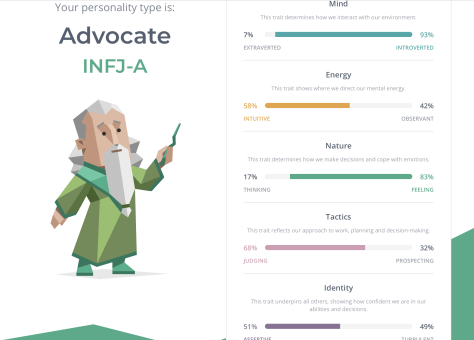
Out of interest I took several online personality tests. Obviously, the results of these are only as good as the information that you put in! And on how truthful you are! And on how well you know yourself to begin with!
Oddly enough they all came out with similar results. The first is based on the standard Myers-Briggs’ 16 categories of personalities which is very well researched, and if I am honest does describe me well.
So – how can you take pictures that describe your personality?
It is (relatively) easy to show some of the aspects – but almost impossible to show others. One of the ways to show your personality is to show the things you are interested in, as this will give an idea of what makes you ‘tick’. Another way would be to take pictures of people you are engaged with and ask than to give a short (one sentence, or preferably one word) description of you as a person. In a wider sense you could look at the community you are involved in, where you live, what you do, what’s around you and show that. But – how do you show kindness, or patience, or diligence?
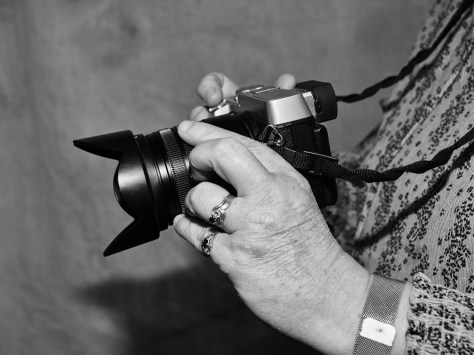
I decided to start by thinking about the things I am interested in that make up part of my identity, and therefore contribute to my personality. I could have just taken a series of images without including myself – a pile of books, my piano and so on but decided to try to take pictures of me involved in these activities. I settled on taking pictures of my hands doing things. This was harder to do than to say. Hands actually tell you a lot about the person.
I bite my nails – therefore I am anxious
I wear a wedding ring
I have a Fitbit – so I try to exercise – or at least pretend that I do
They are wrinkled – therefore older
White and freckled – therefore Caucasian
Process:
I enlisted the help of my son as a stand in to enable me to set up the images and get the focus correct
The images were taken indoors- so I used a tripod and flash
I looked for neutral backgrounds
I considered using a cable release myself – but that altered the hand position so ended up with my assistant actually pressing the release
Images:
What do these tell me about my personality?
I have a range of interests
Most of these interests are solitary (at least the ones I have shown)
I tend to be anxious
I don’t like showing my face in photos (shy, introverted)
Patient (knitting needs patience)
How could this be taken further?
To explain a personality, you need a wide variety of images. To develop a body of work about your own personality is difficult as in many ways everything you take expresses how you are, as you would not take that subject if you were not interested/involved. If I was developing this further, I would move towards doing two pieces of work:
The images of people who I am involved with together with the single word/sentence about what they think of me
Images of me taken by the same people, with them choosing the setting
Those images could then be paired, looking out and looking in.
Sherman was born in America in 1954, so she is slightly older than I am. Her early experiences may well have been similar, although transmuted via an American, rather than British, perspective, you played on the street, you dressed up and pretended to be people, if you were a girl there were very tight gender specific jobs and roles. It took guts and extreme talent to move beyond them. Sherman was the youngest of five children, and no one else in her family was interested in art. She went to art college with very little formal knowledge about art and expecting to have to become a teacher. She initially started her career as a painter, but rapidly abandoned this and took up photography, initially concentrating exclusively on pictures of herself dressed up as various roles. However, Sherman does not describe these works as self-portraiture, but as using herself as ‘a vehicle for a commentary on a variety of issues in the modern world’ (Sherman, 2019). She portrays archetypes, a series of fabricated, fictional characters that are familiar to us because of our familiarity with TV and film people, mediated via the popular press (and more latterly social media). All of these early images are called Untitled, with a series name and often a number – further distancing them from any assumption that they are showing a specific person. A portrait almost always has the name of a person, or, at minimum, a description that personalises them. In later images Sherman used dolls and prosthetic body parts posed in highly charged sexual positions and clearly designed to shock the viewer. Recently she has returned to using herself as the subject, both in a further series of created characters and as a series of distorted images that are freely available to view on her Instagram site.
In a recent article Sherman, when talking about her own work and about selfies (and why her images are the reverses of selfies) says ‘It feels magical, I don’t know what it is I’m looking for until I put the makeup on, and then somehow it’s revealed. I’m disappearing in the world, rather than trying to reveal anything. It’s about obliterating, erasing myself and becoming something else’ (Blasberg, 2019).
Sherman is both a prolific artist and an influential one. Almost every article discussing post-modernism in photography references her. Grunberg describes her work as ‘Perfectly poststructuralist portraits, for they admit to the ultimate unknowableness of the “I”. They challenge the essential assumption of a discrete, identifiable, recognizable author (Grunberg, 2010, p.9). Her work is included in the list of 7 most expensive prints sold (Untitled 96) which is one of the Centrefold series that was originally commissioned for Artforum but never run as the then editor was concerned that they might be misunderstood. I wonder if the editor had really considered any of Sherman’s images as this comment could be applied to most (if not all) of them.
There is a fascinating (and long) discussion on the OCA website about Sherman, discussing her self-portraits – are they narcissistic or not? her background growing up in white, TV obsessed America – and the impact that had on her initial reactions to gender and make-believe that goes on to discus why we like, or don’t like her images and wether an initial ‘gut reaction’ has any validity as a starting point for analysis of an image (The Open College of the Arts, 2011).
I have seen a small number of Sherman’s prints in galleries
An early Madonna in the Sometimes I Disappear exhibition in Edinburgh – discussed in Sometimes I Disappear
Cindy Sherman – Early Works at the Stills Gallery, Edinburgh. This showed some of her very earliest self-portraits – Untitled (Murder Mystery People) together with some images form the untitled Film Stills collection and a very early film Dolls Clothes. Prior to this exhibition most of the images I Had seen were in books. I was surprised at how small the images were. This initially disappointed me, however it had the effect that I had to go in close to look at them in detail, and this drew me into the stories, possibly more so than a large image would have.
I find myself bemused by some of her work, revolted by other pieces (as I am fairly sure she meant people to be) and increasingly interested in it the more I examine it. Very little of it is ‘easy’. Some may be attractive to look at, but the closer you look at it the less obvious it becomes. Three years ago, I would have confidently stated that I did not like her work. My view is now different.
In With My Family (1978) he posed as the father with a mother and their children in their living room. The rooms are busy and reminiscent of the June Street images of Parr and Meadows, although of course, the twist here is that the ‘father’ is not the real father (and possibly the families are rather higher in the social scale). However they look totally relaxed and could easily be mistaken for a ‘real’ family. I wonder who took the images as there is no sign of a cable release– was it an assistant, or could it, in a further twist, have been the actual father. More recently, Trish Morrissey (discussed in Masquerades) has done a similar set of images for her series Front (2005) where she became the ‘mother’ in photographs of families on the beach. In these images she took it further as she borrowed items of clothing from the actual mother before posing. On her website she says, ‘Ideas around the mythological creature the ‘shape shifter’ and the cuckoo are evoked.’ (Morressey, 2017). Both of the series raise the question about the reality of images, and what is truth. Does it matter that the apparently happy family group is a constructed one? What does that say about the identity of families? How can an outsider know? One assumes that groups of people on the beach or in the house are related if they are shown in a family album – but they may not be. The further on in time from the image the less certain one becomes. I have images in my family archives of similar (although less professionally posed groups) where no one now alive is sure who all the people are.
Eijkelboom has carried on working with identity. His more recent work People of the 21st Century, collected into a series of Photo Notes shows people he has photographed on the street. He then collages groups of people who are wearing very similar outfits. Does this show loss of the individual? But everyone is subtly different, their personal slant on what is the current fashion. Although this is in some ways a retake of Sander’s People of the 20th Century there is no overt attempt to categorise the people by their place in life or their class, although assumptions might be made by the grouping and the clothes. In An interview Eijkelboom says, “That’s a very strange development in society. That wasn’t the intention at the start of the project, but in the end you could say the book is about a fight, a war within society: more and more, big companies have their grip on people, in producing the clothes and so on. But in the book you see the possibilities to give it your own personal touch. When you now go to the Kalverstraat in Amsterdam, everybody has their own individual message on their T-shirt. But on the other hand, they all look the same, because they are all people with a message on their T-shirt. You can already see a little bit of change, making the power of the big companies weaker, I think.” (Petridis, 2014).
Philip J Brittan has used photography to help to manage very personal emotions and memories. His latest book Ghosts Are Real was made after a difficult time of his life, when his mother had died, and the family has ‘fractured’. He took long night walks as ‘a kind of haven’ and based the images on feelings and emotions that came from these walks. The images are varied, many are colourful, some show obvious images, a tree, a tower block – while others show sudden flashes of colour that when examined carefully turn into a scene of trees, or birds or possibly a person. They are gloriously abstract. Brittan says, ‘Looking back, it seems clear to me that Ghosts Are Real is about the bruised relationship between the world and the self, with love providing my own protective shield, present everywhere, agile and invulnerable’ (Brittan, 2019).
The phrase ‘the bruised relationship between the world and the self’ says all there is needed about autobiographical work. If you can use any form of media to show this, you have made a worthwhile piece. You may have used direct images like those some of those by Elina Brotherus, they may be more complicated, just alluding to your story like the work of Teichmann, or in Brittan’s case totally abstract – but if they can express your story the exact nature of the work is irrelevant.
Reference:
Brittan, P.J. (2019). Ghosts Are Real. PJB Editions.
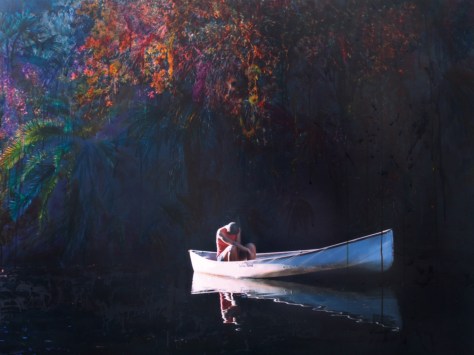
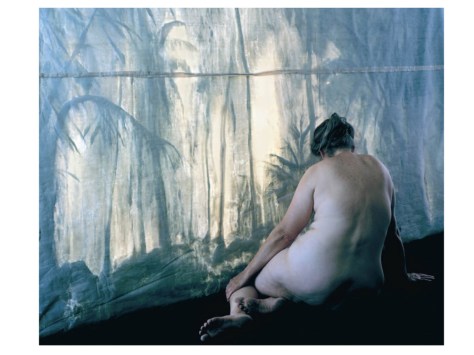
Esther Teichmann uses mixed media, including photographs, painting, poetry, music and sculpture to tell stories. Jessica Brier says ‘Esther Teichmann calls for a new way to look at photographs, not as mirrors of, or windows into the world, but as portals between the personal and universal, reality and the supernatural and photography and other mediums. Through the layering of memory, desire, fear, fiction and fantasy, Teichmann uses and extends the photographic medium as a passage between realms of experience and artistic creation. Her work exploits the tension between photography’s relationship to reality and a sense of otherworldly power. For Teichmann, this complex, even troubled relationship with the medium yields a passionate foray into others’ (Brier, 2014). Brier’s article talks about an alternate view of photographs, not as either windows or mirrors but as portals or wormholes that can transport us from place to place. She discusses Teichmann’s use of photography as a way of retelling myths that shed some light on her personal emotions, seen though a haze of fantasy and suggestion.
Teichmann images are colourful and soft, with a strong Pre-Raphaelite feeling. They are mysterious and float in a world of her imagining. Her work is personal but could relate to anyone. She uses it to explain all the areas that impact on human life. Teichmann is using photography to talk about things that are not easily visualised – imaginary things and places, how your memories of childhood relate to the past, the present and the future. Where you are and where you were – all in one image.
Brier, J. (2014). Esther Teichmann: The Photograph as a Portal. [online] Daylight.co. Available at: https://stories.daylight.co/DD1312 [Accessed 11 Dec. 2019].
I previously looked at the work of Elina Brotherus when doing CAN while looking at autobiographical portraits (Autobiographical self-portraiture). I have now looked at her work in slightly more detail.
I watched the video of her talk to the OCA students (The Open College of the Arts, 2015) and took notes – the quotes are not exact but give the idea of what she said. It was a fascinating talk and I would recommend it to anyone looking at self-portraiture.
Brotherus is a Finnish artist, who works between Finland and France. She initially went to France on a residency but didn’t speak any French. She used a post-it sticker method, starting with basic words. Starting with very concrete words and took photos of them in situ. Gradually moved to less concrete words. Did a series of these images. ‘Starting point of my work’. They took me seriously. Then (2011) invited back to work within the schools. Went back to same place as the initial series to look at the beginning of her art – how would it feel? Eventually became a body of work – ‘a position statement’, a turning point, looking back, again using post-its, but talking in more detail. 12 years ago – then a series of statements about how she felt then and where she is now (when taking the images). The images show a picture with long texts, talking about her life – but more about her feelings ‘I can’t take the company of people my own age’. Made into an exhibition and into a book. Includes ‘all the themes that are important to me’, landscapes, fog, reflections, the human figure in a landscape. A return to autobiographical working. Previously was interested in work related to the history of art.
‘I don’t do things in a hurry, if you have the luxury of time use it’, leave things aside then come back to them.
When the work is personal it’s hard to have anyone else there – but when it’s a study of the human figure it can be anybody, it’s easier to position someone else – but when yourself you end up running back and forward. I like to be alone because there are less distractions and I am not worried about the other person.
I don’t want to hide the camera release – it shows that the person is also the artist – ‘it’s an invitation to a shared contemplation – that’s also why I like the back image’. It’s a different feel when she (the artist) is looking at us or looking away – ‘a frontal figure is a confrontation’. It’s easier as a spectator to enter in (when it’s the back of the artist) as we are together, but we are not disturbing each other.
The Annonciation– it’s a responsibility as an artist to lift the lid on things that are taboo – pictures can allow you a route into things, making something into a picture may allow you to distance yourself, to see myself as a human being and others have similar issues.
Work in a sincere way as its all your work, eventually it will all come together, you have your own way of discovering, work more rather than stay at home and think.’ I shoot a lot, then I leave it aside’. Think afterwards, edit and reflect. There is no one right answer, multiple solutions out of a body of work.
I have also looked at more of her work online (Brotherus, 2014). The series discussed above – 12 Ans Après (1999/ 2011 – 2013) shows a combination of her earliest work and the later images taken at the same place. As noted, there are a combination of landscapes and portraits. Interestingly she has mixed portrait and landscape formats for both types of images. All are colour. Most are melancholy. In several the emotions are overflowing. Some, but not all, of the images include the post-it notes, scattered all over the pictures. Unfortunately, I cannot read French – as I think they add another dimension to the work. One of my favourite images from the series is a very simple view of water and sky – La Saône 3.
The series Carpe Fucking Diem is a recent series in which she attempts to move beyond her perceived failure (not having children) looking at ‘the surprising and surreal undertones of the everyday life, not totally deprived of humour, because even an unhappy end is not The End’ (Brotherus, 2014b). While this series is not so overtly autobiographical as some of her other work it still is clearly based on her life and her feelings. Some of it was actually shot at the same time as the work for The Annonciation and the two series can /should be looked at in parallel.
I find Brotherus’s work fascinating. When I looked at it previously, I actually found it somewhat disturbing and hard to view. My feelings have changed over the last year and I now find it both sad and surprisingly beautiful. The combination of clear autobiography, both sad and funny, (at times uproariously so) with images of small details, a bowl of potatoes, a worm on the street, give an insight into the life of someone I wish I could meet.












 Identity and Place